
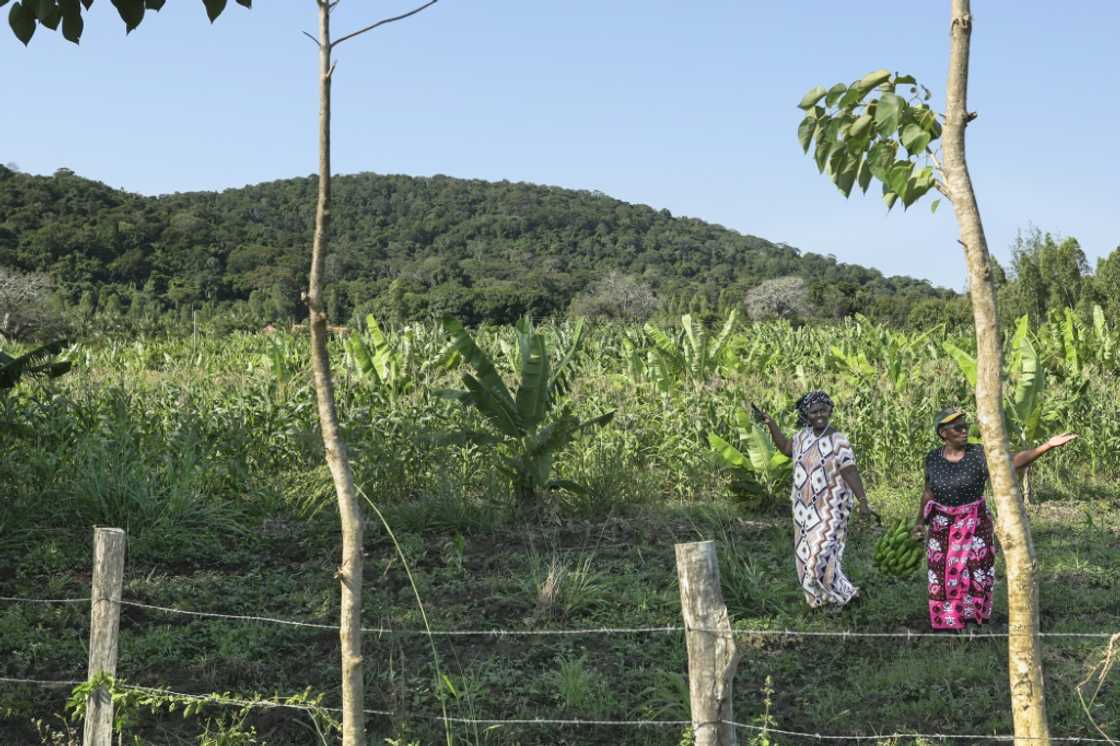
A forest-covered hill in Kwale County has suddenly found itself at the centre of a global scramble involving the United States, China and some of the world's most strategically important minerals.
Mrima Hill, about 65 kilometres southwest of Mombasa, contains deposits of rare earth elements and niobium, materials used in everything from electric vehicles and wind turbines to aircraft, electronics and defence technology.
The Kenyan government estimates the deposit contains more than 105 million tonnes of mineralised material, grading about 0.65% niobium oxide alongside significant rare earth mineralisation. Its 2025 Mining Investment Handbook put the potential value at between Sh5.4 trillion and Sh8.18 trillion.
But those extraordinary numbers come with an equally important warning.

Kenya's own Ministry of Mining says it has not yet prepared an economic viability report for the prospect. That means estimates of trillions of shillings beneath Mrima Hill should not be interpreted as money Kenya is guaranteed to earn.
So what exactly is buried there, why does America want access to it now, and who would benefit if mining finally begins?
What is underneath Mrima Hill?
Mrima Hill is not a new mineral discovery.
Kenya's Mines and Geological Department identified the prospect in the 1930s. Extensive exploration followed in collaboration with Anglo American Corporation during the 1950s, including more than 9,000 metres of test shafts and 3,000 metres of drilling.
More recently, government geological mapping conducted in 2022 confirmed the presence of five elements: niobium, yttrium, thorium, strontium and lanthanum. The Ministry says parts of the formation have recorded concentrations of up to 1.41% niobium oxide and 7.12% total rare earth oxides.
Of these, niobium and rare earth elements are attracting the greatest international attention.
Niobium can be added to steel to make it stronger without dramatically increasing its weight. That makes it valuable for pipelines, construction and aerospace manufacturing.
Rare earth elements are used in high-performance magnets and a wide range of modern electronics. They are increasingly important for electric vehicle motors, wind turbines and advanced military technologies.
Kenya has consequently classified both niobium and rare earth elements as strategic minerals.
Why does America suddenly care?
The answer goes well beyond Kenya.
The United States and China are competing for access to the critical minerals needed to support increasingly technology-dependent economies.
China occupies an especially powerful position in global rare earth supply chains, particularly in processing and refining.
Washington is therefore looking for alternative sources and partners.
On Wednesday, US Assistant Secretary of State for Africa Frank Garcia said Washington was prepared to help Kenya develop its critical minerals processing industry.
“Critical minerals are a top priority for President Trump and Secretary Rubio, and we are ready to work with Kenya as it becomes a regional leader in this space,” Garcia told an American Chamber of Commerce meeting, according to Reuters.
The US offer is significant because Kenya does not simply want foreign companies to extract minerals and ship them overseas.
President William Ruto's administration has increasingly pushed for local processing and value addition, arguing that Kenya should capture more of the economic value generated from its natural resources.
Washington says it is prepared to support that ambition.
Garcia said the US wanted to help Kenya develop a mining sector that attracts legitimate businesses, respects communities and strengthens global supply chains.
Who wants Mrima Hill?
Competition is already intense.
Reuters reported that Kenya is considering competing bids to develop Mrima Hill, with American interests among those seeking the project.
The Financial Times reported in July that the competition included American, Chinese and Australian interests, illustrating how what was once largely a Kenyan mining issue has developed into a geopolitical contest.
Kenya formally designated approximately 31.93 square kilometres at Mrima Hill for award through competitive tender this year. The government invited expressions of interest for the niobium, rare earth elements and associated minerals project, with the initial process closing in April.
That is important because the government is not simply handing the deposit to whichever foreign country wants it.
The process is supposed to operate under Kenya's Mining Act and regulations governing the competitive award of mineral rights.
Who actually owns the minerals?
Legally, neither America, China nor the owner of the land above the deposit automatically owns the minerals.
The State Department for Mining states that minerals belong to the people of Kenya and are managed on their behalf by the national government. A company requires the appropriate mineral rights before it can commercially exploit them.
That gives Kenya considerable leverage.
If several major international investors want access to the same strategic deposit, the government potentially has an opportunity to negotiate more than a mining licence.
It can seek commitments around processing, Kenyan employment, technology transfer, environmental rehabilitation, local procurement and community benefits.
But Mrima Hill also carries historical baggage.
The mine that ended up in an international court
Mrima Hill has previously been at the centre of a major dispute between Kenya and foreign investors.
Cortec Mining Kenya and associated investors held a 21-year mining licence connected to rare earth extraction at Mrima Hill before the government revoked it.
The investors subsequently took Kenya to international arbitration, alleging that the revocation was unlawful.
The dispute became ICSID Case No. ARB/15/29 under the Kenya-United Kingdom investment treaty.
That history is one reason the current tender process matters.
Any company entering Mrima Hill will be dealing not only with potentially valuable geology but with a project that has already generated complex questions over licences, regulation and investor rights.
Is Mrima Hill really worth Sh8 trillion?
Possibly in terms of estimated minerals in the ground. But that is very different from saying Kenya has an Sh8 trillion cheque waiting to be collected.
One widely cited earlier estimate valued the deposit at about $62 billion, but the Financial Times noted that the calculation did not account for the enormous cost of extracting and processing the minerals.
Kenya's own documents provide an even more important qualification.
The Ministry of Mining explicitly says the government has not prepared an economic viability report for Mrima Hill.
Before its true commercial value can be established, investors need to determine how much mineral can economically be recovered, its quality, extraction and processing costs, infrastructure requirements and environmental obligations.
A mineral resource theoretically worth Sh8 trillion therefore does not mean Kenya would earn Sh8 trillion.
Government revenue would instead depend on royalties, taxes, fees and whatever other economic benefits are incorporated into the final project.
There is something else on the hill
Mrima is not merely a mineral deposit.
The hill is also culturally significant to the local Digo community and contains sacred sites. Residents have raised concerns about land ownership, displacement, livelihoods and what mining could do to the environment and their cultural heritage.
That could become one of the project's most difficult issues.
Rare earth mining can involve substantial excavation and processing. The presence of thorium at Mrima Hill also means radioactive-material management would require careful environmental and health safeguards.
For communities living around the hill, the global competition between Washington and Beijing may be less important than simpler questions: Will families lose land? Will local people get jobs? What happens to water and forests? Will communities receive a meaningful share of the wealth?
Those questions could determine whether the project earns local support.
Could Kenya avoid the African raw-material trap?
This is ultimately the bigger story.
Africa possesses enormous mineral resources but has historically exported much of them as raw or minimally processed commodities. Much of the higher-value refining and manufacturing then happens elsewhere.
Kenya says it wants a different model.
If Mrima Hill eventually produces commercially viable rare earths and niobium, processing them locally could create more skilled jobs and retain a greater share of the value inside the country.
It could also help establish Kenya as a regional critical-minerals processing hub rather than simply another source of raw material.
That is precisely why America's offer of assistance matters.
But it also raises a fundamental question.
If the US is seeking alternatives to Chinese-dominated supply chains, Washington naturally wants reliable access to minerals. Kenya, on the other hand, needs to ensure that its strategic resources generate lasting domestic value.
Those objectives can overlap, but they are not necessarily identical.
Mrima Hill therefore presents Kenya with an unusual bargaining opportunity.
The country has a resource that several global powers and international investors want at precisely the moment when critical minerals are becoming increasingly strategic.
The challenge is ensuring the competition does not end with another valuable African resource being extracted, exported and transformed into far more valuable products somewhere else.
Because beneath Mrima Hill may lie minerals worth trillions of shillings.
The bigger question is how much of that wealth will remain in Kenya once the digging begins.
Category: Business
Related Video: Dolly Parton’s Family Announces Her Passing in Emotional Tribute
 Facebook
 Twitter / X
 WhatsApp
 LinkedIn
 Telegram
 Reddit