
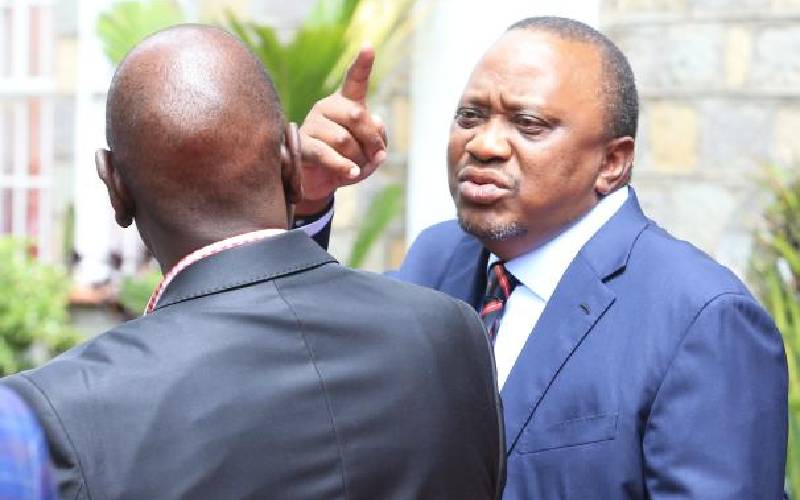
As Ruto opens up about Uhuru, the opposition searches for unity, security chiefs trade accusations and schools reopen under financial strain, Kenya's next election is already casting a long shadow over the country.
NAIROBI — August 23, 2026
Kenya has not yet reached the campaign trail.
But judging by Sunday's newspapers, the campaign has already reached Kenya.
The politicians are moving. The alliances are shifting. Old friendships are being reopened, old grievances are being aired and new political vehicles are being assembled.
And beneath it all is an uncomfortable question:
Can Kenya get to the 2027 election without allowing political rivalry to once again become a threat to national stability?
That question sits between the lines of almost every major political headline this Sunday.
The Sunday Nation puts President William Ruto's relationship with his predecessor, Uhuru Kenyatta, at the centre of the national conversation with the blunt headline: “My problem with Uhuru.”
Taifa Leo is even more direct: “Uhuru amekataa handisheki” — Uhuru has rejected the handshake.
And The Sunday Standard turns its attention to Interior Cabinet Secretary Kipchumba Murkomen, splashing “RECKLESS” across its front page as it questions the tone and consequences of his recent remarks on political violence.
Different newspapers.
Different headlines.
But one story.
Kenya is already fighting the 2027 election.
THE HANDSHAKE THAT NEVER HAPPENED
For Ruto, the past is refusing to stay in the past.
In a wide-ranging interview with the Daily Nation, the President opened up about his failed efforts to repair his relationship with Uhuru Kenyatta, his former political boss and the man under whom he served as deputy president for ten years.
The two men once appeared inseparable.
They campaigned together.
They won together.
They governed together.
Then came the political rupture.
The 2018 handshake between Kenyatta and opposition leader Raila Odinga transformed the political landscape and effectively left Ruto outside the new arrangement. What followed was a bitter political divorce that shaped the 2022 election and continues to influence Kenya's politics four years later.
Ruto now says he tried to repair the relationship.
Kenyatta, however, has not accepted the overtures.
The Nation describes the failed reconciliation efforts as repeated attempts by Ruto to reopen communication with his former boss.
It is more than a personal disagreement.
In Kenyan politics, relationships are rarely merely personal.
They carry votes.
They carry networks.
They carry history.
And, most importantly, they can determine which political coalition controls the centre of the country.
That is why the Ruto-Uhuru story refuses to disappear.
UHURU'S SHADOW OVER RUTO'S 2027 CALCULUS
The irony is impossible to miss.
Ruto is seeking another term in State House.
Uhuru is no longer president.
Yet the former president remains an important figure in the political calculations surrounding 2027.
The question is therefore not simply whether the two men can shake hands.
It is whether the political forces associated with Uhuru will cooperate with, oppose or remain independent of Ruto's re-election project.
That calculation is unfolding at the same time that the President's administration is trying to consolidate a broad political coalition.
Meanwhile, opposition leaders are attempting to construct an alternative.
And that brings Kenya to its next political battlefield.
THE OPPOSITION'S BIG TEST
If Ruto's problem is an old political relationship, the opposition's problem is a new one:
Who leads?
The opposition is preparing for a crucial retreat beginning on August 24, with leaders expected to discuss the political environment ahead of the 2027 election and the future of their alliance.
The meeting could become one of the most consequential political gatherings of the year.
Because defeating an incumbent is one thing.
Agreeing on who should replace him is another.
Across the opposition landscape, familiar names are positioning themselves.
Former Deputy President Rigathi Gachagua is seeking to build a formidable political base, particularly in Mt Kenya.
Fred Matiang'i is presenting himself as another presidential option.
Kalonzo Musyoka remains a major player.
Martha Karua continues to command influence.
Other leaders are waiting.
And beneath their public declarations of unity lies the hardest question in coalition politics:
Who gets the ticket?
The opposition can unite around the slogan of removing Ruto.
But eventually someone must answer the question of who will sit in State House if that happens.
That is where alliances often begin to crack.
THE GOON QUESTION
But perhaps the most dangerous story in Sunday's newspapers is not about who will win the election.
It is about how Kenya gets to the election.
The debate over political goons has become impossible to ignore.
In recent weeks, political confrontations have raised fears about the return of organised violence around political events.
The issue has become particularly explosive following violence surrounding opposition activities in Homa Bay.
Human rights organisations and other stakeholders have warned that organised political violence could undermine the 2027 electoral environment. A national multi-stakeholder forum convened by the International Commission of Jurists in August warned that Kenya risks sliding into another cycle of election-related violence if political goon networks are not confronted early.
The warning carries particular weight in a country whose political memory still bears the scars of 2007-08.
And then came Murkomen.
“THERE IS NO CRISIS”
Interior CS Kipchumba Murkomen has rejected the suggestion that Kenya is experiencing a national crisis caused by political goons.
His message has been uncompromising.
Murkomen has argued that politicians are exaggerating the problem and using violence as a political weapon.
In remarks reported this weekend, he said:
“There is no crisis in Kenya.”
He accused politicians of what he called a “bankruptcy of ideas”, arguing that some resort to goons because they cannot campaign effectively on ideas.
But The Sunday Standard sees the matter very differently.
Its front-page verdict is devastating: “RECKLESS.”
The newspaper argues that Murkomen's remarks risk contradicting the President's own concern about political goons and violence.
The disagreement is not merely semantic.
It goes to the heart of the security question.
If political violence is exaggerated, as Murkomen argues, then the government should be able to demonstrate that through arrests, prosecutions and credible investigations.
If the threat is real, then the government has an even greater responsibility to act before campaign politics turns violent.
Either way, the public deserves answers.
A WARNING FROM THE PAST
Former Interior Cabinet Secretary Fred Matiang'i has taken the opposite view.
He has warned that Kenya is playing with fire.
“We are destroying our country just for purposes of politics,” Matiang'i said this week, warning about political violence and the use of goons ahead of 2027.
That statement should resonate far beyond opposition rallies.
Kenya knows what happens when political competition escapes the ballot box.
The scars of 2007-08 have not disappeared.
Indeed, a recent Nation report cited a Kofi Annan Foundation assessment estimating a high probability of election-related violence during the 2027 election period, while experts have warned that institutions including the police, Judiciary, ODPP, IEBC and NCIC must work together to prevent a repeat of the past.
The danger is not that Kenya has suddenly become 2007.
The danger is that Kenyans know how quickly political theatre can become something much darker.
WHILE POLITICIANS FIGHT, SCHOOLS OPEN
And then, almost quietly, comes the story that may matter most to millions of families.
On Monday, children return to school.
The third and final term begins on August 24.
It is also the shortest and one of the most consequential periods of the academic year, with national examinations looming.
But schools are returning under financial pressure.
The Sunday Nation reports that institutions are reopening with debts and concerns over delayed funding, just as they prepare for the final examination period.
This is the other Kenya.
The Kenya beyond State House.
Beyond coalition meetings.
Beyond political rallies.
It is the Kenya of parents looking for school fees.
Of principals trying to balance budgets.
Of teachers preparing candidates.
Of young people whose future depends far more on their examination results than on which politician wins the next opinion poll.
The Ministry of Education has confirmed that schools will reopen on August 24 despite false notices circulating online suggesting the date had been postponed.
For parents, the political drama in Nairobi may be distant.
The school bus is not.
The examination timetable is not.
The bill from the school is not.
THE REAL 2027 QUESTION
This is what makes the headlines of August 23 so revealing.
Kenya is being pulled in two directions.
One direction points toward the political future:
Ruto versus his challengers.
Old alliances versus new coalitions.
Uhuru versus reconciliation.
Gachagua versus the political establishment.
Opposition unity versus individual ambition.
The other direction points toward everyday life:
schools, jobs, prices, security and the economy.
The danger for Kenya is that the first can consume the second.
A country can spend twelve months discussing who will become president and forget to ask what that president will actually do with power.
THE CLOCK IS ALREADY TICKING
The 2027 election is still months away.
But politically, Kenya is already there.
Every rally is being interpreted through the lens of 2027.
Every defection is being calculated.
Every handshake—or refusal to shake one—is being analysed.
Every controversial statement by a security official is being weighed against the country's painful electoral history.
And every coalition meeting is accompanied by the same silent question:
Who benefits?
The answer will determine more than the careers of politicians.
It will determine the atmosphere in which Kenyans vote.
That is why today's headlines should not be dismissed as another Sunday political drama.
They are a warning.
Kenya has been here before.
It has seen what happens when politicians convince ordinary citizens that their political opponents are enemies rather than fellow citizens.
It has seen young people turned into instruments of political violence.
It has seen businesses burn, families flee and communities divided by an election.
The country cannot afford a repeat.
THE FINAL TEST
President Ruto wants to prove that his government can deliver a transformed Kenya beyond the next election.
The opposition wants to prove that it can unite strongly enough to defeat him.
Uhuru Kenyatta remains an unresolved chapter in Ruto's political story.
Gachagua wants to build a new one.
Murkomen insists the security situation is not a national crisis.
Critics say the warning signs are already flashing.
And tomorrow morning, millions of Kenyan children will simply go back to class.
That contrast should humble every politician.
Because elections come and go.
Presidents come and go.
Coalitions are formed and broken.
But the country remains.
And when the political noise finally dies down, Kenya will still have to live with the consequences of how its leaders chose to fight for power.
The 2027 election will test who can win.
But the months before it will test something more important:
whether Kenya's political class has finally learned how to compete without putting the country itself at risk.
You may also like
Category: Politics · Related Topic: William Ruto
Related Video: Dolly Parton’s Family Announces Her Passing in Emotional Tribute
Related Explainer: Kenya’s short rains: What the 2026 forecast means for you
 Facebook
 Twitter / X
 WhatsApp
 LinkedIn
 Telegram
 Reddit