
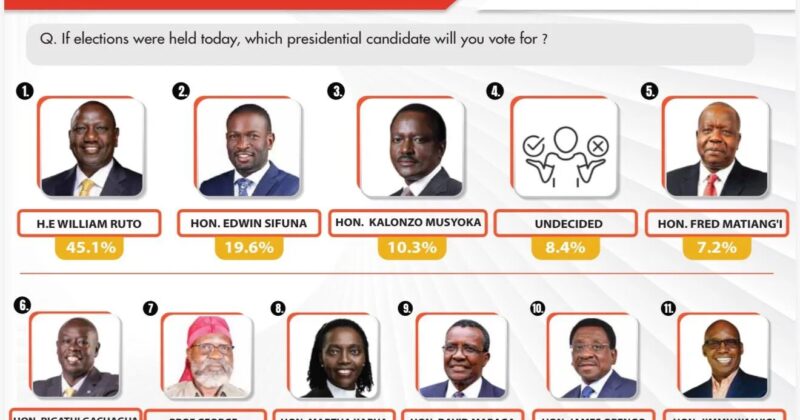
President William Ruto has recorded the highest share of presidential preference in a new Politrack Africa survey, while Nairobi Senator Edwin Sifuna has emerged as the leading opposition figure in the poll.
The survey, conducted between September 15 and 25, 2026, puts Ruto at 45.1 per cent among respondents who selected a presidential candidate.
Sifuna follows with 19.6 per cent, ahead of Wiper leader Kalonzo Musyoka at 10.3 per cent.
Former Interior Cabinet Secretary Fred Matiang’i records 7.2 per cent, while former Deputy President Rigathi Gachagua has 6 per cent.
The figures offer another snapshot of Kenya’s early 2027 political landscape. But they should not be read as a forecast of the election.
With the vote still months away, alliances are being negotiated, parties are changing shape and some potential candidates have yet to settle their political vehicles.
Sifuna's rise draws attention
Sifuna's position is notable because his support has also appeared in other recent surveys, although the numbers differ considerably.
An Infotrak survey released in July put Ruto at 32 per cent, followed by Kalonzo at 13 per cent, with Sifuna and Matiang’i tied at 12 per cent. Eighteen per cent of respondents were undecided.
A separate TIFA survey released in July placed Ruto at 24 per cent, Sifuna at 15 per cent, Matiang’i at 14 per cent and Kalonzo at 13 per cent. TIFA also reported that 20 per cent of respondents were undecided.
The different results underline an important point about early polling: the numbers can vary sharply depending on the methodology, timing, question asked and composition of the sample.
The Politrack survey is therefore best viewed as a measure of sentiment among its respondents at the time it was conducted, rather than evidence of what the 2027 ballot will look like.
Politrack's methodology matters
Politrack says 20,419 people took part in the latest survey.
According to the methodology supplied with the poll, potential voters were reached through a text-based technology platform and invited to respond to questions at their convenience.
Politrack reports a 95 per cent confidence level and a margin of error of plus or minus three percentage points.
That figure needs some caution.
A conventional margin of error is most straightforward when respondents are selected through a probability-based sampling design. An online or platform-based sample can produce a different type of uncertainty, particularly if participation or access to the platform is not evenly distributed across the electorate.
For that reason, the Politrack figures should be compared with other polls rather than treated as a definitive measure of national voter support.
Eight per cent remain undecided
The Politrack survey puts undecided respondents at 8.4 per cent.
That is smaller than the undecided shares reported by some other recent national surveys.
Infotrak's July poll recorded 18 per cent undecided, while TIFA reported 20 per cent in its June survey.
The difference is important because undecided voters can significantly alter the picture as campaigns develop.
Politrack's remaining respondents were spread across other candidates and categories.
Professor George Wajackoyah was reported at 1.1 per cent, while former Chief Justice David Maraga and People’s Liberation Party leader Martha Karua each received 0.8 per cent.
Siaya Governor James Orengo received 0.4 per cent and businessman Jimmy Wanjigi 0.3 per cent.
The timing is significant for Sifuna
The latest poll comes just days after Linda Mwananchi formally endorsed Sifuna as its presidential candidate.
Following a leadership retreat on September 26, the movement announced that Sifuna would lead its presidential campaign and oversee the unveiling of the political party on whose ticket he intends to run in early October.
The endorsement followed weeks of political activity around the movement and discussions over its leadership and presidential direction.
The decision has now given Sifuna a more defined political platform as opposition groups consider possible alliances ahead of the 2027 election.
However, the question of his final political vehicle was still open as of September 29.
Kakamega Senator Boni Khalwale said Linda Mwananchi's principals had discussed several parties but had ultimately given Sifuna the final say on which party he would use.
That means earlier suggestions that he would automatically run on a particular party's ticket should not be treated as settled.
Ruto's campaign is already taking shape
Ruto's position in the Politrack survey comes as the President continues travelling around the country for government project launches, inspections and commissioning ceremonies.
His administration has increasingly used these tours to highlight roads, water projects, health facilities, housing, markets, education infrastructure and other development programmes.
Whether such activity translates into votes in 2027 cannot be established from the poll alone.
The President's support also varies significantly across regions in other surveys.
Infotrak's July findings, for example, put Ruto at 46 per cent in the Rift Valley and 59 per cent in North Eastern, while his support was lower in Central and Nairobi. Sifuna's strongest showing in that survey was among younger respondents, where he received 20 per cent among those aged 18 to 26.
These differences point to a political landscape that remains far from settled.
Opposition field remains fragmented
The latest Politrack figures also show the challenge facing opposition politicians.
No single challenger reaches Ruto's reported level in the survey.
Sifuna is followed by Kalonzo, Matiang’i and Gachagua, with the rest of the field registering much smaller shares.
Other surveys have produced a similar broad picture of a divided opposition, although they disagree on the size of the gap.
TIFA's July findings showed four opposition figures clustered between 7 and 15 per cent, while Infotrak placed three of them between 12 and 13 per cent.
That fragmentation remains one of the central questions for the opposition as parties consider whether to field separate candidates or negotiate a joint ticket.
Kalonzo and Gachagua continue their campaigns
Kalonzo has continued consultations with opposition leaders as political parties explore possible alliances ahead of the election.
Gachagua, meanwhile, has been building the profile of his Democracy for Citizens Party and engaging supporters in Kenya and abroad.
Their support in the latest Politrack survey remains below Sifuna's reported 19.6 per cent.
But the figures are snapshots taken at a particular point in a rapidly changing political environment.
The eventual presidential field is also not yet final.
What the poll does — and does not — tell us
The Politrack survey provides another indication of how the political conversation is changing as the 2027 election approaches.
It shows Ruto with the largest reported share in this particular survey and Sifuna as the strongest opposition figure among the candidates listed.
It does not, however, establish who will win the 2027 election.
Nor does it show how voters would respond once political parties settle their alliances, running mates and final presidential tickets.
The next major test will be whether Sifuna can translate his growing polling presence into a broader political organisation, while opposition leaders determine whether they will compete separately or behind a common presidential candidate.
For Ruto, the question will be whether his current support holds as the campaign moves closer to the ballot and voters weigh the government's record against the alternatives.
With the political field still taking shape, the numbers are likely to keep moving.
You may also like
Category: Politics · Related Topic: William Ruto
Related Video: Dolly Parton’s Family Announces Her Passing in Emotional Tribute
Related Explainer: Fact Check: Did elephants save people during Nepal’s floods?
About the Author
Maureen Onyango is a journalist passionate about storytelling, life coaching and spiritual lessons. She studied at the Kenya Institute of Management and enjoys telling stories that inform, inspire and empower communities.
 Facebook
 Twitter / X
 WhatsApp
 LinkedIn
 Telegram
 Reddit