
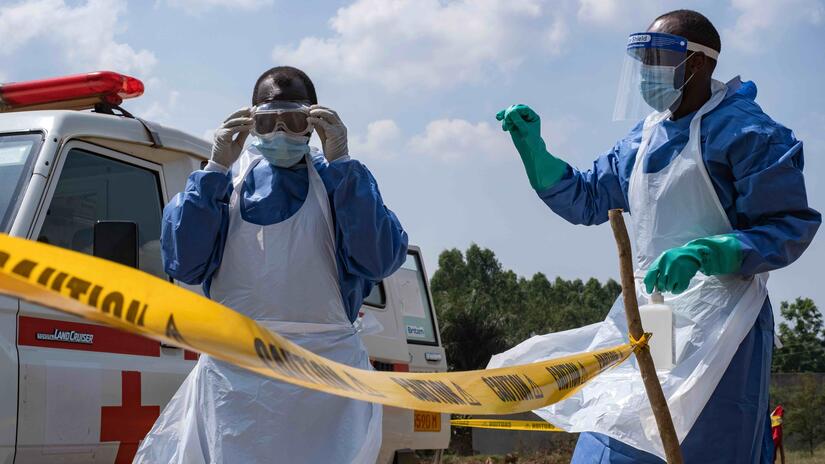
KAMPALA, Uganda, October 26, 2026 — Ugandans returning from the Democratic Republic of Congo (DRC) must spend 21 days in quarantine at their own expense, as authorities tighten border controls to prevent Ebola from re-entering the country.
The measures come as the outbreak of Bundibugyo virus disease continues to spread in the DRC, while Kenya and Nigeria have reported cases linked to travel in the region.
Uganda says it remains Ebola-free, having declared its outbreak over on July 28. But the government is stepping up surveillance as investigators work to establish how a woman who travelled from Uganda to Nigeria became infected.
In a statement issued on Sunday, October 25, Health Minister Chris Baryomunsi said Ugandans with a history of travel to the DRC would be required to undergo 21 days of quarantine and cover the cost themselves.
The government has also barred travellers with a history of travel to the DRC from transiting through Uganda, including on chartered flights. Non-essential Congolese travellers seeking to enter Uganda will be returned to the DRC, while permitted essential travellers, including humanitarian workers and truck drivers, must undergo health screening.
Uganda steps up screening at borders
The Ministry of Health has increased screening at Entebbe International Airport, land border crossings and designated road checkpoints.
All travellers entering Uganda by air, land or water must complete a passenger locator form, according to the government. The forms are intended to help health teams trace people if a suspected infection is identified.
Authorities are also monitoring contacts of confirmed cases. Anyone identified as having had contact with a suspected case may be placed in institutional quarantine for 21 days from their last exposure. People listed as contacts of an active case can also be barred from leaving the country during the monitoring period.
The restrictions follow the investigation of a Kenyan man who travelled from the DRC through Uganda before arriving in Nairobi on October 3. He tested positive for Bundibugyo virus disease and died two days later.
Ugandan health teams traced 60 people linked to his movements through the country. Baryomunsi said all had completed their 21-day monitoring period without developing symptoms and had been discharged from follow-up. The group included people linked to border crossings, hotels and transport services.
Kenya reports two deaths as cases reach nine
Kenya has confirmed nine Ebola cases, including two deaths, according to the Ministry of Health's latest update reported on October 23.
The second fatality was a 65-year-old woman who was a close relative of the first patient. She developed symptoms while in quarantine and later died in an infectious disease unit.
The remaining seven patients were receiving care at two isolation facilities. Kenyan authorities said the cases remained within one cluster linked to the first patient, with no evidence of wider community transmission at the time of the update.
The outbreak has placed health teams across East Africa on alert because people routinely cross borders for work, trade, healthcare and family visits. The cases also underline the importance of tracing contacts quickly when an infected person has travelled through several locations.
Nigeria case raises questions about travel history
Nigeria confirmed its first case of Bundibugyo virus disease on October 20. The patient is a woman who travelled from Uganda to Abuja, where she was isolated and received medical care.
Investigators are examining her movements, interactions and possible exposure to the virus. Uganda has said it is working with Nigerian health authorities and international partners to establish her complete travel history and the likely source of infection.
The World Health Organization said the virus identified in Nigeria was closely related to the strain found in Kenya. However, that finding alone does not establish a direct link between the two patients or prove where the Nigerian patient became infected. Investigations remain under way.
Ugandan officials have maintained that no new infections have been confirmed within the country since its outbreak was declared over. The latest restrictions are precautionary measures intended to prevent a new chain of transmission.
DRC outbreak remains the main concern
The DRC continues to carry the heaviest burden of the outbreak. The WHO reported 9,704 confirmed cases and 4,687 deaths there as of October 20, with transmission recorded across 66 health zones in eight provinces.
The current outbreak is caused by the Bundibugyo virus, a species of Ebola virus. There is no approved vaccine or specific treatment for this strain, although patients can receive supportive care. Early detection, isolation, infection prevention and careful contact tracing remain central to efforts to contain it.
The WHO has advised countries against imposing general restrictions on travel to or trade with affected countries, while urging governments to strengthen surveillance, coordinate across borders and identify cases quickly. Uganda's latest measures are targeted at people with a history of travel to the DRC and at controlling entry across its borders.
For Ugandans returning from the DRC, the practical consequence is clear: they must prepare for a 21-day quarantine at their own cost. For the wider region, the challenge is to prevent further infections without disrupting essential movement and the trade on which communities along the border depend.
You may also like
Category: News
Related Video: What Dangote’s proposed Lamu oil refinery could mean for East Africa
Related Explainer: Ebola contact tracing: Why the 21-day window matters in Kenya’s response
About the Author
Maureen Onyango is a journalist passionate about storytelling, life coaching and spiritual lessons. She studied at the Kenya Institute of Management and enjoys telling stories that inform, inspire and empower communities.
 Facebook
 Twitter / X
 WhatsApp
 LinkedIn
 Telegram
 Reddit