
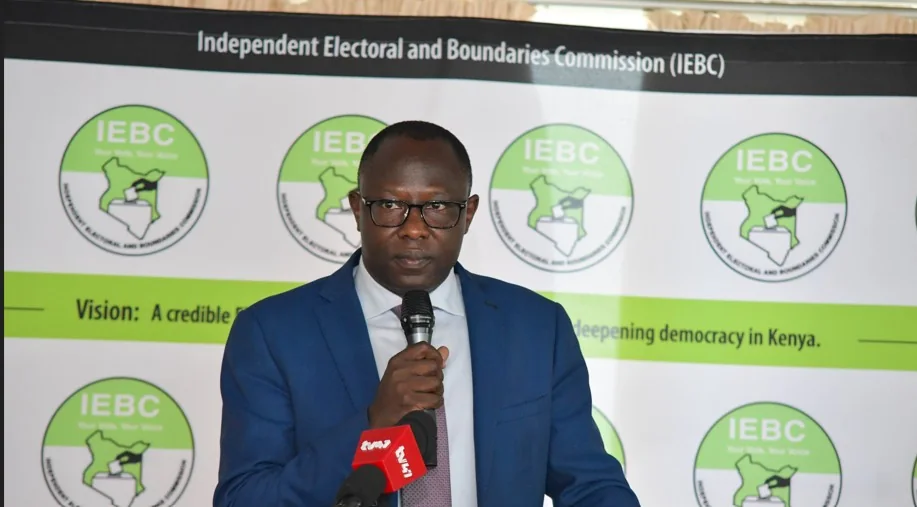
NAIROBI, Kenya, October 26, 2026 — A proposal that would allow the Independent Electoral and Boundaries Commission (IEBC) chairperson to declare a presidential winner before every constituency has submitted its results is drawing attention as Parliament revisits Kenya’s election laws ahead of the 2027 General Election.
But the provision is not a new power being introduced by the Senate. Kenya’s existing Elections Act already allows the IEBC chairperson to declare a winner before all constituency results arrive, provided the outstanding results cannot change the outcome. The current debate centres on a wider proposal to rewrite Section 39 of the Elections Act, which governs the announcement, transmission and declaration of election results.
The Senate’s version of the Elections (Amendment) (No. 2) Bill, 2024, sought to replace the section with new rules for handling results. The National Assembly, however, removed the clause containing those changes when it passed the Bill on October 22, leaving the existing section intact. The Bill now returns to the Senate for consideration of the changes made by MPs. It has not completed the legislative process.
What the Senate had proposed
Clause 22 of the Senate’s version sought to repeal and replace Section 39. Among its provisions was the ability to declare a presidential candidate elected before all constituencies had transmitted their results, provided the IEBC was satisfied that the missing results could not affect the winner.
The proposed section also set out procedures for the transmission and verification of results.
It required the IEBC to electronically transmit presidential results within two hours of their declaration at polling stations. Where transmission failed within that period, the commission would have to explain the delay in the prescribed manner.
The proposal also provided for the physical delivery of tabulated results to constituency and national tallying centres, publication of polling-station result forms on an online portal, and verification that electronic records matched the results declared at polling stations.
These provisions addressed how results would move from polling stations to the national tallying centre. However, the proposed replacement did not expressly retain the existing requirement for the IEBC to establish a mechanism for livestreaming results announcements.
That omission became a major point of contention as the country prepares for the next general election.
Why MPs removed the clause
The National Assembly deleted Clause 22 after considering public participation, engagement with stakeholders, including the IEBC, and a High Court judgment delivered on September 22, 2026.
In the case of Okoiti and another v Independent Electoral and Boundaries Commission and five others, the court upheld the constitutionality of Section 39 and Regulation 83(2) of the Elections (General) Regulations. It also urged Parliament to take the legal interpretation of those provisions into account as it considered changes to electoral law.
Parliamentary Affairs Principal Secretary Aurelia Rono said the National Assembly had removed the clause to preserve the existing legal framework.
“Contrary to these reports, the amendment passed by the National Assembly retains the requirement on the IEBC to establish a mechanism for the livestreaming of election results,” Rono said, according to a statement reported by Citizen Digital.
National Assembly Majority Leader Kimani Ichung’wah also rejected claims that MPs had passed a law scrapping the livestreaming requirement. The House maintained that deleting the clause left Section 39, including subsection 39(1G), in place.
The position is significant because the law distinguishes between transmitting results electronically and livestreaming their announcement for public information.
Why livestreaming matters
Under the existing Section 39(1G), the IEBC must establish a mechanism for livestreaming results as announced at polling stations. The law specifies that the streamed results are for public information and do not, by themselves, form the basis for the commission’s declaration. Electronic transmission serves a different purpose. It moves result records through the IEBC’s systems, while publication of result forms allows the public to inspect the documented figures.
Livestreaming, by contrast, allows people outside a polling station to follow the announcement of results as it happens. The distinction has become central to the current debate because retaining electronic transmission and online publication does not automatically replace a requirement to livestream announcements.
Former Law Society of Kenya president Faith Odhiambo has called for Parliament to make the final wording of the Bill public and clarify the practical effect of the proposed changes. The demand reflects wider concern about ensuring that voters, political parties, journalists and observers can follow how results are reported.
The IEBC has also previously explained that the proposed amendments were linked to concerns about results transmission where network coverage is inadequate. The commission has argued for procedures that preserve the role of official result forms in verifying votes. Other changes in the Elections Bill
The Bill covers more than presidential results. It proposes changes to voter registration, political party nominations, the recall of elected representatives and the handling of electoral disputes.
Among the proposals are making the voters’ register available for public inspection outside specified periods before an election or referendum, limiting the suspension of voter registration during a by-election to the affected electoral area, and changing the IEBC’s role in political party primaries.
It also seeks to revise procedures for recalling Members of Parliament and give political parties greater flexibility in identifying and nominating candidates for elective positions and party lists.
These proposals could affect how elections are administered and how parties select candidates. However, they remain subject to the legislative process and should not be treated as final law.
What happens next?
Because the National Assembly amended a Bill that originated in the Senate, it must return to the Senate for consideration of those changes under Article 110(4) of the Constitution. The two Houses must resolve their differences before the legislative process can be completed.
For voters, the immediate issue is not simply whether the IEBC chairperson can declare a winner before every constituency reports. That provision already exists in the law, subject to the condition that outstanding results cannot change the outcome.
The wider question is whether the final legislation will preserve clear and effective safeguards for the transmission, verification and public viewing of election results.
With the 2027 General Election approaching, the wording Parliament ultimately approves will help determine the legal framework under which Kenyans follow the counting and declaration of their votes.
You may also like
Category: News
Related Video: What Dangote’s proposed Lamu oil refinery could mean for East Africa
About the Author
Maureen Onyango is a journalist passionate about storytelling, life coaching and spiritual lessons. She studied at the Kenya Institute of Management and enjoys telling stories that inform, inspire and empower communities.
 Facebook
 Twitter / X
 WhatsApp
 LinkedIn
 Telegram
 Reddit