
NAIROBI, Kenya — President William Ruto has ordered thorough inspections of public service vehicles (PSVs) following a deadly collision on the Nairobi–Mombasa Highway, putting renewed focus on whether stricter enforcement can prevent more mass-casualty crashes.
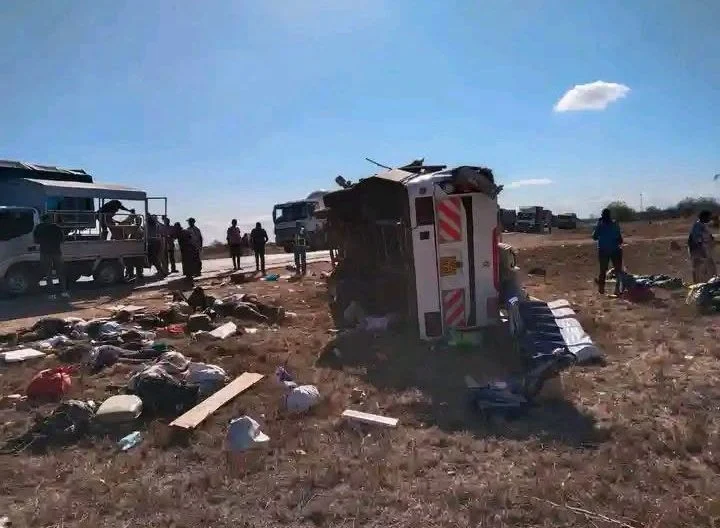
The accident occurred on Sunday, October 25, at Kanga near Mtito Andei in Makueni County, when a passenger bus collided head-on with a commercial lorry. Initial reports confirmed 22 deaths, with subsequent reports putting the toll at 23 and later 24. Several passengers were injured.
In his condolence message, Ruto expressed sympathy with the families and friends of those killed and wished the injured a speedy recovery. He also called on motorists, particularly drivers carrying passengers, to observe traffic rules and take greater care on the road.
The President directed the relevant authorities to inspect public service vehicles to establish whether they meet the required safety standards.
“I further direct all relevant authorities to ensure thorough inspection of public service vehicles to guarantee compliance with safety standards so that accidents can be eliminated,” Ruto said.
The directive comes as investigators work to establish what caused the collision and as attention turns to the safety of one of Kenya’s busiest transport routes.
Dangerous overtaking under investigation
The crash involved a bus belonging to Power of the Word Church International in Mombasa and a commercial cement tipper truck. The bus was reportedly carrying passengers returning from a burial ceremony.
Preliminary findings cited by the National Transport and Safety Authority (NTSA) suggest that improper overtaking may have contributed to the head-on collision. The precise circumstances remain under investigation, and the preliminary account should not be treated as a final finding on responsibility.
The collision caused major damage and disrupted traffic along the highway. Injured passengers were taken to nearby health facilities for treatment.
The crash has again highlighted the risks posed when passenger vehicles and heavy commercial trucks share a busy two-way highway. A moment of misjudgement while overtaking can leave little room for either driver to avoid an oncoming vehicle.
However, establishing the cause of this particular crash will require investigators to examine the available evidence rather than rely solely on early accounts.
Government promises wider road safety measures
Beyond the President’s directive, Roads and Transport Cabinet Secretary Davis Chirchir has announced plans for stronger road safety measures, including action against dangerous overtaking and speeding, improved driver training and attention to identified accident black spots.
The proposals place responsibility on several parts of the transport system. Vehicle inspections can help identify mechanical defects, but they cannot by themselves prevent every crash. Driver conduct, compliance with traffic rules, enforcement and the safety of road infrastructure also matter.
For PSV operators, inspections are an opportunity for authorities to check whether vehicles meet the required standards. For passengers, the priority is ensuring that vehicles are safe to travel in and that drivers operate them responsibly.
The government has not, in the reports reviewed, provided a detailed timetable for implementing the latest inspection directive or explained how compliance will be monitored nationwide.
Nairobi–Mombasa Highway faces renewed scrutiny
The Kanga accident is the latest in a series of serious crashes on the Nairobi–Mombasa Highway. A Daily Nation report published on October 25 said three major crashes over roughly three months had claimed 41 lives, renewing calls for action on dangerous sections of the route.
The highway is a key link between Nairobi and the Coast, carrying passenger buses, private vehicles and heavy goods trucks. Its mix of traffic makes safe overtaking, appropriate speeds and reliable vehicle condition particularly important.
The NTSA has also called for road traffic crashes to be treated as a national disaster, arguing that the scale of deaths and injuries requires a coordinated response across government agencies.
That proposal reflects the wider challenge facing road safety authorities: preventing fatalities requires more than issuing warnings after a tragedy. Inspections and enforcement need to be followed by sustained action, while investigations must establish what went wrong and whether any safety rules were breached.
For families mourning loved ones after the Kanga collision, the immediate loss cannot be reversed. The test for authorities will be whether the promised inspections and wider measures lead to practical changes that reduce the risk of another such crash.
Ruto’s directive sets out the government’s immediate response. Its impact will depend on how consistently it is carried out and whether the wider causes of deadly road crashes are addressed.
You may also like
Category: News · Related Topic: William Ruto
Related Video: Dolly Parton’s Family Announces Her Passing in Emotional Tribute
About the Author
Maureen Onyango is a journalist passionate about storytelling, life coaching and spiritual lessons. She studied at the Kenya Institute of Management and enjoys telling stories that inform, inspire and empower communities.
 Facebook
 Twitter / X
 WhatsApp
 LinkedIn
 Telegram
 Reddit