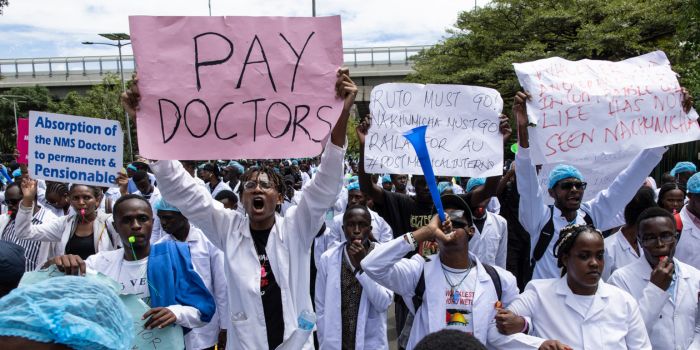
NAIROBI, Kenya — Kenya’s doctors’ union has set December 2026 as its target for concluding a new collective bargaining agreement, as it pushes the national and county governments to settle outstanding employment issues and implement previously agreed salary adjustments.
The Kenya Medical Practitioners, Pharmacists and Dentists Union (KMPDU) says it is shifting towards structured negotiations to secure better terms of service for doctors over the 2025–2029 period.
But the talks come with a pressing complication. The union says 27 county governments had yet to implement agreed salary adjustments by the end of September and has warned it could issue a strike notice on November 1 if the counties fail to act.
The two developments put pressure on the parties to resolve existing disputes while negotiating a new agreement that will shape doctors’ pay and working conditions for the coming years.
National negotiations begin in Mombasa
KMPDU Secretary General Davji Atellah announced the December target on Monday, October 26, following a joint meeting of the union’s National Advisory Council and National Executive Council held on October 16.
The union says the Ministry of Health has submitted a counter-proposal to its proposed CBA, creating a basis for formal negotiations.
Principal Secretary for Public Health and Professional Standards Mary Muthoni Muriuki has constituted an inter-ministerial negotiating committee and invited KMPDU representatives to meetings scheduled for October 26 and 27 in Mombasa.
Atellah said the union was approaching the process with a clear mandate to pursue doctors’ welfare and employment terms at both levels of government.
“We are stepping into these negotiation rooms organised, legally anchored, and unified across both national and county levels,” he said.
The December target is ambitious. The parties must work through competing proposals and reach agreement on the outstanding terms before the end of the year. Setting a deadline, however, does not mean the CBA has been agreed or signed.
County talks aim to bring all 47 governments to one table
KMPDU has also announced progress towards centralised negotiations covering all 47 county governments.
According to the union, the Council of Governors (CoG) and the Salaries and Remuneration Commission (SRC) have agreed to its request for a coordinated process. The union has nominated a 12-member team to represent doctors in the county-level talks scheduled for October 29 and 30.
Centralised negotiations could give the union and county representatives a common forum to address issues affecting doctors across devolved health services, rather than requiring separate negotiations with each county.
The arrangement does not, on its own, settle the outstanding disputes. The parties will still need to agree on the terms and how any commitments will be implemented.
That implementation question is particularly important because the union has raised concerns over counties that have not applied previously agreed salary adjustments.
Unresolved salary adjustments raise strike risk
On October 24, KMPDU warned that 27 counties had failed to implement salary adjustments it says were agreed earlier in the year. The union said it could issue a strike notice on November 1 if the affected county governments did not comply.
The dispute highlights a central challenge in public-sector bargaining: reaching an agreement is only part of the process. Employers must also put agreed terms into effect, including making the necessary payroll changes.
County governments have to manage their health services within their budgets, while the union is pressing for doctors to receive the pay and conditions it says were agreed. The parties will need to resolve the dispute through engagement if they are to avoid further disruption to health services.
The Salaries and Remuneration Commission has separately suspended revised remuneration structures for some categories of county officials, citing concerns about the affordability and sustainability of county wage bills. That decision concerns specified county officeholders and should not be confused with the separate dispute over doctors’ salary adjustments.
Lessons from the previous CBA dispute
KMPDU says its approach to the new negotiations has been shaped by the difficulties experienced during the 2017–2021 CBA cycle.
The previous round of industrial conflict exposed how prolonged disagreements over doctors’ employment terms can escalate into strikes, affecting both health workers and patients. A return-to-work agreement signed in May 2024 ended a prolonged doctors’ strike, but disputes over implementation and outstanding employment commitments have continued.
The union has continued to argue that doctors’ welfare is directly linked to the quality and reliability of public healthcare. In a statement reported on October 24, Atellah renewed calls for outstanding CBAs to be fast-tracked and signed.
For the government, the task is to negotiate terms that can be implemented and funded. For KMPDU, the challenge is to secure an agreement that addresses doctors’ concerns and ensure existing commitments are honoured.
The coming weeks will test whether the national and county governments can make enough progress to meet the December target while resolving the salary dispute threatening another confrontation.
For patients, the stakes extend beyond the negotiating table. A deal that is concluded and implemented could help provide greater certainty for doctors and their employers. Failure to resolve the outstanding issues, however, risks prolonging tensions in a health system on which millions of Kenyans depend.
You may also like
Category: Health
Related Explainer: Ebola contact tracing: Why the 21-day window matters in Kenya’s response
About the Author
Maureen Onyango is a journalist passionate about storytelling, life coaching and spiritual lessons. She studied at the Kenya Institute of Management and enjoys telling stories that inform, inspire and empower communities.
 Facebook
 Twitter / X
 WhatsApp
 LinkedIn
 Telegram
 Reddit