
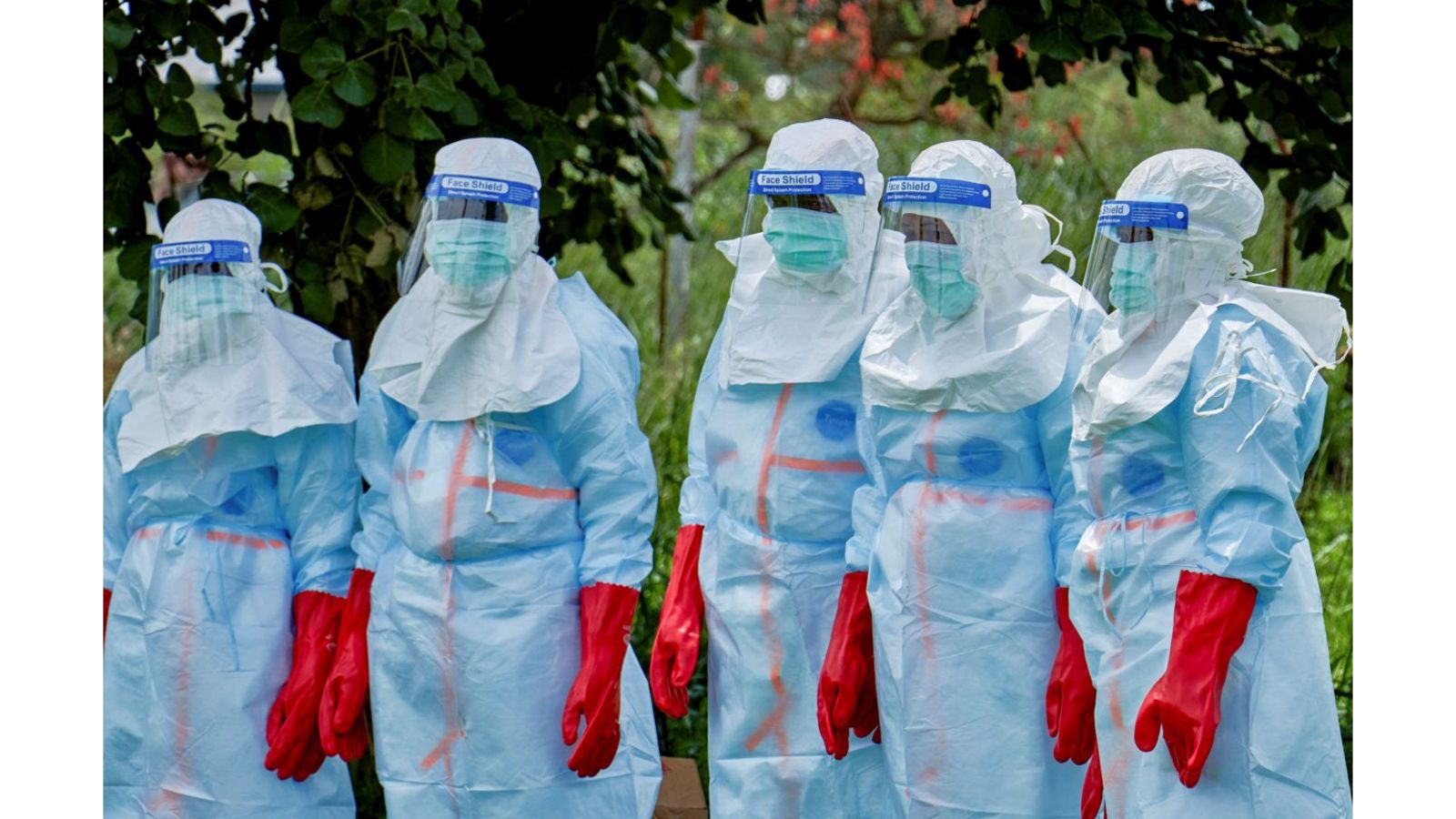
The children most at risk of dying from Ebola in the Democratic Republic of Congo are also among those struggling to access the very research that could help protect them.
That is the warning from Médecins Sans Frontières (MSF), which is calling for children to be included more quickly in research into treatments and preventive medicines for the Bundibugyo strain of Ebola.
The appeal comes as the outbreak in eastern and northern DRC continues to grow.
By August 31, authorities had recorded more than 6,000 confirmed cases and nearly 3,000 deaths, making the outbreak one of the fastest-growing Ebola epidemics ever recorded. The World Health Organisation says the virus has spread to 60 health zones across six provinces.
But behind those numbers is a particularly worrying pattern.
Children, especially those under five, appear to be dying at a far higher rate than adults once infected.
MSF says data available as of August 4 showed a crude case-fatality ratio of 61.7 per cent among children under five, compared with 28.9 per cent among adults. Of 345 confirmed cases in children under five for whom the outcome was known, 213 had died.
Among all confirmed infections for which age was recorded, children accounted for 357 of 1,124 reported deaths — about 32 per cent.
The figures are not final and the case-fatality estimates may change as surveillance improves. But MSF says the disparity is already too stark to ignore.
The research gap
The immediate concern is not simply whether children can receive care once they become sick.
It is whether they can be protected after a high-risk exposure to the virus.
A clinical trial known as EBO-PEP began in July to test the oral antiviral obeldesivir as post-exposure prophylaxis — medicine given to people who have had a high-risk contact in an attempt to prevent them from developing disease.
The trial is being conducted by the DRC's National Institute for Biomedical Research, France's ANRS Emerging Infectious Diseases programme and partners including ALIMA and MSF.
The initial obeldesivir study was designed primarily for people aged over 12, with participants required to have had a high-risk exposure within the previous five days and to have no symptoms. The trial aims to enrol about 1,000 participants.
That creates a problem for younger children.
MSF says children weighing below 30kg — roughly 12 years old or younger — were excluded under the original design. A planned amendment is expected to lower the threshold to children weighing more than 20kg.
But children below 20kg, generally those aged about six or younger, still face a major barrier.
There is no available paediatric formulation of obeldesivir and insufficient published evidence on safely crushing or dissolving the adult tablets to establish appropriate doses for younger children.
For a disease that is killing young children at such a high rate, that gap is particularly troubling.
An alternative exists — but it is difficult
Researchers are not leaving younger children without any option.
A separate EBO-PEP sub-study is examining remdesivir for children under 12, as well as pregnant and breastfeeding women who have had high-risk exposure.
But remdesivir is administered intravenously.
That matters in an outbreak setting where families may live far from treatment facilities, health systems are under pressure and insecurity can make repeated hospital visits difficult.
The EBO-PEP team says the remdesivir study is specifically designed for populations for whom there is currently insufficient evidence to use obeldesivir.
MSF argues that a daily intravenous treatment course over several days is much harder to deliver to young children during an emergency than an effective oral medicine would be.
The issue, therefore, is not simply having a drug.
It is having the right formulation, the right dose and evidence that it can safely be given to the people who need it most.
MSF: children cannot be an afterthought
Dr Neal Russell, MSF's paediatric adviser, says children are too often excluded from medical research during health emergencies.
“Too often, the inclusion of children in the development of medical countermeasures to address public health emergencies is left to the ‘small print’,” Russell said.
He called for researchers, donors and other stakeholders to support a paediatric obeldesivir study and speed up research into other oral antivirals and monoclonal antibodies that could be used after high-risk exposure.
“We need to generate the evidence now so that children can access effective preventive treatments alongside everyone else — not after the outbreak is over,” he said.
That last point is crucial.
Clinical evidence generated after an outbreak has peaked may be scientifically useful, but it comes too late for the children who were exposed during the crisis.
Gilead promises a child-friendly formulation
MSF says Gilead Sciences, the US pharmaceutical company that manufactures obeldesivir, has committed to producing a paediatric formulation.
The organisation wants the company to provide a clear timeline and for researchers to begin paediatric studies as soon as the formulation becomes available.
The goal is to establish whether the medicine can safely be given to younger children and at what dose.
Gilead's involvement is significant because the lack of a suitable formulation is not simply a question of hospital capacity. It is a product-development problem.
Until the appropriate formulation and dosing evidence exist, researchers face limits on how far they can responsibly include young children in the oral obeldesivir trial.
A deadly outbreak with few proven options
The urgency is amplified by the nature of the virus itself.
The current outbreak is caused by Bundibugyo ebolavirus, a different species from the Zaire ebolavirus responsible for several previous major Ebola outbreaks.
There is currently no licensed vaccine specifically approved for Bundibugyo virus and no approved treatment specifically for the strain.
The WHO's latest assessment says the DRC outbreak remains severe, with sustained transmission, high mortality and continued geographical expansion. As of August 26, there were 5,794 confirmed cases and 2,786 deaths, a crude case-fatality ratio of 48.1 per cent.
The figures have risen further since then.
WHO has also warned that the response is being complicated by insecurity, limited healthcare capacity, funding shortages and infections among health workers. Its August rapid risk assessment rated the risk as very high inside the DRC and high for neighbouring countries sharing borders with the country.
The situation has already spilled beyond the DRC.
Uganda, which shares a border with the DRC, declared its Bundibugyo outbreak over in August after recording 20 confirmed cases and two deaths. But WHO continues to monitor the risk of cross-border transmission.
The bigger lesson for outbreak research
The debate over paediatric access raises a broader question about how quickly medical research can adapt when an outbreak affects groups who are often under-represented in clinical trials.
Children are not simply smaller adults.
Their medicines may require different formulations and doses, and researchers must establish safety and effectiveness at different stages of development.
Those safeguards are necessary.
But the challenge is ensuring that caution does not become permanent exclusion.
The current DRC outbreak provides a difficult test.
If children are among those most likely to die after infection, researchers need evidence that allows them to benefit from prevention studies while the outbreak is still active.
That means moving quickly without cutting corners.
For MSF, the message is straightforward: paediatric research cannot wait for the emergency to pass.
The race against Ebola is not only taking place in treatment centres and laboratories.
It is also taking place in the gap between who is most vulnerable and who current research can actually protect.
You may also like
Category: Health
Related Video: Human Ladder Reaches Dangerous Heights as Climbers Keep Going
Related Explainer: Ebola contact tracing: Why the 21-day window matters in Kenya’s response
About the Author
Maureen Onyango is a journalist passionate about storytelling, life coaching and spiritual lessons. She studied at the Kenya Institute of Management and enjoys telling stories that inform, inspire and empower communities.
 Facebook
 Twitter / X
 WhatsApp
 LinkedIn
 Telegram
 Reddit