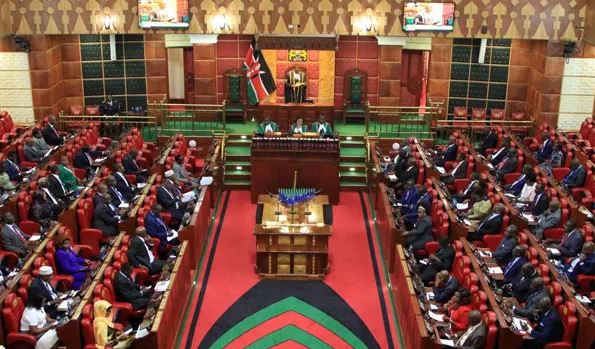
On Tuesday, June 20, Members of Parliament gathered to vote on proposed amendments to the Finance Bill (2023) during its third and final reading.
Following a resounding endorsement during the second reading on Wednesday, June 14, where 176 MPs voted in favor and 81 against, the Finance Bill faced its crucial final reading.
During the ongoing third reading, MPs will cast their votes on the amendments put forth by the Parliamentary Finance and Planning Committee.
National Assembly member Moses Wetangula addressed concerns raised by Rarieda MP Otiende Amollo, affirming that it was lawful for Treasury Cabinet Secretary Njuguna Ndung'u to present the 2023/2024 financial budget on Thursday, June 15, a week prior to the final reading of the Finance Bill 2023.
Suna North MP Junet Mohammed expressed his belief that the government allocated unrealistic sums of money to various projects. Wetangula countered, stating that Junet's viewpoint was pessimistic while the government remained optimistic.
National Assembly representative Kimani Ichungw'ah declared that President William Ruto's government would not initiate any new road infrastructure projects for the 2023/2024 financial year.
Opposing the Appropriation Bill, National Assembly Minority Leader Opiyo Wandayi highlighted the challenge the government would face in raising funds to finance the 2023/2024 budget, which would result in the suspension of numerous ongoing projects.
Nominated MP John Mbadi pointed out that Kenya Kwanza had overreached itself by proposing a Ksh3.6 trillion budget for the 2023/2024 financial year.
"The financing of this budget is going to be a challenge. The government is deluding itself that we can increase ordinary revenue from Ksh1.9 trillion to Ksh2.5 trillion. This is unrealistic, ambitious, and likely to fail," he expressed.
The Chairperson of the Budget and Appropriations Committee, Ndindi Nyoro, presented the second reading of the Appropriation Bill, 2023.
Wetangula introduced two Bills passed in the Senate: the first reading of the County Allocation Revenue Bill, 2023, and the first reading of the Equalisation Fund Appropriation Bill, 2023.
National Assembly Speaker Moses Wetangula ensured that a quorum was present to address parliamentary matters and barred MPs from debating Bills already passed in the Senate.
MPs gathered in Parliament ready to engage in deliberations over the Bill.
While Ruto rallied Kenya Kwanza to unanimously support the bill, Raila, through Azimio La Umoja minority leader Opiyo Wandayi, presented ten proposals to be considered before the Bill is enacted.
One of their proposals aimed to prevent the doubling of the value-added tax (VAT) on petroleum products, which Ruto intended to increase from eight to sixteen percent.
Azimio also sought to contest the sixteen percent fuel VAT, challenge the proposal exempting aircraft importers from paying 16 percent VAT, abolish the 3.5 percent import declaration fee (IDF) and the two percent Railway Development Levy (RDL).
The opposition further aimed to amend the section of the Bill reintroducing VAT on chopper importation and oppose the 1.5 percent housing tax.
You may also like
Category: News · Related Topic: William Ruto
Related Video: Gachagua’s explosive Ruto scorecard: Debt, taxes, State capture and a government ‘that has failed’
 Facebook
 Twitter / X
 WhatsApp
 LinkedIn
 Telegram
 Reddit