
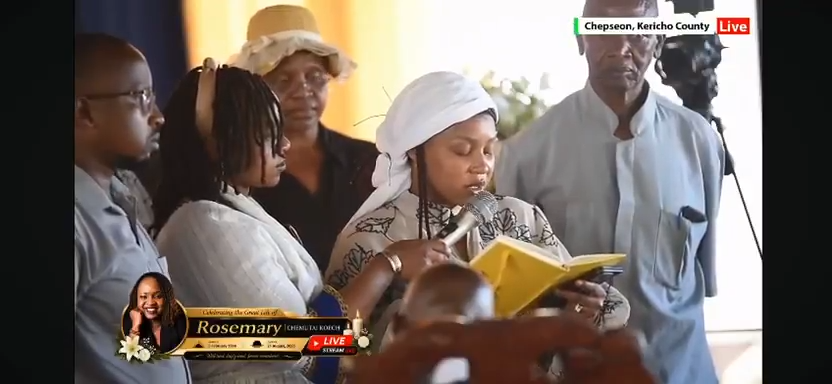
The private words left behind by Rosemary Koech have offered a deeply personal glimpse into the emotional turmoil she was experiencing in the period before her death.
Speaking about the journal entries, Chepngeno-Neno said she was deeply affected by what she found, particularly the pain, disappointment and sense of betrayal reflected in Rosemary’s own writing.
In one entry, Rosemary appeared to wrestle with the fear that years of hard work could be lost or enjoyed by someone else.
“The fact that I worked so hard on something and I feel betrayed and used.”
She also wrote about feeling undervalued by people to whom she had given her all, while questioning how co-parenting would work.
“I feel undervalued by people I gave my all.”
The entries suggest that much of her distress was centred not necessarily on relationships themselves, but on things she had built over the years.
Rosemary wrote that she did not care as much about the loss of relationships, marriages or friendships as she did about losing the things she had worked to create.
“It is all about the things that I have built.”
She appeared to draw strength from the belief that she could rebuild.
At the end of the journal, she wrote about refusing to allow a difficult period of her life to define her future.
“I shall not let a three-year span define me and the rest of my life.”
She told herself that the difficult period would pass and that she needed to remain strong and focused on what she needed to do.
But according to Chepngeno-Neno, the emotional struggle was profound.
She said Rosemary experienced what she described as hatred, bullying, backstabbing and what she called “vile” treatment from someone in whom she had invested a significant part of her life and resources.
Chepngeno-Neno said Rosemary's state of mind remained a concern even while she was receiving treatment in mental health facilities.
She recalled that much of what Rosemary spoke about during that period centred on the things she had lost.
The account also describes a community that rallied around Rosemary during difficult periods of her life.
According to Chepngeno-Neno, when Rosemary lost everything, her father stepped in to support her, while members of the community came together to help her rebuild.
“As a community, we came together and we restored her.”
That sense of community support continued after her death.
Chepngeno-Neno said family members and friends came together once again to give Rosemary a dignified farewell.
“We will bury our sister. And we did bury our sister.”
Her account presents a picture of a woman who, despite periods of profound difficulty, continued trying to rebuild her life and protect what she had created.
The journal entries also reveal the importance Rosemary placed on hard work, respect and independence.
Rather than allowing a painful chapter to define her entire life, she appeared determined to look beyond it.
Her words — “All this shall pass” — reflected an attempt to find strength in the belief that the circumstances surrounding her would eventually change.
Chepngeno-Neno's decision to share the contents of the journal has brought renewed attention to the private struggles that can remain hidden behind a person's public life.
The account is also a reminder that grief does not always begin with death. For families and communities, it can involve revisiting the struggles, hopes and pain that a loved one carried while still alive.
For those who knew Rosemary, her final story is therefore not only about what she lost.
It is also about the people who stood with her, the things she built, and her determination to rebuild after some of the most difficult moments of her life.
You may also like
Category: News
Related Video: What Dangote’s proposed Lamu oil refinery could mean for East Africa
Related Explainer: Ebola contact tracing: Why the 21-day window matters in Kenya’s response
 Facebook
 Twitter / X
 WhatsApp
 LinkedIn
 Telegram
 Reddit