
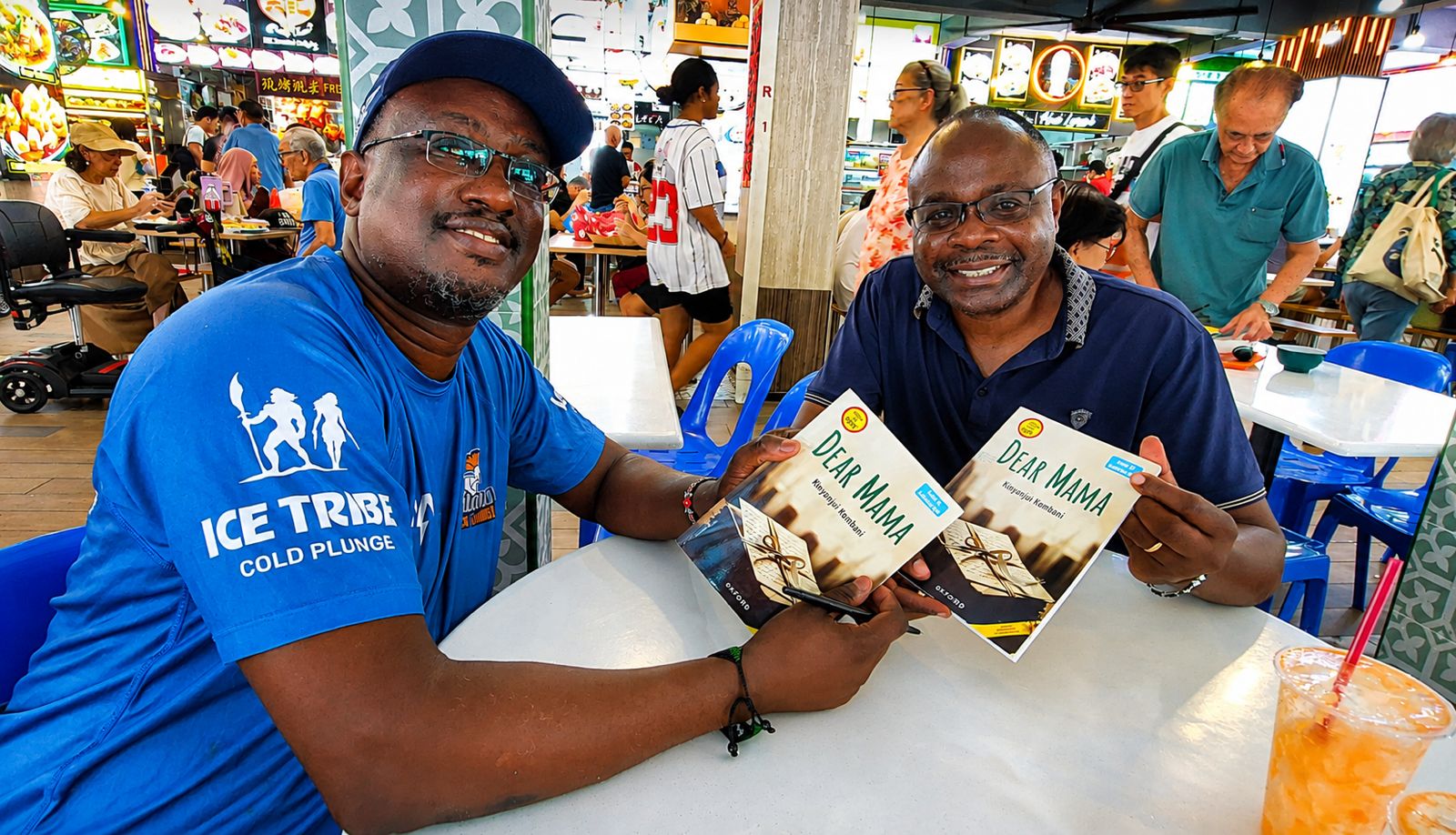
Kenyan author and banker Kinyanjui Kombani is building an unusual bridge between his life abroad and a new generation of readers back home.
Kombani, who is based in Singapore through his banking career, recently featured in a meeting shared under the hashtag #HapaSingapore, where Kenyan media personality Alex Chamwada highlighted the writer’s journey and his contribution to Kenyan literature.
At the centre of that journey is Dear Mama, Kombani’s latest book and his most personal work yet.
The book is written as a series of letters to his late mother, who died 26 years before its publication. Rather than presenting a conventional account of his achievements, Kombani uses the letters to revisit his childhood, struggles, career and the experiences that shaped him.
The result has taken his story beyond Kenya’s literary circles.
Dear Mama has been approved by the Kenya Institute of Curriculum Development (KICD) as a compulsory autobiography set text for Grade 10 Literature students. The book is therefore expected to introduce Kombani's personal story and writing to a large new audience of Kenyan learners.
From Molo to Singapore
Kombani's story is itself part of what makes Dear Mama significant.
Born in Molo, Nakuru County, he was raised by his mother in a single-roomed mabati house alongside his four siblings. His autobiography follows his family's move back to their farm in Njoro, his difficult period in Nairobi's Ngando informal settlement and his eventual turnaround through education at Kenyatta University.
His professional life developed along two seemingly different paths: banking and writing.
Kombani began his banking career as a clerk at Standard Chartered's Moi Avenue branch before eventually relocating to Singapore through his work with the bank in 2020. At the same time, he developed a literary career that has produced novels, children's books, young adult fiction, plays and other works.
That dual identity — banker by profession and writer by passion — has become one of the defining features of his public profile.
The book that changed the conversation
Kombani has said Dear Mama began after he was challenged to write his autobiography.
He initially questioned why anyone would want to read about his life. He eventually found his answer in the person who would have cared most about what happened to him: his mother.
The book became a way of telling her about the years she never got to see — from his struggles and disappointments to his career and literary achievements.
That approach also gives the book a wider appeal.
It is not simply the story of a successful Kenyan professional living overseas. It is an account of the difficult and often ordinary experiences that preceded that success.
For students encountering the book in school, the journey offers a different picture of achievement: one that includes uncertainty, hardship, mistakes and persistence.
A Kenyan writer with a global life
Kombani's career also illustrates the changing nature of Kenyan identity in a globalised world.
He is now living in Singapore, a major international financial centre, while his writing continues to draw heavily from Kenyan experiences.
His earlier works have similarly focused on ordinary people and social realities. The Last Villains of Molo, first published in 2008 and later republished by Longhorn, became a university study text. Den of Inequities followed in 2014, while his children's and young-adult works have reached learners in Kenya and beyond.
His literary career has also received formal recognition. He has been named among notable Kenyan authors and has won awards including the Jomo Kenyatta Prize for Literature Youth Category and the CODE Burt Award for African Young Adult Literature.
Why the Singapore connection matters
The Singapore meeting offers a useful reminder that Kenyan stories are not confined to Kenya.
Kombani's life now stretches between the international financial world and Kenya's literary and education sectors.
His day job is in banking. His books, however, continue to take him back to Molo, Njoro, Nairobi and the experiences that shaped him.
And through Dear Mama, those experiences are now entering classrooms.
For a writer who once wanted simply to see his book displayed in a bookshop window, having his autobiography selected for the Grade 10 curriculum represents a considerable shift in scale.
#HapaSingapore I met prominent Kenyan author @KKombani. He works for an international bank. Kombani's Dear Mama is a set book in grade 10 in Kenya. He has written 25 books. Well done Kombani for Shining majuu and back home. #DaringAbroad @ChamsMedia @ChamsLodwar pic.twitter.com/EaoxvlYJeR
— Alex Chamwada OGW, MBS (@AlexChamwada) August 30, 2026
The story of Kinyanjui Kombani is therefore no longer only about a Kenyan author who made a career abroad.
It is about how a personal story — written initially as letters to a mother who could no longer read them — has become part of the education of a new generation back home.
From Molo to Nairobi, and now Singapore, Kombani's journey shows how far a Kenyan story can travel — and still find its way home.
Category: Features
Related Video: What Dangote’s proposed Lamu oil refinery could mean for East Africa
 Facebook
 Twitter / X
 WhatsApp
 LinkedIn
 Telegram
 Reddit