
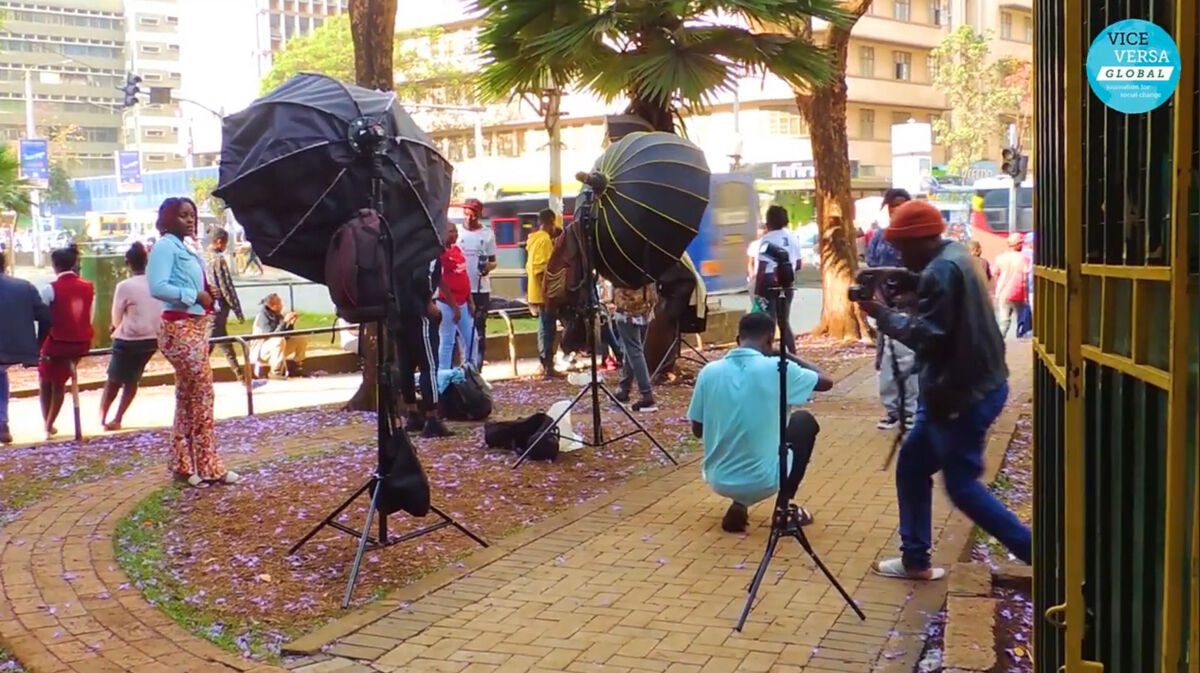
For a passer-by, it may look like a simple camera pointed at a stranger.
For Nairobi’s street photographers, it is a day’s work.
As smartphones become increasingly capable of producing sharp portraits, editing apps make professional-looking images easier to create, and artificial intelligence changes how photographs can be altered, the people carrying cameras through the city are facing a question that seems increasingly obvious: who still needs a photographer?
The answer, for a growing group of young Kenyans, is simple — enough people do.

Street photographers are finding ways to sell something a phone cannot easily provide: the experience of being photographed, professional composition, quick editing and a finished image that can be shared almost immediately.
For some, the work is also much more than a creative pursuit. It is how they pay their bills.
From unfinished studies to the streets
For Kim Dilan, photography was not the career he initially planned.
He studied cyber security but had to stop when he could no longer afford his fees.
“I did Cyber Security, but I didn't finish because I couldn't pay my school fees. I decided I couldn't continue burdening my parents, so I came to the streets to earn money and help pay my fees,” he said.
Photography gave him a way to make money while keeping alive the possibility of returning to education.
Kim says he was encouraged by the work of Kenyan photographer Joseph Maina, popularly known as Kapedo.
“I saw the art in his photography and I decided to join photography so that one day I can reach the level he is at. I'm aiming even higher,” he said.
Kapedo's own journey illustrates how difficult — and unpredictable — the creative economy can be. He moved into photography after the disruption caused by Covid-19 and later built a large online following around his work. His story has included periods when he struggled to afford equipment before receiving support that helped him pursue photography seriously.
That path has helped inspire younger photographers trying to build careers without traditional employment.
Daniel saw the future through a camera
For Daniel Brian, the fascination started much earlier.
As a schoolboy, he watched television programmes that featured cameras and video editing and imagined himself doing the same work.
“Nikiwa primary na high school nilikuwa fan wa Ten Over Ten. Nilikuwa naona editing na venye cameras zilikuwa zinafanya kazi, nikajiambia siku moja nitakuwa narecord watu hivyo,” he said.
He eventually worked with a YouTuber before moving into street photography.
Now, his workplace is the city itself.
But owning a camera is only the beginning.
The real skill is finding a customer
Street photography is a business built around human interaction.
Photographers have to identify potential customers, approach them without putting them off, show examples of their work and convince them that the photograph is worth paying for.
Social media has become part of that sales pitch.
A photographer can show a potential customer previous work on a phone, complete the shoot and send the finished images digitally.
Kim says income can vary considerably depending on the day.
“On weekdays unaweza make KSh3,000 to KSh4,000. Weekends, especially Sundays, are usually better because many people are out in town taking photos. Unaweza make at least KSh6,000,” he said.
Those figures are the photographers' own estimates rather than a measure of average earnings across the profession. Like much of Kenya's informal creative economy, income can change sharply from one day to another.
Still, for someone struggling to find formal employment, even an unpredictable income can provide a route to independence.
The smartphone is both friend and rival
The biggest change in the business is sitting in almost everyone's pocket.
Modern smartphones can produce high-quality photographs, while apps allow users to edit images within seconds.
For photographers, that technology has made some parts of the job easier.
Daniel says he no longer needs to send customers away and ask them to wait for prints.
“Kitambo mtu alikuwa anangoja hard copy. Siku hizi nampiga picha, naedit kwa simu yangu, halafu namtumia hapo hapo. Kila kitu nafanya na simu,” he said.
The same tools, however, have created a new competitor.
Brages Silvanus, another photographer, says technology has changed customer expectations.
“Technology imetusaidia, lakini pia imetuathiri. Mtu anaweza kusema hana haja ya photographer kwa sababu anaweza kupiga picha na simu yake na kutumia AI kubadilisha muonekano wake,” he said.
That tension is playing out across the photography industry.
The photographer is no longer selling access to a camera. The customer already has one.
Instead, photographers have to sell skill, direction, composition, editing and convenience.
That is a harder proposition, but it also creates room for those who can distinguish their work.
More than a photograph
There is another reason the business has survived.
People do not always want a technically perfect picture. Sometimes they want someone to tell them where to stand, how to pose and how to make the moment look good.
That is where street photographers have an advantage.
The interaction itself becomes part of the service.
The photographers featured in this story say their earnings have helped them pay rent and bills, support themselves and, in Kim's case, continue working towards his education.
Their cameras have therefore become more than creative tools.
They are small businesses.
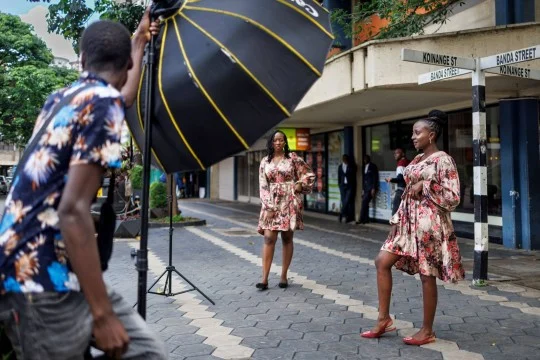
And Nairobi's streets have become their office.
A changing creative economy
The rise of street photography also says something broader about work in Kenya.
Young people who cannot find formal jobs are increasingly creating their own income streams around skills, social media and digital tools.
The barrier to entry can be relatively low compared with some traditional businesses. But competition is intense.
Photographers have to constantly improve their work, market themselves and adapt to technology that can also make their services appear less necessary.
Even established photographers face the same pressure to build and protect their brands online. Kapedo, for example, lost a TikTok account with a reported following of more than 780,000 after it was hacked in 2025, illustrating how dependent creative businesses can become on digital platforms.
For the photographers working on Nairobi's streets, the lesson is already clear.
The camera alone will not pay the bills.
The person behind it has to.
You may also like
Category: Features
Related Video: How a tweet cost Idris Mukhtar a job with CNN | Globe Traktion Ep# 11
About the Author
Maureen Onyango is a journalist passionate about storytelling, life coaching and spiritual lessons. She studied at the Kenya Institute of Management and enjoys telling stories that inform, inspire and empower communities.
 Facebook
 Twitter / X
 WhatsApp
 LinkedIn
 Telegram
 Reddit