
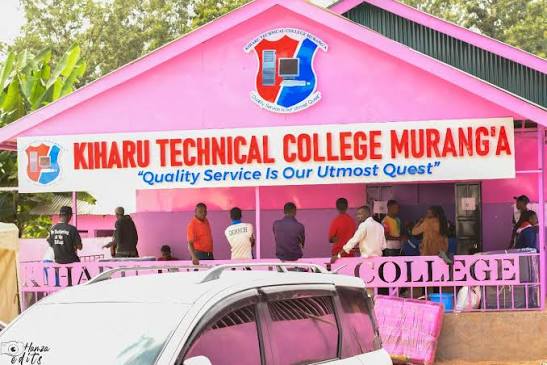
In Central Kenya, Kiharu Technical College Murang'a, famously known as KTCM, is emerging as an important reference point in the conversation about youth unemployment, skills development and the future of work. Led by Chief Principal George K. Njau, the institution represents a growing recognition that Kenya's young people need more than academic certificates to navigate an increasingly competitive labour market. They need practical, market-relevant skills that can help them secure employment, create businesses and respond to the changing demands of the economy.
For many young Kenyans, the journey through education has traditionally followed a familiar path: perform well in school, proceed to college or university, graduate and look for a job. But for a growing number of graduates, the final step is proving to be the most difficult. Years of education do not always translate into immediate employment, leaving many young people competing for a limited number of formal jobs.
The challenge has forced an uncomfortable but necessary conversation about what education should achieve.
Is the purpose of education simply to produce graduates, or should it also equip young people with practical abilities that can be applied to solve problems, provide services and create opportunities?
The experience of Kiharu Technical College Murang'a offers one answer.
Located along the Murang'a-Mugoiri Road, about 500 metres from Mukuyu town, KTCM has positioned itself as an institution focused on technical and vocational training, with programmes designed to prepare learners for the workplace and a changing job market. The college says it has grown from a computer training centre into a technical and vocational institution, with accreditation from TVETA and recognition from examination and assessment bodies including KNEC, NITA, TVET-CDACC and KASNEB.
Its broad range of training areas illustrates an important reality about today's labour market: opportunity is not concentrated in one profession.
KTCM offers training across areas including building and civil engineering, electrical and electronic engineering, computing and informatics, medical and health sciences, mechanical and automotive engineering, hospitality and institutional management, business and economics, cosmetology, fashion and design, as well as journalism and media studies. The college also offers shorter courses for people seeking to add skills to their existing qualifications.
This diversity is significant because the modern economy requires different kinds of skills.
A construction project needs engineers, but it also needs trained technicians, electricians, plumbers, masons, carpenters and other specialists. The transport sector needs engineers and mechanics. Hospitals require medical professionals as well as trained technical and support personnel. Businesses increasingly depend on ICT and digital skills. Hotels and restaurants need chefs, food and beverage specialists and hospitality professionals.
The lesson for young people is clear: there is no single definition of a successful career.
For decades, technical and vocational education has sometimes been unfairly viewed as an option for students who did not perform well enough to attend university. That perception is increasingly difficult to defend in an economy where practical skills can be as valuable as academic qualifications.
A young person who knows how to install electrical systems, repair a vehicle, develop software, build a website, prepare food professionally, design clothes, provide beauty services or operate specialised equipment possesses something that can be immediately applied in the marketplace.
That is the power of a skill.
Unlike a certificate that may simply indicate that a person completed a course, a practical skill demonstrates what that person can actually do.
This distinction matters in an economy where employers are increasingly interested in competence, adaptability and the ability to solve problems.
For Kenya's youth, therefore, investing in technical skills should not be seen as abandoning ambition. It should be seen as broadening the definition of ambition.
A university degree can open doors, but so can a technical qualification. In some cases, a practical skill can provide a young person with an opportunity to start earning while continuing to develop professionally.
This is particularly important for young people who cannot afford to wait indefinitely for formal employment.
A trained electrician, for example, can seek employment with a company while also taking on private assignments. A mechanic can work in a garage and eventually establish one. A trained beautician can build a client base and grow into a business. A web developer can provide services to businesses beyond the physical boundaries of their home county. A chef can work in hospitality or develop a catering enterprise.
The common factor is that the individual has acquired a skill that solves a real problem.

Kiharu Technical College Murang'a provides a useful illustration of this approach. Its training programmes span traditional technical trades and newer areas of opportunity, including computing, web design and development, software development, computer engineering, agriculture, photography and content creation. This combination reflects a labour market that is no longer divided neatly between "technical" and "non-technical" careers. Today, almost every profession is being influenced by technology.
The digital economy has also changed the meaning of employability.
A young person may now need to combine technical knowledge with digital literacy, communication, creativity and entrepreneurship. A technician who can market their services online may have an advantage over one who relies only on traditional advertising. A small business owner who understands social media can reach customers beyond their immediate neighbourhood. A content creator with photography and digital production skills can work with businesses, organisations and individuals.
This is why skills development must evolve with the economy.
For institutions such as KTCM, the responsibility is not simply to train students to pass examinations. It is to prepare them for a world in which technology, industry and consumer needs are constantly changing.
The college highlights hands-on training, market-driven courses and industry connections as part of its approach to preparing students for real-world success. It also says it seeks attachment and internship opportunities for students, an important bridge between classroom learning and workplace experience.
Such exposure is important because the transition from school to work can be difficult. A student may understand theories in class but still need practical experience to become confident in a professional environment.
This is where technical education can make a difference.
The emphasis on hands-on learning allows students to develop competencies that can be tested outside the classroom. It can also help young people understand the realities of their chosen industries before they enter the job market.
But the responsibility does not rest with colleges alone.
Young people must also rethink their relationship with skills.
Instead of asking only, "Which course will get me a job?", they should ask, "Which skill can help me solve a problem?"
That change in mindset is crucial.
The future of work will require people who can adapt. A skill acquired today may need to be upgraded tomorrow. A young person trained in ICT must be prepared to learn new technologies. A mechanic must keep pace with changes in vehicle technology. A hospitality professional must understand changing customer expectations. A media practitioner must adapt to new digital platforms.
The most valuable investment, therefore, is not simply obtaining one qualification. It is developing the habit of continuous learning.
Kiharu Technical College Murang'a's range of programmes offers young people an opportunity to choose different routes depending on their interests, abilities and career goals. Diploma programmes are available for learners with KCSE grades of C- and above, certificate programmes for those with D plain and above, while artisan programmes are open without a minimum grade requirement. The college also offers short courses for professionals, graduates and others seeking additional skills.
That flexibility is important in a country where young people have different educational backgrounds and financial circumstances.
Not everyone follows the same path. Some young people may need a short course to acquire a specific skill. Others may pursue an artisan qualification before progressing to higher levels. Another student may choose a diploma and later continue with further education.
The important thing is that young people should have access to multiple pathways to economic independence.
Kenya's response to unemployment must therefore include a stronger focus on technical and vocational education. Government, training institutions, industry and communities must work together to ensure that the skills taught in classrooms remain relevant to the needs of employers and the wider economy.
Training institutions also need to continue investing in modern equipment, competent trainers and meaningful links with industry. Employers, on their part, should provide opportunities for young people to gain workplace experience and demonstrate their abilities.
At the same time, society must change the way it talks about technical careers.
A skilled technician should not be viewed as less successful than a person working in an office. A professional who builds, repairs, designs, installs or creates is contributing directly to the economy.
The electrician who keeps a business operating, the mechanic who keeps vehicles on the road, the plumber who maintains essential infrastructure, the chef who serves customers, the ICT specialist who keeps a business connected and the builder who contributes to housing and infrastructure are all part of the same economic system.
Their skills matter.
For young people in Central Kenya and beyond, Kiharu Technical College Murang'a offers a reminder that the journey to employment does not have to follow one predetermined route. The institution's broad training portfolio demonstrates the possibilities available when education is connected to practical skills and the realities of the labour market.
Under the leadership of Chief Principal George K. Njau, KTCM's role in this conversation is particularly relevant at a time when young people are looking for alternatives to the increasingly crowded race for formal employment.
The message is not that every young person should abandon university education.
Rather, it is that Kenya needs to expand its understanding of what makes a young person employable.
The country needs graduates who can think critically, but it also needs skilled professionals who can build, repair, create, design, install, operate and innovate.
It needs young people who can move from being job seekers to becoming problem-solvers.
As the unemployment challenge continues to shape the lives of thousands of young Kenyans, the answer may not lie solely in creating more jobs. It must also lie in preparing young people to recognise and respond to opportunities that already exist, while equipping them with the skills to create new ones.
The story of Kiharu Technical College Murang'a is therefore part of a much larger national conversation.
It is a conversation about changing attitudes towards technical education, investing in practical skills and preparing a generation for a labour market that will demand flexibility, creativity and competence.
Related Stories
- Owalo’s 2027 Gamble: Can the ‘Fresh’ Candidate Break Kenya’s Political Binary?
- Fame First, Values Later? Inside Gen Z’s Integrity Crisis in 2026
Category: Education
Author: Stephen Eugene
 Facebook
 Twitter / X
 WhatsApp
 LinkedIn
 Telegram
 Reddit