
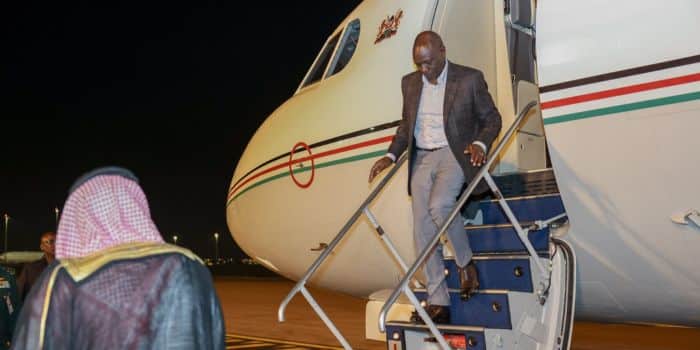
Kenya's presidential aircraft, popularly known as Harambee One, has returned home after almost a year in the Netherlands, where it underwent extensive maintenance and a series of technology upgrades.
The Kenya Air Force's Fokker 70, registration KAF308, had been undergoing work at Fokker Services Group in the Netherlands since August 2025.
Its return marks the end of a prolonged period in which President William Ruto has had to rely on alternative aircraft for some overseas engagements.
But despite its return, the aircraft has not yet been used for a presidential mission, according to the latest available flight information.
The development provides a new twist to the debate over Kenya's ageing presidential aircraft, which has served four presidents since it was acquired three decades ago.
What has changed on Harambee One?
The aircraft underwent what its Dutch maintenance provider described as deep maintenance, interior refurbishment and systems upgrades.
One of the most significant additions is a new Gogo Galileo FDX satellite communications system, installed in partnership with Gogo Business Aviation.
The system uses Eutelsat's OneWeb low-Earth-orbit satellite network to provide high-speed connectivity while the aircraft is airborne.
Eutelsat says the system has now been successfully installed on KAF308, describing it as a head-of-state aircraft requiring reliable connectivity for government and mission-critical operations.
According to technical information reported by The Standard, the system can provide download speeds of up to 195 Mbps and upload speeds of up to 32 Mbps through an electronically steered antenna.
The upgrade means the aircraft returns to service with capabilities that would have been difficult to imagine when it entered Kenyan government service in the 1990s.
From a 70-seater to a presidential aircraft
KAF308 is a Fokker 70 Extended Range aircraft acquired by Kenya in 1995.
Although the aircraft was originally designed to carry about 70 passengers, it was subsequently configured for presidential and VIP duties with 26 seats, providing more space and greater range for official travel.
It has carried Presidents Daniel arap Moi, Mwai Kibaki, Uhuru Kenyatta and William Ruto.
The aircraft is now more than 30 years old.
That has repeatedly raised questions about whether Kenya should continue investing in an ageing airframe or replace it altogether.
The return from the Netherlands does not appear to settle that question.
Instead, the latest overhaul gives Kenya more time to decide what comes next.
Why was the aircraft away for so long?
Harambee One left Kenya for maintenance in August 2025 and remained out of service for most of the following year.
Its absence became increasingly visible as President Ruto travelled abroad using other aircraft.
In June 2026, for example, Mr Ruto travelled to South Africa aboard a privately chartered Boeing 737-800 BBJ2 for a three-day state visit. The aircraft was operated by Dubai-based Empire Aviation Group.
The use of chartered aircraft has attracted public and political attention, particularly amid concerns over government expenditure.
The return of KAF308 therefore comes at a politically sensitive moment.
Its availability could reduce the need for the presidency to charter private executive aircraft for future missions.
But it is not yet clear how quickly Harambee One will resume its role as the president's principal aircraft.
The aircraft is flying again — but not yet with Ruto
There is an important distinction between the aircraft returning to Kenya and returning to presidential service.
According to reporting by The Standard, KAF308 has already resumed flying, undertaking domestic sectors linking Nairobi, Eldoret, Mombasa and Malindi.
However, it has not yet been identified on a presidential mission since returning to Kenya.
The aircraft has recently operated under the FLOKI100 designation rather than the Kenya 001 call sign associated with presidential operations.
That suggests the aircraft may first be going through operational checks and post-maintenance activities before being deployed for presidential travel.
The Kenya Defence Forces and State House have not publicly announced a first presidential trip for the refurbished aircraft.
A modern aircraft inside an old airframe
The latest upgrade creates an interesting contrast.
Harambee One remains a Fokker 70 designed more than three decades ago, but its communications equipment has been brought closer to modern aviation standards.
The new OneWeb-based system is designed to provide connectivity through low-Earth-orbit satellites.
Eutelsat says the KAF308 installation demonstrates the growing use of its OneWeb network for government and head-of-state aviation.
For the presidency, that means the aircraft can potentially support modern digital communications while travelling internationally.
But the upgrade does not change the aircraft's age.
The Fokker 70 model is no longer in mainstream commercial production, following the collapse of Dutch manufacturer Fokker in the 1990s.
That leaves Kenya with a familiar dilemma: maintaining an aircraft it already owns or eventually investing in a replacement.
The cost question
One issue remains largely unanswered: how much did the overhaul cost the Kenyan taxpayer?
The latest reports confirm the scope of the work but do not provide a publicly disclosed figure for the full maintenance and upgrade programme.
That figure is likely to be closely watched given the controversy surrounding presidential travel during the aircraft's absence.
The government has previously faced criticism whenever the president has travelled on privately chartered aircraft, with questions raised over the cost and procurement arrangements.
The return of Harambee One may therefore ease one pressure on the administration — but could create another if the public is left without clear information about the cost of keeping the 30-year-old aircraft operational.
What happens to Harambee One now?
The immediate priority is likely to be ensuring that KAF308 is fully cleared for its intended duties after the extensive maintenance programme.
Its recent domestic flights provide evidence that it is back in operation.
The next significant test will be whether it carries President Ruto on an international mission.
That could provide a clearer indication of whether the overhaul has restored Harambee One as the country's main presidential aircraft or whether it will mainly serve as a backup and VIP transport platform.
For now, the aircraft has returned to Kenya with a refurbished interior, upgraded systems and a new high-speed satellite communications capability.
But the bigger question remains unanswered.
Will Kenya continue modernising its three-decade-old presidential aircraft, or is Harambee One's latest overhaul simply buying time before the country replaces it?
That decision could become increasingly important as the government weighs the cost of maintaining an ageing aircraft against the expense — and political sensitivity — of acquiring a new presidential jet.
For the moment, one thing is certain: after nearly a year in a Dutch hangar, Harambee One is back in Kenyan skies.
You may also like
Category: Business · Related Topic: William Ruto
Related Video: What Dangote’s proposed Lamu oil refinery could mean for East Africa
 Facebook
 Twitter / X
 WhatsApp
 LinkedIn
 Telegram
 Reddit