
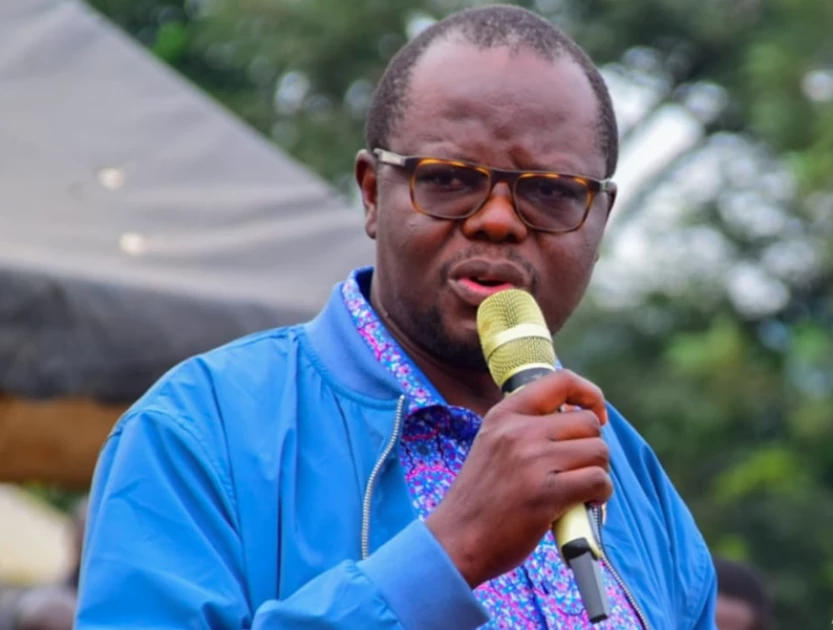
Migori Governor Ochilo Ayacko has said President William Ruto is his preferred presidential candidate for the 2027 election, while arguing that Nyanza's political priorities should move beyond the traditional politics of opposition and towards participation in government.
Speaking to political analyst Herman Manyora on A Conversation with Manyora, Mr Ayacko said he was working to build support for Mr Ruto in Migori, citing what he described as the president's engagement with the region and development projects in the county.
"We are trying to get all the people of Migori to be behind President R," Mr Ayacko said, referring to President Ruto. He said the president had visited Migori more than 10 times and that his administration had left a "footprint of development" in the county.
His comments offer a glimpse into the political calculations underway in Nyanza ahead of the 2027 election, as the region's long-standing opposition alignment faces pressure from new alliances between parts of the former opposition and Mr Ruto's Kenya Kwanza administration.
Mr Ayacko's position is particularly significant because he also described himself as belonging to the "mainstream" ODM, insisting that there is only one ODM and arguing that some politicians had allowed personal ambitions to take precedence over the party.
The governor's comments suggest that, for him, ODM's future does not necessarily require permanent opposition to the government.
Ayacko's case for working with Ruto
Mr Ayacko framed his support for Mr Ruto primarily around development rather than ideology.
He pointed to projects in Migori that he said had been pursued through cooperation between the county and national governments.
Among them is the upgrading of the Migori airstrip. Mr Ayacko said he had approached Mr Ruto with a proposal for an international airport and that the national government was now putting up a terminal valued at Sh400m.
He also cited a stadium being constructed through cooperation between the two levels of government. He put its value at Sh800m and said it was about 80% complete at the time of the interview.
The governor said the county was also developing a pier on Lake Victoria after setting aside 40 acres of land, arguing that lake transport could eventually become part of Migori's wider transport network.
These claims are presented here as the governor's account of projects in the county; the interview did not independently establish the current completion status or funding arrangements for each project.
A different argument about Nyanza politics
Mr Ayacko also rejected the idea that the political aspirations of the Luo community should be reduced to the search for a regional "kingpin".
He argued that Nyanza's political objective should increasingly be participation in government and the ability to influence policy and development.
"The fight that they do as a community are pursuing is to be able to bring transformation by being part of the government of the day," he said.
He said the community wanted, like other Kenyans, to occupy influential government positions, including the presidency, and use political power to deliver change.
That represents a notable shift in emphasis: rather than defining political success primarily through opposition, Mr Ayacko presented access to government as a route to delivering development.
ODM's future remains a fault line
The governor's position comes against an unsettled debate within ODM over its relationship with the Kenya Kwanza administration.
In the interview, Mr Ayacko argued that ODM should remain open to negotiations and possible coalition arrangements rather than making opposition to Mr Ruto the central organising principle of its politics.
He said the party needed leadership capable of bringing different factions together and negotiating a coalition agreement for the next political period.
He also criticised politicians who had left the party, arguing that some had been motivated by personal ambitions.
The comments are likely to add to the debate over whether the Broad-Based Government arrangement and cooperation between former opposition figures and Mr Ruto's administration will translate into a durable political alliance in 2027.
Devolution: Ayacko wants counties to control more resources
Away from presidential politics, Mr Ayacko used the interview to make a broader argument about the limits of Kenya's devolution system.
He said counties needed greater authority over resources found within their territories, particularly minerals.
Migori is known for gold mining, but the governor said key aspects of the sector remain under national government control.
He argued that Parliament should change the legal framework to give counties greater responsibility over mineral resources and licensing.
Mr Ayacko said Migori currently collects about Sh760m in own-source revenue annually, which he said had increased from previous levels.
His argument goes to one of the central questions surrounding devolution more than a decade after counties were established: how much economic power should counties actually control?
For governors such as Mr Ayacko, political devolution without greater control over locally generated economic resources limits what counties can deliver.
Development becomes part of the 2027 campaign
The governor is also increasingly presenting his record in Migori as the basis for seeking another term.
He said he would be happy to win re-election as governor and said he was already engaging political groups as he looked beyond the 2027 election.
He highlighted agriculture as another area where he believes his administration has changed the county's economic prospects.
Mr Ayacko said the county has compiled data on farmers, their acreage and crops, and has deployed agricultural officers to help farmers turn production into businesses through value addition and better access to markets.
He also said Migori had developed more than 20 fresh-produce markets and had become one of Kenya's significant maize-producing counties.
Again, these figures and claims are those made by the governor during the interview and would require independent verification before being presented as audited measures of county performance.
What does Ayacko's position mean for Nyanza?
Mr Ayacko's remarks do not, on their own, establish that Nyanza has shifted politically behind President Ruto.
But they illustrate the increasingly complicated choices facing politicians in the region.
For decades, Nyanza has been one of the strongest bases of opposition politics. The death of veteran opposition leader Raila Odinga has also created uncertainty over how the region's political influence will be organised going into 2027.
Mr Ayacko is effectively making a different pitch: Nyanza can retain its political influence by negotiating for a place inside government rather than remaining permanently outside it.
That argument is likely to face resistance from politicians and voters who see cooperation with the Ruto administration differently.
It also leaves an important question unanswered: will voters in Nyanza follow individual leaders into new alliances, or will the region's established political loyalties remain stronger than the development argument?
The 2027 question
Mr Ayacko was unequivocal when asked whether Mr Ruto was his presidential candidate.
"He is my presidential candidate," he said.
He said that even if Mr Ruto lost the presidential election while he won his own gubernatorial contest, he would continue talking to voters about issues that mattered to them.
That suggests Mr Ayacko is positioning his political message around development, access to government and his record in Migori, rather than treating the presidential and county contests as necessarily inseparable.
Whether that strategy succeeds will depend on how Nyanza voters assess the government's record, the strength of rival alliances and the candidates who emerge before the 2027 vote.
For now, Mr Ayacko's message is clear: he wants Migori to work with the government of the day, he supports Ruto for president, and he believes Nyanza's next political chapter should be about converting political influence into participation in government and development.
The bigger question is whether that message can overcome the region's deeply rooted political traditions.
You may also like
Category: Politics · Related Topic: William Ruto
Related Video: Dolly Parton’s Family Announces Her Passing in Emotional Tribute
 Facebook
 Twitter / X
 WhatsApp
 LinkedIn
 Telegram
 Reddit