
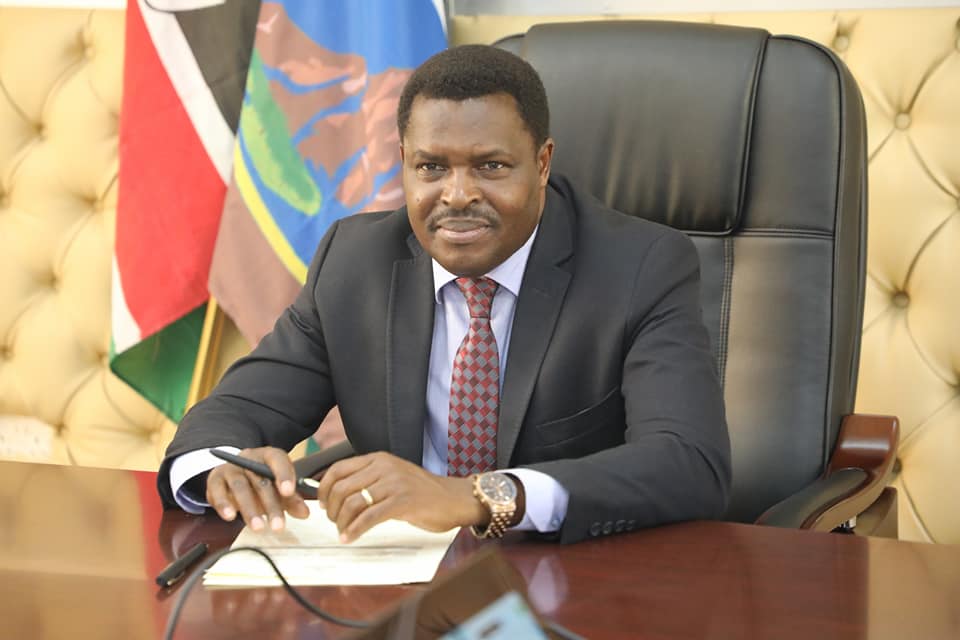
NAIROBI, Kenya — Tharaka Nithi Governor Muthomi Njuki has taken over as chairperson of the Council of Governors (CoG) after fellow governors opted for a consensus arrangement to avoid a divisive contest for the leadership of their umbrella body.
Bungoma Governor Kenneth Lusaka will serve as his deputy, while Baringo Governor Benjamin Cheboi retains the position of council whip.
The new leadership was announced on Monday, 12 October 2026, following a full council meeting in Nairobi. Njuki succeeds Wajir Governor Ahmed Abdullahi, who completed two consecutive one-year terms.
The leadership deal comes at a critical time for Kenya’s 47 county governments. Governors are pressing for adequate funding, predictable disbursement of national government allocations and payment of outstanding obligations that affect their ability to deliver services.
The choice of consensus also carries a political message. With counties facing shared financial and administrative challenges, the governors need a united position when negotiating with the national government.
How governors avoided a leadership split
The contest for the chairperson’s position had drawn interest from both Njuki and Lusaka, with reports indicating that support among governors was divided.
Rather than proceed with a potentially divisive vote, the governors agreed to share the top positions, placing Njuki in the chair and Lusaka in the deputy role.
Lusaka said the arrangement had helped preserve unity within the council.
“Today, the Council of Governors opted for consensus in the election of its chair and vice chair, averting a division within our ranks,” he said in a statement following the meeting.
He also stressed that the interests of counties should take precedence over individual ambitions.
“Devolution is bigger than any one of us,” Lusaka said, pledging to work with fellow governors to defend and strengthen the system.
The arrangement gives both leaders a role in steering the council, but its success will depend on whether they can maintain cooperation beyond the leadership transition.
County funding tops the agenda
Njuki inherits an office that sits at the centre of negotiations over how money and responsibilities are shared between the national government and county administrations.
Counties rely heavily on equitable share transfers from the national government to finance essential services. Delays or uncertainty over these funds can complicate planning, affect payments to suppliers and put pressure on county operations.
Governors have repeatedly called for predictable disbursements and the settlement of pending bills owed to county governments.
The new chairperson will therefore need to coordinate the counties’ position on funding, while engaging the national government and Parliament on the financial arrangements that underpin devolution.
The challenge is not simply to secure larger allocations. Counties also face public scrutiny over how they spend the resources already available to them, the completion of stalled projects and the quality of services residents receive.
Njuki’s leadership will be judged partly on whether the council can turn collective demands into practical agreements that benefit residents across the 47 counties.
Devolution and the 2027 political climate
Njuki’s election comes less than a year before Kenya’s scheduled General Election on 10 August 2027, a period when questions about public spending, development and government performance are likely to feature prominently in political debate.
The Council of Governors is not an electoral body. Its role is to coordinate county governments, represent their shared interests and facilitate consultation with the national government on matters affecting devolution.
Even so, the council’s position can influence national discussions on funding, healthcare, agriculture, infrastructure and the division of responsibilities between the two levels of government.
A coordinated approach will be particularly important where counties believe that resources have not kept pace with their assigned functions.
The new leadership will also need to balance the different priorities of counties, which vary in population, economic activity, geography and service-delivery needs.
Maintaining a common position among governors with different political affiliations and local interests could prove as important as negotiating with the national government.
Who is Muthomi Njuki?
Njuki is serving his second term as governor of Tharaka Nithi County.
He entered elective politics in 2013, when he won the Chuka/Igambang’ombe parliamentary seat. He served as MP until 2017, when he was elected governor.
He retained the governorship in the 2022 General Election on a United Democratic Alliance (UDA) ticket.
Before entering politics, Njuki worked as a teacher and was involved in business, including the telecommunications sector.
He holds a Bachelor of Education degree from Kenyatta University and a master’s degree in Entrepreneurship and Innovations Management from the University of Nairobi.
Before his election as chairperson, Njuki had served as the council’s vice chairperson and chaired its Health Committee, giving him experience in the council’s coordination of county-level policy matters.
His elevation places him at the forefront of efforts to present a unified position on issues affecting devolved government.
Lusaka brings experience to the deputy role
Lusaka served as Bungoma governor from 2013 to 2017 before returning to office in 2022.
His experience in county leadership gives the new executive a deputy who has worked through different phases of Kenya’s devolved system.
His decision to support a consensus arrangement may also help the leadership maintain cooperation among governors who backed different candidates during the contest.
Cheboi’s retention as whip adds continuity to the council’s executive team.
The immediate test for all three leaders will be whether the new arrangement can translate the governors’ shared concerns into progress on county funding, service delivery and the protection of devolution.
For residents, the significance of the leadership change will ultimately be measured not by the positions filled in Nairobi, but by whether county governments become better equipped to deliver the services on which millions of Kenyans depend.
You may also like
Category: News · Related Topic: 2027 Elections
Related Video: What Dangote’s proposed Lamu oil refinery could mean for East Africa
About the Author
Maureen Onyango is a journalist passionate about storytelling, life coaching and spiritual lessons. She studied at the Kenya Institute of Management and enjoys telling stories that inform, inspire and empower communities.
 Facebook
 Twitter / X
 WhatsApp
 LinkedIn
 Telegram
 Reddit