
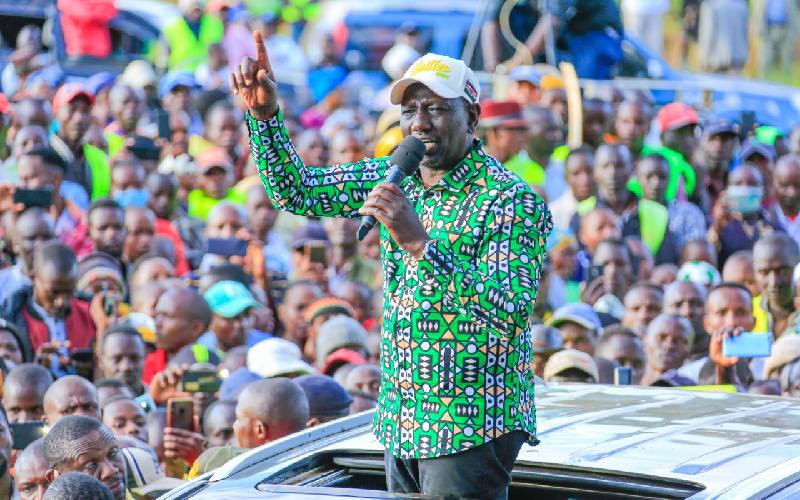
President defends his development record in Nandi, telling rivals that anti-government slogans will not win them the 2027 election.
President William Ruto has challenged Kenya’s opposition to move beyond anti-government slogans and convince voters that it has practical solutions to the country’s economic and governance challenges, sharpening the political contest ahead of the August 2027 election.
Speaking in Tinderet, Nandi County, on Monday, October 12, Ruto dismissed chants calling for his removal from office and argued that his administration’s record on development would give him an advantage when Kenyans return to the ballot.
“I’m ready to stand before Kenyans and show them the work I have done so that they can give me another chance to work,” the President said, according to remarks reported during his North Rift tour.
He accused his critics of acting out of what he called “raw jealousy” rather than offering credible alternatives to his policies.
The remarks underline Ruto’s emerging re-election message: that voters should judge his administration by the projects it has delivered and the services it has expanded, rather than the political criticism directed at State House.
But that argument also places the government’s development record under greater scrutiny, as Kenyans weigh official promises against the cost of living, access to healthcare, employment opportunities and the delivery of public services.
Ruto puts development record at the centre of his campaign
The President cited the fertiliser subsidy programme, affordable housing, road construction, rural electrification and the expansion of universal health coverage as evidence of his administration’s work.
He argued that opposition leaders had focused too heavily on slogans such as “One Term” and “Kasongo Must Go”, instead of explaining how they would address the problems facing ordinary Kenyans.
At a rally in Tinderet, he challenged his rivals to develop policies that could compete with the government’s agenda.
The approach fits into a wider political strategy in which Ruto has used development tours to promote government projects while engaging residents across different regions.
His latest tour covers six North Rift counties: Trans Nzoia, Uasin Gishu, Nandi, Elgeyo Marakwet, West Pokot and Baringo. The itinerary includes visits to roads, markets, health facilities, affordable housing developments and electricity projects ahead of Mashujaa Day on October 20.
The programme is intended to showcase government activity in a region that will host this year’s national celebrations in Eldoret.
However, the existence of a project does not, on its own, establish its impact. The condition of completed roads, the affordability of housing, the accessibility of healthcare and the benefits reaching local households will remain important measures of delivery.
SHA figures put healthcare claims in focus
Ruto also pointed to the Social Health Authority (SHA), saying 33 million Kenyans had registered under the new health financing system.
The figure highlights the administration’s emphasis on expanding enrolment as part of its healthcare reforms. However, registration numbers alone do not show how effectively the system is meeting patients’ needs.
In an update published on June 12, 2026, the Ministry of Health reported that 31.39 million Kenyans had registered with SHA. The ministry also reported KSh147.37 billion in claims paid and 11,034 contracted health facilities at that time.
The figures are a useful benchmark, although they reflect the position reported in June rather than the latest possible total. The President’s claim of 33 million registrations would need to be assessed against a newer official update to establish the precise progress since then.
For households, the central question is whether registration translates into accessible treatment, reliable services and manageable medical expenses.
The same scrutiny applies to the other projects cited by the President. Roads, markets, electricity connections and housing schemes must ultimately be assessed by their quality, completion, cost and effect on residents’ livelihoods.
Opposition faces its own test ahead of 2027
The President’s challenge comes as opposition leaders seek to build a united front against his re-election bid.
A common candidate could help the opposition consolidate support, but reaching agreement on a flagbearer remains a major political test. Leaders with presidential ambitions must find a way to manage competition within their ranks while agreeing on a shared programme.
The opposition also faces a challenge beyond choosing a candidate: explaining what it would do differently if elected.
Criticism of government policy can raise legitimate concerns, but a credible alternative would need to set out clear proposals on taxation, public debt, jobs, healthcare, agriculture and the cost of living. It would also need to explain how those proposals would be funded and implemented.
Equally, Ruto’s criticism does not settle the question of whether his administration has adequately addressed those concerns. Voters will be able to assess the government’s record independently of the President’s characterisation of his opponents.
The coming months will therefore test both sides. The government must demonstrate that its programmes are delivering tangible benefits, while the opposition must show that it can turn public discontent into a coherent political alternative.
North Rift tour builds towards Mashujaa Day
Ruto began the regional tour in Endebess, Trans Nzoia County, on Saturday, October 10. The programme is scheduled to continue across the six counties before culminating in the national Mashujaa Day celebrations at Kipchoge Keino Stadium in Eldoret on October 20.
The tour combines project inspections and commissioning ceremonies with public rallies, giving the President an opportunity to highlight his administration’s work in the run-up to the national event.
The political significance is difficult to separate from the development agenda. With the 2027 election approaching, public appearances provide a platform for the President to defend his record and reinforce his message to voters.
His challenge to the opposition is straightforward: slogans alone are not a governing programme.
The test for the President, however, is just as clear. By the time Kenyans vote, they will expect more than announcements and campaign promises. They will want evidence that the projects highlighted by the government have improved their lives.
You may also like
Category: Politics · Related Topic: William Ruto
Related Video: What Dangote’s proposed Lamu oil refinery could mean for East Africa
Related Explainer: Kenya’s inflation holds near 30-month high as transport and food costs squeeze households
About the Author
Maureen Onyango is a journalist passionate about storytelling, life coaching and spiritual lessons. She studied at the Kenya Institute of Management and enjoys telling stories that inform, inspire and empower communities.
 Facebook
 Twitter / X
 WhatsApp
 LinkedIn
 Telegram
 Reddit