
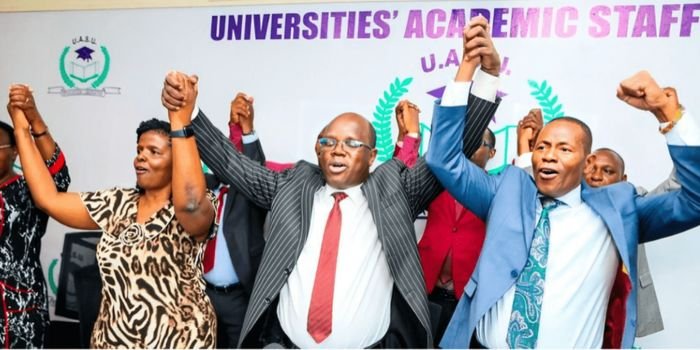
Students face further disruption as UASU and KUSU reject the government’s latest proposal, insisting that the dispute requires a binding agreement on pay and working conditions.
University students across Kenya face more uncertainty after talks between the government and lecturers’ unions collapsed on Monday, October 12, with the unions rejecting a reported KSh12 billion offer to end the nationwide strike.
The Universities Academic Staff Union (UASU) and the Kenya Universities Staff Union (KUSU) say the proposed amount does not adequately address their demands over the 2025–2029 Collective Bargaining Agreement (CBA) and other outstanding employment issues.
UASU Secretary-General Constantine Wasonga described the government’s counteroffer as insufficient and said the union had rejected it.
“The counteroffer from the government is awfully inadequate, and we have rejected it in total,” Wasonga said.
The breakdown means there is no confirmed date for lecturers to return to classrooms, extending a dispute that has disrupted teaching and other operations at public universities since October 2.
The latest setback also raises questions about why previous negotiations have failed to produce an agreement that both sides can accept.
Why the Sh12 billion offer failed
At the centre of the dispute is the proposed CBA covering university staff for the 2025–2029 period.
The unions want the agreement negotiated and implemented through a formal process, rather than having their employment terms determined by proposals they consider inadequate.
UASU has also raised concerns about the government’s failure to provide a satisfactory financial counterproposal for the new agreement. The union says it has been waiting for clear commitments on how the deal will be funded.
Before the strike began, UASU rejected a proposed allocation of KSh9.76 billion, arguing that it was insufficient for a four-year agreement. The reported KSh12 billion offer represents a later proposal, but the unions have again declined to accept the government’s terms.
The disagreement is therefore not simply about whether money has been offered. It is also about the amount required, the terms to be negotiated and the government’s ability to honour the final agreement.
UASU says university councils, the Ministry of Education and the National Treasury have also failed to honour a return-to-work formula signed on November 5, 2025.
The unions want a settlement that addresses these outstanding matters and provides clear commitments on implementation.
Government says previous arrears have been cleared
The Ministry of Education has maintained that it has taken steps to address longstanding grievances involving earlier CBAs.
Education Cabinet Secretary Julius Ogamba said on October 5 that arrears under the 2017–2021 and 2021–2025 agreements had been cleared. He urged lecturers to resume work and allow negotiations over the current agreement to continue.
“As we speak today, all arrears under the 2017–2021 and 2021–2025 CBAs have been fully cleared,” Ogamba said.
He also said the government remained committed to negotiating and concluding the 2025–2029 agreement.
However, the government’s position on historical arrears has not resolved the current dispute. The unions are demanding progress on the new CBA and other employment issues, while the government must establish a financial arrangement it can implement.
The two sides therefore remain divided over what constitutes an adequate settlement and which outstanding commitments must be resolved before lecturers return to work.
Students bear the cost of the stalemate
While the government and the unions negotiate, students are among those most directly affected.
Interrupted lectures can delay coursework, examinations, graduation dates and the completion of academic programmes. Students who live in university hostels or rented accommodation may also continue paying living expenses while teaching remains suspended.
Those approaching graduation or preparing for professional opportunities face additional uncertainty if academic calendars are revised.
The disruption also affects universities, which must manage interrupted teaching schedules and plan how to recover lost academic time once the strike ends.
There is no confirmed nationwide resumption date following Monday’s failed talks.
The Ministry of Education’s Principal Secretary for Higher Education, Beatrice Inyangala, previously said the government wanted students back in class as soon as possible but would not announce a date before the outstanding issues were resolved.
That position reflects the difficulty of promising a quick return to normal operations while negotiations remain unsettled.
A second round of talks fails to break the deadlock
The collapse on Monday follows an earlier unsuccessful meeting on October 8, when representatives of the unions, the Inter-Public Universities Councils Consultative Forum and the Ministry of Labour failed to reach an agreement.
At the time, Wasonga said the government needed to consult before presenting a counteroffer.
The latest meeting was expected to move the process forward, but the reported Sh12 billion proposal did not secure the unions’ approval.
UASU has maintained that its members will not resume teaching until an acceptable agreement is reached and signed.
The Kenya Universities Staff Union is also part of the industrial action. Members of the Kenya Union of Domestic, Hotels, Educational Institutions, Hospitals and Allied Workers (KUDHEIHA), which represents other university employees, have also been involved in the wider dispute.
The participation of different staff groups adds pressure on university managements to find a settlement that addresses the concerns affecting their employees.
What must happen before lecturers return?
The immediate challenge is for the government and the unions to agree on the financial terms of the CBA and establish how the commitments will be implemented.
A settlement would need to address the unions’ concerns without creating commitments the government cannot meet. It would also need to be clear enough to prevent another dispute over the same issues.
For students, the priority is a credible agreement that allows teaching to resume and provides a realistic plan for recovering lost academic time.
For lecturers, the question is whether the government will make commitments that satisfy their demands and can be honoured in practice.
The failed talks have shown that a substantial financial offer alone may not be enough to end the strike. Until both sides agree on the terms and implementation of a settlement, thousands of students remain uncertain about when their studies will return to normal.
Category: Education
Related Video: What Dangote’s proposed Lamu oil refinery could mean for East Africa
Related Explainer: Kiharu Technical College September Intake 2026: Courses, Skills and New Opportunities
About the Author
Maureen Onyango is a journalist passionate about storytelling, life coaching and spiritual lessons. She studied at the Kenya Institute of Management and enjoys telling stories that inform, inspire and empower communities.
 Facebook
 Twitter / X
 WhatsApp
 LinkedIn
 Telegram
 Reddit