
Former Deputy President promises to make sacrifices for opposition unity, but the battle over who will face William Ruto remains unresolved.
Rigathi Gachagua believes the opposition’s biggest breakthrough ahead of Kenya’s 2027 General Election will come when its leaders finally agree on one presidential candidate. The challenge is ensuring that those competing for the ticket are willing to accept the same choice.
The Democracy for the Citizens Party (DCP) leader has promised to put aside personal ambitions if necessary to help unite opposition leaders behind a single candidate to challenge President William Ruto.
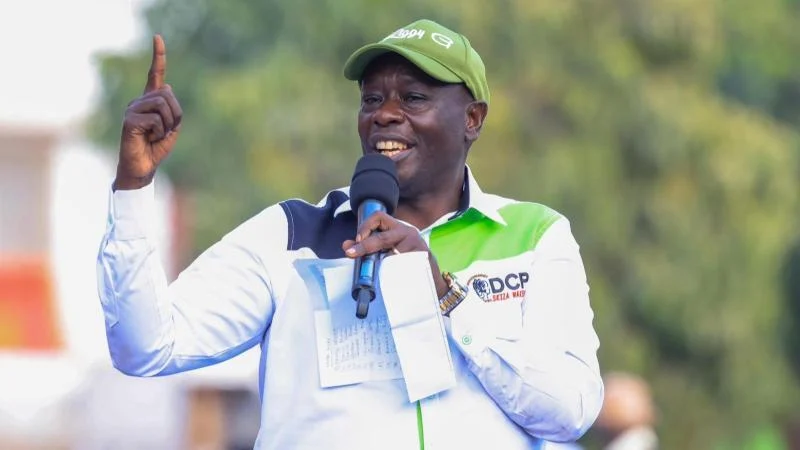
Speaking to Kenyans during a church service in Dracut, Massachusetts, in the United States, on Sunday, October 11, Gachagua expressed confidence that the eventual flagbearer would win broad public support.
“I want to assure the people, the candidate we shall pick, you people will be happy. And the day we announce that candidate, the elections will be won that day,” he said.
The former Deputy President’s remarks were a renewed appeal for unity at a time when opposition leaders are yet to settle the question of who should lead their campaign.
His promise to make sacrifices is significant because he is himself a potential presidential contender. Supporting a rival would require him to convince his supporters that unity matters more than his individual ambition.
Gachagua has previously said he considers himself well placed to lead the opposition but would support another candidate if that is the agreement reached by the group.
The unresolved question is whether the other leaders, and their supporters, will make the same commitment when the negotiations become more difficult.
The candidate question threatens opposition unity
The opposition’s efforts to build a common front have brought together several political figures with different ambitions, support bases and ideas about how to challenge Ruto.
Among the leading names are Wiper leader Kalonzo Musyoka, former Interior Cabinet Secretary Fred Matiang’i, Gachagua and Nairobi Senator Edwin Sifuna. Narc Kenya leader Martha Karua and other opposition figures are also part of the wider political debate.
But agreeing that the opposition needs one candidate is easier than deciding who that person should be.
Recent reporting has highlighted competing positions among political camps, with allies of different leaders pressing for their preferred candidates. The emergence of Sifuna as a potential contender has also added a generational dimension to the contest, challenging the assumption that the ticket will automatically go to one of the more established opposition figures.
A Politrack Research Team survey published by The Star on October 1 placed Sifuna at 19.6 per cent among presidential preferences, followed by Kalonzo at 10.3 per cent, Matiang’i at 7.2 per cent and Gachagua at 6 per cent. President Ruto led the overall presidential preference figures with 45.1 per cent.
The poll was conducted between September 15 and 25, 2026. These figures represent respondents’ preferences at that time, not a prediction of the eventual election result or a guarantee of how voters would behave if the opposition united behind one candidate.
The findings nevertheless illustrate the challenge facing opposition leaders. Several politicians have a constituency to protect, and each will need to decide whether a joint ticket offers a better chance of victory than pursuing an individual campaign.
For Gachagua, the task is to persuade both leaders and their supporters that a shared candidate is worth the personal and political compromises involved.
Gachagua turns to the 2002 election for lessons
To reinforce his argument, Gachagua invoked the 2002 General Election, when opposition parties rallied behind Mwai Kibaki to challenge the ruling Kenya African National Union (KANU).
Kibaki was selected as the opposition’s joint presidential candidate under the National Rainbow Coalition (NARC). He went on to win the December 2002 election with approximately 62.2 per cent of the presidential vote, ending KANU’s long hold on power.
Gachagua argued that the scepticism now surrounding opposition unity resembles the doubts that preceded that election.
“I want to tell that MP, the way he is talking is the same way people were talking in 2002,” he said, referring to criticism that the current opposition would fail to agree on a candidate.
The comparison offers the opposition an example of how political cooperation can change an election. It does not, however, guarantee a repeat of the outcome.
The political circumstances of 2002 differed from those facing Kenya today. The opposition must now navigate a different field of parties, personalities and voter concerns, while convincing supporters that its alliance has a clear purpose beyond defeating the incumbent.
In 2002, the NARC coalition brought together influential political figures and parties behind Kibaki. Its victory demonstrated the electoral value of coordination, but it also showed that winning together requires political negotiations and an ability to manage competing interests.
For the current opposition, the lesson is not simply to announce a candidate. It is to build an agreement that can survive the pressures of campaigning.
Naming a candidate is only the first test
Gachagua’s declaration that the election will effectively be won on the day the candidate is announced sets a high bar for the opposition’s selection process.
A joint candidate could help prevent competing opposition campaigns from dividing their support. But the announcement alone would not resolve questions about campaign leadership, the distribution of political roles, regional support or the policies the coalition would present to voters.
The opposition would also need to explain what it intends to change if it takes power, including its approach to taxation, public debt, employment, healthcare and the cost of living.
For voters, a united ticket may offer a clearer choice. Yet unity without a credible policy programme could leave important questions unanswered.
The coalition would also have to demonstrate that the candidate enjoys support beyond the political circles negotiating the deal. A decision reached by party leaders is not necessarily the same as a decision embraced by their supporters.
The process of choosing a flagbearer will therefore be an important test of whether the opposition can turn its shared desire to defeat Ruto into a workable political alliance.
Ruto remains the target as 2027 approaches
President Ruto is seeking another term in the August 2027 election. The opposition’s central calculation is that a common candidate would present a stronger challenge than several leaders campaigning separately.
Gachagua’s latest remarks seek to reassure supporters that the leaders understand the stakes and will eventually reach an agreement.
He has also urged Kenyans living abroad to continue supporting and praying for the opposition as it works towards a common ticket.
But assurances of unity will ultimately be judged against decisions. Opposition leaders will have to demonstrate that they can settle their differences, agree on a candidate and persuade supporters to rally behind that person.
The 2002 election provides a historical example of what a united opposition can achieve. Whether the current group can reproduce that success will depend on more than a declaration of confidence.
For now, Gachagua is making a promise: the opposition will have one candidate. The harder task is ensuring that everyone who wants the ticket is prepared to stand behind the person who gets it.
You may also like
Category: Politics · Related Topic: William Ruto
Related Video: Murkomen Says Kenya Is Safe: “Stop Creating a Crisis” | Political Goons & Security Under Scrutiny
Related Explainer: Kenya’s inflation holds near 30-month high as transport and food costs squeeze households
About the Author
Maureen Onyango is a journalist passionate about storytelling, life coaching and spiritual lessons. She studied at the Kenya Institute of Management and enjoys telling stories that inform, inspire and empower communities.
 Facebook
 Twitter / X
 WhatsApp
 LinkedIn
 Telegram
 Reddit