
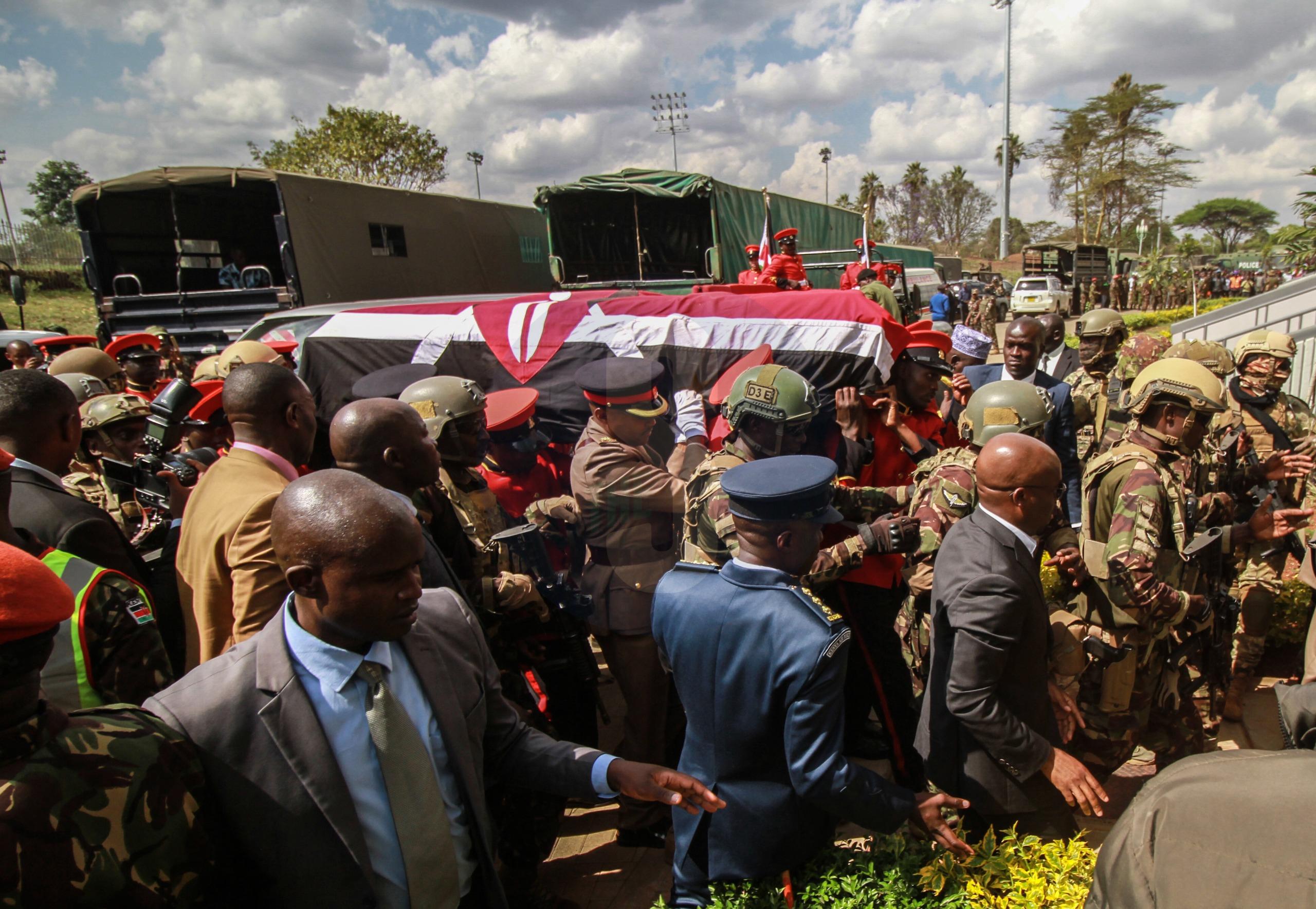
A year after three mourners were killed at Raila Odinga’s farewell, a BBC investigation has placed the victims far from the clashes and raised fresh questions about police use of lethal force.
Three Kenyans went to Kasarani Stadium to mourn former Prime Minister Raila Odinga. They never made it home.
Now, a BBC Africa Eye investigation has reconstructed the fatal shootings that disrupted the public viewing of Odinga’s body on 16 October 2025. Its findings raise serious questions about the police response and the accountability process that followed.
The BBC reviewed more than 1,500 photographs and videos, examined post-mortem evidence and interviewed relatives of the victims. It concluded that the three people killed were not part of the confrontation near the VIP pavilion that preceded the gunfire.
The investigation also traced the movements of officers from a specialist police unit responsible for protecting the President. At least three officers identified as members of the unit appear to fire their weapons in the footage examined by the BBC.
However, the investigation could not determine which bullets killed each victim. It also could not rule out the possibility that other officers fired the fatal shots. The findings do not amount to a judicial determination of individual responsibility.
Victims were far from the confrontation
The three victims were Evans Kiche, a 40-year-old chef and father of seven; Vincent Ogutu, 36, a father of three; and Jidah Burka, 42.
According to the BBC’s reconstruction, Kiche was about 60 metres from the confrontation when he was shot in the head. Ogutu and Burka were at least 160 metres away, in stands on the opposite side of the stadium.
Post-mortem reports reviewed by the BBC recorded a gunshot wound to Ogutu’s chest and a fatal head wound to Burka.
The distances are significant because they challenge any suggestion that the three victims were directly involved in the violence near the VIP pavilion. They do not, on their own, establish who fired the shots or the circumstances surrounding each death.
The BBC’s findings also highlight the difficulty of explaining how gunfire near a restricted section of the stadium resulted in the deaths of mourners elsewhere in the venue.
What happened at Kasarani?
Odinga died in India on 15 October 2025, aged 80, while receiving medical treatment. His death prompted an outpouring of grief, with thousands of Kenyans gathering to accompany his body from Jomo Kenyatta International Airport and pay their last respects.
The public viewing was moved to Kasarani at short notice after the crowds exceeded expectations and officials faced security concerns.
Thousands waited for hours at the stadium. The BBC reported that there was no public address system to provide regular updates, while mourners endured the heat as they waited for the ceremony to proceed.
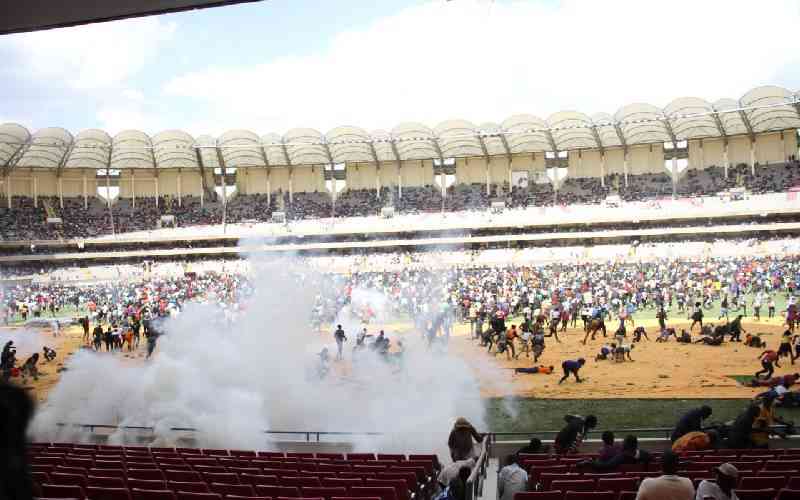
Tensions later escalated near the VIP pavilion. Some people attempted to push into the restricted area, and objects, including plastic chairs, were thrown towards officers.
Police fired live rounds as the situation deteriorated. The gunfire and efforts to disperse the crowd triggered panic inside the stadium.
The BBC’s analysis found that footage showed objects being thrown but provided no evidence that the objects included stones, contrary to the account given by Interior Cabinet Secretary Kipchumba Murkomen.
The distinction matters because the justification for using force must be assessed against what officers faced, the threat they were responding to and whether their actions were proportionate.
Murkomen defends officers’ response
Murkomen told the BBC that officers had been under considerable pressure. They had worked for long hours and were deployed to a venue that had been selected at short notice.
He defended the response as restrained and suggested that the decision to fire was made by an officer in the heat of the moment, rather than following a direct order.
“I don't think… somebody [was] sitting there and saying: 'Shoot now'. It is the judgment of the police officer at the spur of the moment,” he told the BBC.
The National Police Service also acknowledged the need to learn from the incident. In a response to the BBC, it said the events had provided lessons for more professional policing in future.
Those explanations offer the authorities’ account of the operational pressures facing officers. But they do not settle the central questions raised by the BBC’s reconstruction: which officers fired, whether the use of lethal force was justified and who, if anyone, should be held responsible.
The presidential protection link
The BBC identified at least eight officers moving together in tactical clothing and camouflage. They carried assault rifles, had their faces covered and displayed no visible identifying insignia.
Their clothing and movements were consistent with a security team assigned to protect the President and other senior officials before and after the shooting, the investigation found.
The BBC identified three of the officers as members of the specialist unit responsible for presidential protection. At least three members of that group appear to fire their weapons in the footage.
This is a significant finding because the unit’s role is to protect senior officials, not to determine criminal responsibility for the deaths. The footage, as analysed by the BBC, raises questions about the actions of officers present during the incident, but it does not establish which individual fired the rounds that killed the three mourners.
That distinction will be crucial to any formal investigation and any decision on possible criminal or disciplinary action.
Families still waiting for answers
For the families, the passage of time has not eased the uncertainty surrounding the deaths.
Yvonne Akinyi, Ogutu’s widow, told the BBC that the people expected to protect the public had instead caused her family profound pain.
She said her husband’s death had left their children without their father and described the lasting emotional toll on the family.
The BBC reported that the Independent Policing Oversight Authority (IPOA) was still investigating the deaths and the police response almost a year after the incident. No officer had been held accountable at the time of the report.
IPOA did not respond to the BBC’s request for comment. Murkomen said the government expected the authority’s findings to guide appropriate legal action.
The status of the inquiry is therefore central to what happens next. The BBC’s findings may provide material for investigators to examine, but they do not replace the need for an independent investigation that establishes the facts and identifies individual responsibility where the evidence supports it.
A wider test of police accountability
The Kasarani shootings have renewed scrutiny of how police manage large public gatherings, particularly when crowd pressure and security concerns collide.
Officers have a duty to protect life and maintain order. At the same time, the use of firearms must be justified by the circumstances and consistent with the law. Where people die during a police operation, the public has a legitimate interest in knowing what happened and whether the response was lawful.
The BBC’s reconstruction adds detail to an incident that shocked mourners at a national farewell. It challenges the idea that the three victims were close to the confrontation and raises questions about the actions of a specialist security unit.
But the investigation leaves an important gap: it has not established which officers fired the fatal bullets.
That is where the official inquiry must now provide answers. For the families of Kiche, Ogutu and Burka, and for a public still seeking accountability, the decisive test will be whether the evidence leads to clear findings and, where warranted, legal action.
You may also like
Category: News
Related Video: What Dangote’s proposed Lamu oil refinery could mean for East Africa
Related Explainer: Why the BCG Vaccine Leaves That Small Scar on Your Arm
About the Author
Maureen Onyango is a journalist passionate about storytelling, life coaching and spiritual lessons. She studied at the Kenya Institute of Management and enjoys telling stories that inform, inspire and empower communities.
 Facebook
 Twitter / X
 WhatsApp
 LinkedIn
 Telegram
 Reddit