
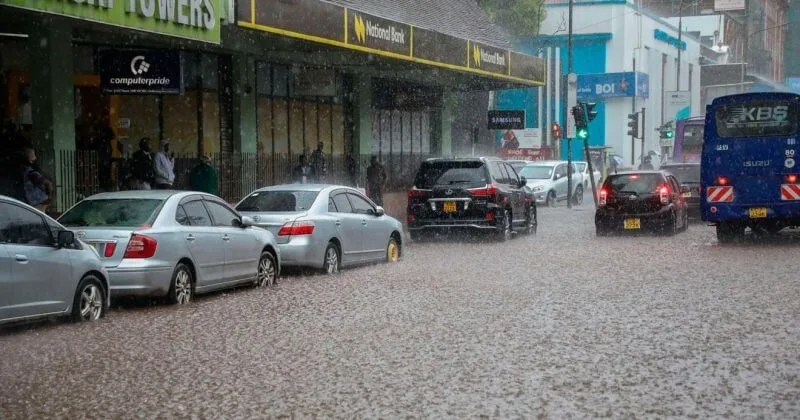
Kenya’s weather forecasters are urging the public not to assume that a powerful El Niño will automatically bring heavy rain everywhere in the country. But the message is not a reason to relax: Kenya’s latest seasonal outlook points to enhanced rainfall across much of the country during the October–December short rains.
The Kenya Meteorological Department says the impact of El Niño depends on how it interacts with other climate systems, including the Indian Ocean Dipole, prevailing winds and wider atmospheric conditions.
That distinction matters as Kenya enters a critical rainy season. Some areas could experience prolonged wet spells and intense storms, while others may receive less rain or see it spread unevenly across the season.
In a clarification shared on Friday, October 9, Kenya Met said the strength of an El Niño event alone cannot determine how much rain Kenya will receive.
“El Niño does not mean rainfall, and the strength of an El Niño event doesn’t directly determine how much rain we receive in Kenya. A strong El Niño does not automatically mean heavy rainfall,” the department stated.
The warning is about how forecasts should be understood, not a dismissal of the current rainfall risk.
What Kenya’s latest rainfall forecast says
Kenya Met’s October–December 2026 seasonal outlook anticipates enhanced rainfall across much of the country. The forecast also warns of prolonged wet periods and occasional isolated storms in several areas.
The department expects rainfall to vary by location. Some areas are likely to receive above-average totals, while Turkana and Samburu are among the places where rainfall distribution is expected to be less favourable.
The regional outlook from the IGAD Climate Prediction and Applications Centre (ICPAC), released in August, also points to a greater likelihood of wetter-than-normal conditions across parts of the Greater Horn of Africa. It highlighted the influence of both El Niño and a positive Indian Ocean Dipole.
These forecasts provide a basis for preparation, but they are not guarantees of specific rainfall totals or daily weather conditions. Seasonal outlooks describe the likelihood of conditions over a period; shorter-range forecasts are needed to understand when and where particular downpours may occur.
Sources: Kenya Met’s official seasonal forecast and ICPAC’s regional outlook for October–December 2026.
Why El Niño does not tell the whole story
El Niño is a recurring climate pattern marked by warmer-than-usual sea-surface temperatures in the central and eastern tropical Pacific Ocean. It changes atmospheric circulation and can shift rainfall patterns around the world.
Its effects are not identical in every country or season. In East Africa, rainfall is also influenced by conditions in the Indian Ocean, including the Indian Ocean Dipole, which reflects differences in sea-surface temperatures across the ocean.
These systems can reinforce one another, increasing the likelihood of wetter conditions. At other times, their effects may differ, changing how much moisture reaches a particular area.
Prevailing winds and other weather systems also influence where rain-bearing clouds form and move. This helps explain why one county can experience heavy rainfall while another receives much less, even during the same season.
The US National Oceanic and Atmospheric Administration’s Climate Prediction Center reported on October 8 that El Niño was continuing to strengthen, with a strong-to-very-strong event likely to persist into early 2027. That assessment describes the Pacific climate pattern; it does not, by itself, establish how much rain will fall in any Kenyan county.
Source: NOAA Climate Prediction Center.
What this means for households and farmers
For residents, farmers and businesses, the practical question is not simply whether El Niño is present. It is what the latest local forecast says about rainfall, and whether there is a risk of flooding, landslides, transport disruption or damage to crops and property.
Farmers should use current local forecasts when making decisions about planting, harvesting, drainage and protecting livestock. Residents in flood-prone or landslide-prone areas should pay attention to official warnings and follow instructions from local authorities.
People should also avoid treating a forecast of above-average seasonal rainfall as a prediction that every day will be wet. Rainfall can be uneven, with dry intervals between intense downpours.
Kenya Met says it is monitoring the interaction between El Niño and other climate drivers as the season progresses. It has also reported that parts of the country are already receiving rain, with more expected as the season develops.
The department advises the public to follow its regular forecasts and updates for their specific areas rather than relying on assumptions about El Niño alone.
The bottom line: El Niño does not guarantee heavy rainfall in every part of Kenya. But with the current seasonal outlook pointing to enhanced rains across much of the country, the sensible response is to prepare for local risks and keep checking official updates.
You may also like
Category: News
Related Video: Dolly Parton’s Family Announces Her Passing in Emotional Tribute
Related Explainer: Explainer: Why Kenya is moving hospitals to HMIS and what it means for SHA patients
About the Author
Maureen Onyango is a journalist passionate about storytelling, life coaching and spiritual lessons. She studied at the Kenya Institute of Management and enjoys telling stories that inform, inspire and empower communities.
 Facebook
 Twitter / X
 WhatsApp
 LinkedIn
 Telegram
 Reddit