
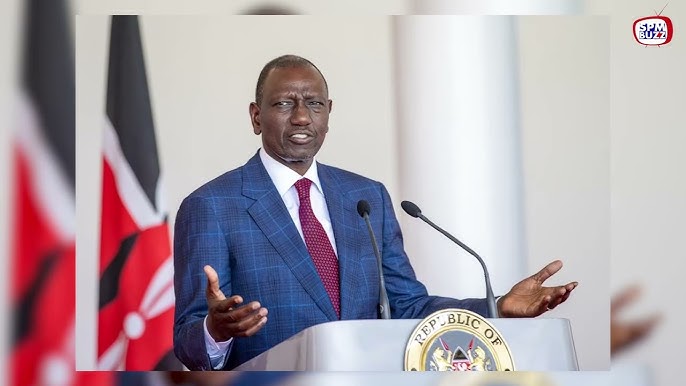
President William Ruto has acknowledged the constitutional legitimacy of the 2024 Gen Z protests, saying young Kenyans were exercising their right to demand accountability and a greater voice in the running of the country.
Speaking at the Katiba Day 2026 symposium in Nairobi on Thursday, August 27, Ruto said the demonstrations should not simply be viewed as a challenge to the State.
Instead, he described them as an important test of Kenya's constitutional democracy.
“During the protests of 2024 and those that followed, young Kenyans and other citizens exercised their constitutional freedoms to speak, assemble, demonstrate, picket, and petition public authorities. Their message was clear. They wanted to be heard,” Ruto said.
His remarks come two years after the protests against the Finance Bill 2024 grew into a broader youth-led movement over taxation, the cost of living, governance and accountability.
The demonstrations began largely peacefully but became increasingly violent in some areas, particularly after June 25, 2024, when protesters stormed Parliament.
Ruto: Protest is a constitutional right
Ruto pointed to Article 37 of the Constitution, which guarantees every person the right, peaceably and unarmed, to assemble, demonstrate, picket and petition public authorities.
He said that right must have practical meaning.
“No Kenyan should lose their life, liberty or dignity merely for criticising the government, expressing an unpopular opinion or participating in a peaceful demonstration,” the President said.
“That protection must be real.”
The statement marks a notable acknowledgement of the constitutional questions raised by the protests, particularly around how security agencies respond to dissent.
But Ruto also drew a line between lawful protest and criminal conduct.
He said the Constitution protects peaceful and unarmed demonstrations, but does not shield looting, violence, intimidation or destruction of public and private property.
“Rights and responsibilities are not enemies. Responsibility protects the conditions in which everyone’s rights can be enjoyed,” he said.
Human rights violations remain a major unresolved issue
Ruto's comments also recognised the darker side of the protests.
He said some families were still living with the loss of loved ones and referred to allegations of unlawful arrests, enforced disappearances and excessive use of lethal force.
“We cannot honour the Constitution by looking away from such allegations,” he said.
The President called for credible allegations of rights violations to be investigated independently, thoroughly and transparently.
Those concerns are supported by findings from the Kenya National Commission on Human Rights (KNCHR), which documented widespread rights violations during the 2024 demonstrations.
The Commission recorded 1,376 arbitrary arrests and 74 cases of enforced or involuntary disappearance between June and November 2024. It also documented hundreds of injuries, including cases involving gunshot wounds.
In an update issued during the protests, KNCHR said the demonstrations had largely started peacefully but later became violent, while also accusing security officers of using excessive and disproportionate force.
At the same time, the Commission documented violence and destruction of property by some protesters, including damage to government buildings and other facilities.
The competing realities have remained central to the debate over the 2024 protests: the constitutional right to demonstrate on one hand, and the obligation to prevent violence and protect life and property on the other.
The protests changed Kenya's political conversation
The 2024 demonstrations began with opposition to the proposed Finance Bill, which contained tax measures that young Kenyans and other citizens strongly opposed.
The movement quickly expanded beyond the Bill.
Young protesters demanded greater accountability, questioned government spending and called for political leaders to listen to citizens.
The pressure eventually contributed to President Ruto declining to sign the Finance Bill 2024 after withdrawing it.
The protests also pushed issues such as police accountability, public debt, taxation and the cost of living to the centre of national debate.
Two years on, Ruto said the lesson should not be that Kenya has to choose between freedom and order.
Instead, he argued that the two should reinforce each other.
A test of Kenya's constitutional promise
The President said Kenya's challenge is to build an orderly society without suppressing legitimate dissent.
“Our national task is not to choose between liberty and order,” he said, “but to build an order founded on liberty.”
That argument will remain particularly relevant as Kenya heads towards the 2027 General Election, when political competition and public demonstrations are likely to intensify.
The experience of 2024 has already exposed the risks on both sides.
For citizens, the Constitution promises a right to speak, assemble and challenge government.
For the State, that right comes with a duty to protect citizens while responding lawfully to criminal acts.
But the experience of the past two years has also left another question hanging over Kenya's constitutional journey: whether the institutions responsible for protecting those rights can be trusted to enforce them consistently.
KNCHR's more recent assessments suggest that concerns over police accountability and civic freedoms have not disappeared. In its 2025 human rights assessment, the Commission continued to report concerns about excessive use of force, arbitrary detention and other violations.
Ruto's Katiba Day message therefore comes with a significant test.
It is not enough to recognise the right to protest in speeches.
The real measure, for many Kenyans, will be what happens when citizens exercise that right again.
You may also like
Category: News · Related Topic: William Ruto
Related Video: Dolly Parton’s Family Announces Her Passing in Emotional Tribute
Related Explainer: Kiharu Technical College September Intake 2026: Courses, Skills and New Opportunities
About the Author
Maureen Onyango is a journalist passionate about storytelling, life coaching and spiritual lessons. She studied at the Kenya Institute of Management and enjoys telling stories that inform, inspire and empower communities.
 Facebook
 Twitter / X
 WhatsApp
 LinkedIn
 Telegram
 Reddit