
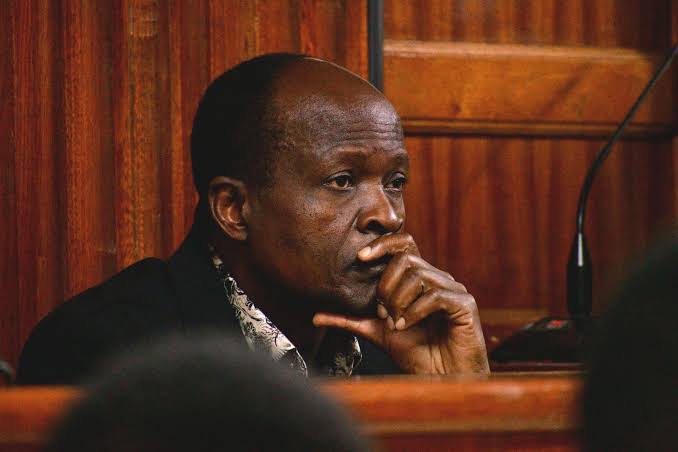
Former Migori Governor Okoth Obado is asking the High Court for leniency after being found guilty of murdering Rongo University student Sharon Otieno, arguing that his age, health and the nearly eight-year trial should be taken into account when he is sentenced.
Obado is seeking a non-custodial sentence, according to a pre-sentence social inquiry report presented to the court. He also told probation officers that he remains willing to support Sharon’s family and take part in reconciliation efforts.
The plea comes less than a month after Justice Cecilia Githua convicted Obado, alongside his former personal assistant Michael Oyamo and former Migori County clerk Caspal Obiero, following one of Kenya’s most closely watched murder trials.
The three were convicted on July 23 after the court found that the prosecution had proved its case beyond reasonable doubt.
Obado points to age, health
In his interviews with probation officers, Obado maintained that he was not involved in Sharon’s killing, despite the court’s finding against him.
He said he respected the judgment but disagreed with the conclusion that he participated in the murder.
He nevertheless expressed remorse over Sharon’s death and said he was prepared to support her family.
The report also cites his health as a factor for consideration. Obado has hypertension and reported pain around his left shoulder.
He further pointed to the length of the proceedings and the fact that he has no previous criminal convictions.
His request will now form part of the material the High Court considers before determining the appropriate sentence.
What the court found
Obado’s mitigation comes against the backdrop of a detailed judgment in which Justice Githua found that the three men acted together in the events that led to Sharon’s death.
The judge found that the prosecution had established a complete chain of circumstantial evidence linking the three to the murder.
The court concluded that Obado had a role in the planning and financing of the operation, while Oyamo and Obiero were found to have played separate roles in its execution and concealment.
The ruling marked the end of a criminal case that began after Sharon, then 26 and about seven months pregnant, was abducted in September 2018. Her body was later found in Homa Bay County.
The court’s finding was significant because Obado was not at the scene when Sharon was killed. Justice Githua nevertheless held that his involvement could be established through the evidence presented during the trial.
Obado and his co-accused had denied the murder allegations throughout the proceedings.
Sharon’s family supports leniency
In a separate part of the probation assessment, Sharon’s family told officers that it had no objection to Obado receiving a lenient sentence.
The family cited support it says Obado has provided since Sharon’s death.
It also asked that he be allowed to honour commitments and pledges he had made to Sharon’s parents. The family said fulfilling those commitments could help ease some of the financial difficulties it has faced since her death.
The position adds a striking dimension to the sentencing stage. While the court has found Obado criminally responsible for Sharon’s murder, her family has indicated that it would welcome measures that could provide practical support to her children and relatives.
A case that has taken nearly eight years
Sharon’s murder has remained in the public eye since 2018.
The trial involved 42 prosecution witnesses and extensive documentary, forensic and circumstantial evidence. The case also went through several stages before the court ultimately required Obado and his co-accused to defend themselves.
Following their conviction, Justice Githua cancelled their previous bond terms and ordered that they remain in custody as pre-sentence and victim assessment reports were prepared.
The sentencing process will therefore consider two very different sides of the case.
The prosecution is expected to argue for a sentence that reflects the seriousness of the offence. The defence, meanwhile, will rely on mitigation, including Obado’s personal circumstances and the factors contained in the probation report.
The Office of the Director of Public Prosecutions had previously called for a sentence that reflects the gravity of the crime and serves the interests of justice.
Sentencing is the next major test
The High Court is expected to consider the probation report, the victim impact assessment, the defence mitigation and the prosecution’s submissions before deciding the sentence.
The sentencing hearing has been set for September 16, 2026.
For Sharon’s family, however, the end of the trial is unlikely to mark the end of the consequences.
Her children have grown up without their mother. Her parents and siblings have spent years attending court and living with the emotional and financial consequences of her death.
The sentencing hearing will now determine not only what punishment the three convicts receive, but also how the court weighs the circumstances of those convicted against the lasting impact of Sharon’s killing on those she left behind.
You may also like
Category: News · Related Topic: Social Health Authority (SHA)
Related Video: Gachagua’s explosive Ruto scorecard: Debt, taxes, State capture and a government ‘that has failed’
Related Explainer: Ebola contact tracing: Why the 21-day window matters in Kenya’s response
About the Author
Maureen Onyango is a journalist passionate about storytelling, life coaching and spiritual lessons. She studied at the Kenya Institute of Management and enjoys telling stories that inform, inspire and empower communities.
 Facebook
 Twitter / X
 WhatsApp
 LinkedIn
 Telegram
 Reddit