
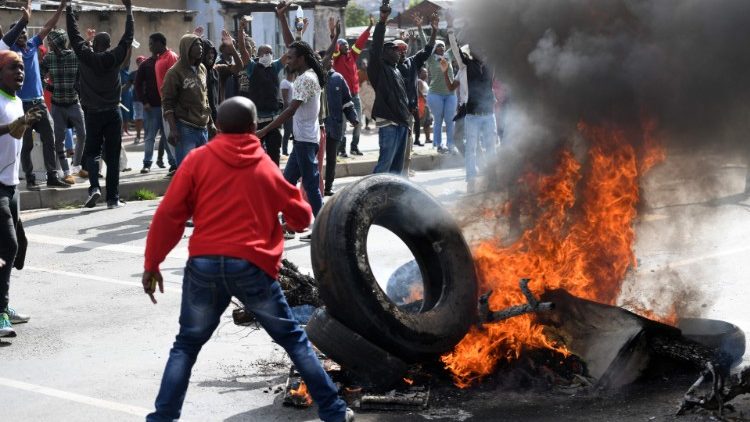
South Africa is facing renewed anti-migrant violence after protests over an asylum ruling turned into attacks on foreign-owned businesses, with vehicles set alight in Johannesburg’s Soweto township and the coastal city of Durban.
Police reported that at least 24 vehicles were torched on Thursday, 8 October, as crowds confronted foreign nationals, shops were looted and buildings damaged. The unrest has exposed how misleading claims about a court decision can inflame tensions in a country already struggling with deep divisions over immigration.
The demonstrations centred on a July ruling by South Africa’s Constitutional Court that removed legal barriers preventing some people from having their asylum applications considered. The decision has fuelled anger among anti-immigration campaigners, some of whom fear it will make it easier for undocumented migrants to remain in the country.
But the ruling does not automatically grant asylum or permanent residence. Each claim must still be assessed through the country’s asylum system.
Government officials have warned that false accounts of the judgment have distorted its meaning, while police have promised to pursue those responsible for the violence.
Durban and Soweto hit by clashes
In Durban, protesters gathered outside a government refugee reception centre, demanding that it stop accepting asylum applications. The unrest later spread into the city centre, where businesses closed their doors as police moved to disperse crowds.
Police said 14 vehicles were set alight in Durban. Three foreign nationals were arrested over an alleged assault on a protester, an incident reported to have helped trigger the violence. The circumstances surrounding the alleged assault were still being investigated.
Senior local police officer Xolani Fihla told South African public broadcaster SABC that clashes had broken out between South African nationals and foreign nationals.
In Soweto, near Johannesburg, residents gathered in Orlando West to demand the closure of small convenience shops known as spaza shops, some of which are operated by foreign nationals.
The protest escalated into attacks on businesses and vehicles. Police initially reported 10 vehicles torched in Soweto, bringing the combined toll in the two cities to 24. Some subsequent local reports gave a higher figure for Soweto, illustrating that casualty and damage assessments were still being updated.
Reports also described gunfire allegations and damage to buildings. Police said reinforcements had been deployed to prevent further violence.
Acting national police commissioner Lieutenant General Puleng Dimpane condemned the destruction and warned that those responsible would face the law.
“We will not tolerate lawlessness. We will not allow people to burn vehicles, and we will not allow people to destroy others’ property,” Dimpane said, according to local media reports.
Police have urged residents to raise their concerns through lawful channels rather than attacking people or destroying property.
What the court ruling actually says
The protests follow a Constitutional Court judgment delivered on 7 July in a case involving the Scalabrini Centre of Cape Town and the Department of Home Affairs.
The court struck down provisions of the Refugees Act that imposed procedural hurdles on some people seeking asylum. Under the invalidated rules, applicants could face barriers because they entered South Africa irregularly or failed to meet certain reporting requirements.
The court found that such procedural failures could not be used to prevent asylum claims from being considered on their merits.
The judgment does not mean that everyone who applies will be recognised as a refugee. Applicants must still undergo the relevant assessment, and the authorities retain responsibility for processing claims under the law.
The Department of Home Affairs has acknowledged that the ruling has affected operations at refugee reception centres, where more people have sought to lodge applications.
Government spokesperson William Baloyi has said the judgment has been misrepresented, creating the impression that undocumented migrants would automatically receive legal status.
The distinction matters. The right to have an asylum claim considered is not the same as being granted refugee status, citizenship or permanent residence.
Migration tensions extend beyond the court case
The violence comes amid years of hostility towards migrants in South Africa, where foreign nationals have repeatedly faced threats, attacks and displacement.
Anti-immigration campaigners often accuse migrants of taking jobs, contributing to crime and putting pressure on public services. However, these broad accusations should not be treated as established facts about migrant communities.
South Africa faces serious unemployment, poverty and inequality, problems that affect both citizens and migrants. The country remains an important destination for people seeking work, safety and better opportunities elsewhere in Africa.
The latest unrest also follows anti-immigration demonstrations earlier in 2026, when groups called for undocumented foreign nationals to leave the country. The new violence suggests that tensions over migration remain high, even as the government attempts to manage asylum applications through the courts and immigration authorities.
The history is painful. In 2008, xenophobic attacks across South Africa killed more than 60 people and displaced tens of thousands. That record underlines the danger of allowing political disputes and unverified claims to escalate into attacks on communities.
Police step up response as government faces pressure
Following Thursday’s clashes, police said they were increasing deployments in affected areas and working to identify those involved in arson, looting and assaults.
Dimpane said those responsible would be investigated and arrested where evidence supported prosecution. Authorities have also urged the public to remain calm while the government addresses concerns about the asylum process through established legal and constitutional channels.
The government faces two immediate challenges: restoring safety for residents and foreign nationals, and explaining the court ruling clearly enough to counter misinformation.
For migrants whose shops and vehicles have been targeted, the damage is immediate. For South Africa, the broader test is whether legitimate concerns about immigration can be handled through lawful policy and public debate without turning foreign nationals into targets.
You may also like
Category: International
Related Video: What Dangote’s proposed Lamu oil refinery could mean for East Africa
Related Explainer: Inside Kenya’s crude supply puzzle as Dangote prepares to break ground in Lamu
About the Author
Maureen Onyango is a journalist passionate about storytelling, life coaching and spiritual lessons. She studied at the Kenya Institute of Management and enjoys telling stories that inform, inspire and empower communities.
 Facebook
 Twitter / X
 WhatsApp
 LinkedIn
 Telegram
 Reddit