
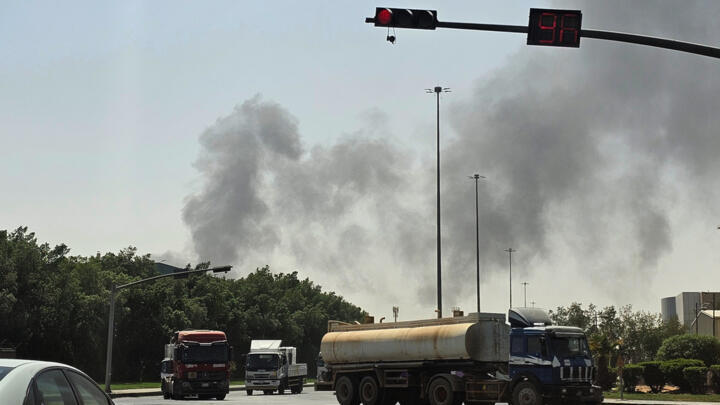
Saudi Arabia's state-owned oil company, Saudi Aramco, has suffered extensive damage to its headquarters in Dhahran following an attack attributed to Yemen's Houthi movement.
The attack, which occurred on Tuesday night, October 13, damaged several floors of an administrative building and triggered a fire that continued into the early hours of Wednesday.
Reuters reported that the fire spread across several floors of the building, with extensive damage to the upper levels.
The office area associated with Aramco chief executive Amin Nasser was among the sections reportedly affected.
Saudi Arabia's Energy Ministry acknowledged the incident but described the resulting fire as limited.
No deaths or injuries were reported.
Did the attack stop Saudi oil production?
Despite the damage to its headquarters, Aramco's operations have continued.
Some employees were instructed to work remotely, while certain functions were transferred to other company offices.
The headquarters complex contains important administrative and operational systems used to coordinate oil production, refining, pipelines and export activities.
However, damage to an administrative building does not automatically mean Saudi Arabia's oil production or exports have stopped.
There has been no confirmed shutdown of Aramco's wider production network attributable to the headquarters attack.
Why the Houthis are targeting Saudi Arabia
The attack comes amid renewed fighting between Yemen's Houthi movement and Saudi-backed Yemeni government forces.
The Houthis say their strikes are retaliation for Saudi military operations in Yemen.
They have threatened further attacks against Saudi airports and petroleum infrastructure.
The latest escalation follows a deadly strike on Riyadh's King Khalid International Airport, where 13 people were killed.
The renewed confrontation has raised concerns about civilian safety, international aviation and energy infrastructure.
Why global markets are worried
Saudi Arabia is one of the world's most important petroleum producers and exporters.
Any credible threat to its production facilities, pipelines or export terminals can increase uncertainty in international energy markets.
Shipping disruptions can also increase freight charges and insurance premiums, even when physical oil production remains unaffected.
The situation is particularly sensitive because the Middle East contains several strategically important maritime routes used to transport petroleum to international markets.
What the attack means for Kenya
Kenya imports most of its petroleum products and is exposed to international market movements.
Higher fuel-import costs can eventually affect domestic pump prices, transport expenses and the prices of goods transported over long distances.
However, it would be misleading to attribute a particular EPRA price increase solely to this attack.
Kenya's pump-price calculations reflect imported-product costs over a pricing period, foreign exchange rates, taxes and other regulated components.
The Aramco incident is therefore an additional risk to an already unsettled international energy market.
A growing humanitarian crisis in Yemen
The military escalation is also worsening conditions for civilians in Yemen.
Humanitarian agencies report that fighting has disrupted healthcare services and blocked access to essential assistance.
The World Food Programme says more than 600,000 people in Taiz have been cut off from life-saving humanitarian support.
For international policymakers, the challenge is increasingly twofold: protecting regional infrastructure while preventing further civilian suffering.
The immediate focus will be whether the conflict spreads to additional energy facilities and whether diplomatic efforts can prevent a broader regional confrontation.
You may also like
Category: International
Related Video: What Dangote’s proposed Lamu oil refinery could mean for East Africa
Related Explainer: Inside Kenya’s crude supply puzzle as Dangote prepares to break ground in Lamu
 Facebook
 Twitter / X
 WhatsApp
 LinkedIn
 Telegram
 Reddit