
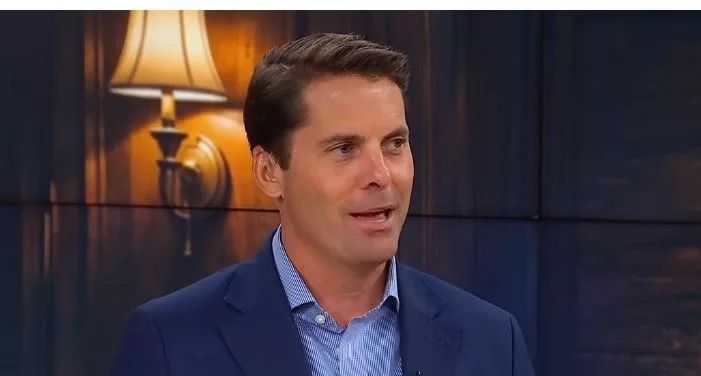
The US television presenter sparked an online backlash after using Nairobi as a negative comparison in a debate about immigration. Here is what to know about his career and the controversy.
American television host Rob Finnerty has apologised to Kenyans after comparing Nairobi to US cities he described as deteriorating because of immigration, turning a debate about American politics into an international controversy.
Finnerty, who presents a prime-time programme on the conservative-leaning Newsmax network, made the remarks during a broadcast discussion about immigration and conditions in New York City.
The comments prompted criticism from Kenyans, many of whom questioned why their capital had been singled out as an example of urban decline.
On Tuesday, October 13, 2026, Finnerty issued a public apology, acknowledging that he had misspoken.
“I want to offer an apology to the people of Nairobi, Kenya. The passion you have for your city and homeland is amazing,” he said.
“We all make mistakes. I misspoke, and I am sorry to anyone I have offended.”
The apology came after the remarks circulated widely on social media, with Kenyans challenging both the comparison and the assumptions behind it.
What did Rob Finnerty say about Nairobi?
The controversy began during an October 9 broadcast of Finnerty, his Newsmax programme.
The discussion focused on immigration under former US President Joe Biden and the impact of migration on American cities, particularly those governed by Democrats and operating under sanctuary-city policies.
Finnerty argued that immigration from developing countries had changed the character of some American urban areas.
“They move to blue sanctuary cities, and the cities then start to look more like Nairobi than New York City,” he said.
The segment also featured street interviews with people who identified themselves as being from countries including Guatemala, Bangladesh, Burkina Faso, Senegal, Mexico and Guinea.
None of the people featured in the supplied clip identified themselves as Kenyan.
That detail became a central point of criticism. Kenyans questioned why Nairobi was used as a negative benchmark in a discussion about immigration when the people interviewed were from several other countries.
Others argued that the comparison relied on a broad stereotype of African cities rather than evidence about the specific conditions being discussed in New York.
The debate also raised a wider question about how African cities are portrayed in international media, particularly when they are used as shorthand for problems such as congestion, poverty or poor public services.
Finnerty's remarks were part of a political argument about immigration in the United States. However, critics said the reference to Nairobi carried implications beyond that domestic debate.
Why did Kenyans react so strongly?
The backlash was fuelled by more than the mention of Nairobi.
For many Kenyans, the comparison suggested that an African capital was an appropriate symbol of urban decline, without explaining which aspects of the city were being referenced or providing evidence to support the claim.
Others pointed to Nairobi's role as a regional centre for business, diplomacy, technology and international organisations.
The city faces genuine urban challenges, including traffic congestion, uneven access to public services, waste management problems and informal settlements. Those issues are part of its reality, but they do not tell the whole story of a city that also serves as an important economic and diplomatic hub in East Africa.
The criticism therefore centred on both the language Finnerty used and the wider assumptions behind it.
The episode also illustrates how a television segment aimed at a domestic audience can quickly attract international scrutiny when it invokes another country or city as a negative example.
Social media users called on Finnerty and Newsmax to address the remarks. His subsequent apology acknowledged that his words had caused offence, although he did not provide a detailed explanation of why he had chosen Nairobi for the comparison.
Who is Rob Finnerty?
Rob Finnerty is an American television news presenter who hosts Finnerty, a weekday evening programme on Newsmax.
He has worked in broadcast journalism for more than two decades, beginning his career in sports reporting before moving into local television news and political coverage.
According to Newsmax's official biography, Finnerty grew up on Cape Cod, Massachusetts, and studied communications at Fairfield University in Connecticut.
His early career included work at New England Cable News, where he covered major sporting events, including the World Series and the National Basketball Association finals.
He later moved into local television news, working as a morning anchor and reporter at KBAK/KBFX in Bakersfield, California, and KCTV in Kansas City, Missouri.
He subsequently joined WTSP, a CBS-affiliated television station in Tampa, Florida, where his reporting included major hurricanes and political developments.
Those roles helped establish his career as a television news presenter before his move to national cable news.
How did he rise at Newsmax?
Finnerty joined Newsmax in 2021 to anchor Wake Up America, the network's morning news and discussion programme.
He became a familiar face to viewers through the show's coverage of American politics, national affairs and current events.
In October 2024, Newsmax moved him to its evening schedule, launching his own programme, Finnerty, in the 8pm Eastern Time slot.
The move marked a step into prime-time political commentary, where presenters often combine news coverage with analysis and arguments about public policy.
Newsmax is generally regarded as a conservative-leaning US news network. Its programming frequently focuses on Republican politics, immigration, cultural issues and criticism of Democratic administrations.
Understanding that setting helps explain the context of Finnerty's comments. The segment was not simply a discussion of city planning or Nairobi itself; it was part of a wider argument about immigration and the political leadership of American cities.
That context does not settle whether the comparison was fair or justified. It does, however, show why the remarks became controversial beyond their immediate reference to Kenya.
Finnerty's earlier on-air controversies
The Nairobi remarks are not the first time Finnerty has attracted attention for his approach to television commentary.
In May 2021, he had a tense live exchange with David Litt, a former speechwriter for President Barack Obama, during a discussion that turned towards criticism of Newsmax.
In April 2022, Finnerty staged an April Fools' prank on his programme by announcing that Russia had surrendered to Ukraine before revealing that the claim was a joke. The stunt drew criticism, including reports of dissatisfaction within the network.
Later that year, he criticised American Girl, the doll manufacturer, after saying he could not find a doll resembling his young daughter at the company's Rockefeller Center store in New York. He described the company as having become “wokeified”, a remark that attracted criticism from people who disputed his account of the dolls available.
These episodes involved different subjects and should not be treated as evidence of wrongdoing in the Nairobi controversy. They do, however, form part of the public record of a presenter whose commentary has sometimes attracted attention beyond his regular audience.
What happens after the apology?
Finnerty's statement expressed regret and acknowledged that his words had caused offence. It did not set out a detailed response to the criticism about how Nairobi was portrayed.
For some Kenyans, the apology may be sufficient. Others may want a fuller explanation or a correction during the same programme in which the remarks were made.
The available reporting does not establish that Newsmax has issued a separate corporate apology or announced any disciplinary action against the presenter.
The controversy also offers a reminder of the responsibility that comes with presenting political arguments to a large audience. When a journalist uses another country or city to illustrate a claim, the comparison should be clear, relevant and supported by evidence.
Nairobi, like New York, has strengths and serious challenges. Reducing either city to a single image can obscure the complexity of the people who live there and the issues they face.
Finnerty's apology may help calm the immediate dispute. But the questions raised by the episode — about stereotypes, evidence and how African cities are represented in international media — are likely to remain part of the conversation.
You may also like
Category: Entertainment
Related Video: Murkomen Says Kenya Is Safe: “Stop Creating a Crisis” | Political Goons & Security Under Scrutiny
Related Explainer: Ebola contact tracing: Why the 21-day window matters in Kenya’s response
About the Author
Maureen Onyango is a journalist passionate about storytelling, life coaching and spiritual lessons. She studied at the Kenya Institute of Management and enjoys telling stories that inform, inspire and empower communities.
 Facebook
 Twitter / X
 WhatsApp
 LinkedIn
 Telegram
 Reddit