
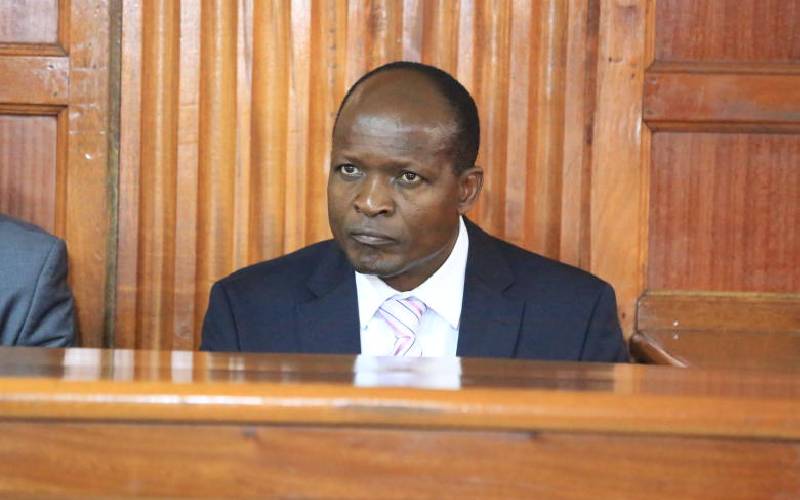
Former Migori Governor Okoth Obado will spend years behind bars after the High Court sentenced him to 25 years in prison for the murder of Rongo University student Sharon Otieno.
His former personal assistant, Michael Juma Oyamo, received the same sentence, while former Migori County Clerk Caspal Ojwang’ Obiero was jailed for 18 years.
Justice Cecilia Githua delivered the sentences at the Milimani Law Courts on Friday, November 27, bringing a major chapter of a case that has gripped the country since Sharon was killed in September 2018.
The decision came after a deeply divided mitigation hearing. While the Director of Public Prosecutions sought the maximum punishment, Obado asked for a non-custodial sentence. Sharon’s parents also made an emotional appeal for leniency towards the former governor, citing reconciliation between the families and the future of her three children.
But the judge held that the family's wishes could not determine the punishment for a crime that had already been proved in court.
The court also directed that the time each convict had spent in lawful custody be considered when calculating the prison terms.
Why the court rejected calls for leniency
The prosecution had urged the court to impose the death penalty, arguing that Sharon’s killing was planned and that the three men had played different roles in carrying it out.
State counsel Gikui Gichuhi told the court that the offence was not a spontaneous act. She argued that the planning and coordination involved made it particularly serious and that reconciliation could not erase the circumstances of the murder.
Obado’s defence team, led by Senior Counsel Kioko Kilukumi and lawyer Rodger Sagana, asked for a three-year non-custodial sentence.
They cited his status as a first-time offender, his previous public service, health concerns and efforts to reconcile with Sharon’s family. They also argued that allowing him to remain out of prison would give him an opportunity to support Sharon’s three children.
Sharon’s mother, Melida Auma, also appealed for mercy, saying the family had forgiven Obado and feared that sending him to prison would bring another painful loss.
Her husband, Douglas Zacharia Otieno, expressed a different position towards Oyamo and Obiero, whom he accused of being involved in the events that led to his daughter’s death.
The judge considered the submissions but found that the aggravating circumstances outweighed the mitigating factors.
She also declined to award compensation to Sharon’s family, finding that the evidence presented did not sufficiently establish the financial loss for which compensation was being sought.
The ruling underlined an important distinction in criminal sentencing: reconciliation and the wishes of a victim’s relatives may be considered, but they do not remove the court’s responsibility to impose a punishment that reflects the offence.
What the court found about each convict’s role
The three men were convicted on July 23, 2026, after Justice Githua found that the prosecution had proved the murder charge beyond reasonable doubt.
The court found that Obado had supplied the motive, instigated the killing and provided money to facilitate it.
Oyamo, who was Obado’s personal assistant at the time, was found to have coordinated the operation, while Obiero was found to have provided logistical support and helped conceal the crime.
The judge also found that Obado’s absence from Migori at the time Sharon was killed did not absolve him of responsibility. The court applied the principle of common intention, under which people who participate in a shared criminal plan can be held responsible for the resulting offence.
The prosecution called 42 witnesses and presented 81 exhibits during the trial.
The evidence included witness accounts, mobile phone records, financial transactions and other material used to reconstruct the events leading to Sharon’s death.
The court also acquitted the three men of the separate charge relating to the death of Sharon’s unborn child. Their convictions and sentences relate to Sharon’s murder.
The night Sharon disappeared
The case dates back to the night of September 3, 2018, when Sharon, then a 26-year-old Rongo University student, was seven months pregnant.
She had been in contact with a journalist who was helping her bring attention to her personal circumstances and her relationship with Obado.
On the evening of September 3, Sharon and the journalist went to Graca Hotel in Rongo, where they met Oyamo.
According to evidence set out in the court judgment, Oyamo asked them to move to another location, saying the hotel was too public for the message he wanted to pass on.
They boarded a vehicle that later changed direction towards Homa Bay. Other men joined them along the journey.
The journalist was attacked inside the vehicle but managed to escape by jumping out while it was moving. Sharon did not escape.
Her body was later found in the Owade area of Rachuonyo, Homa Bay County.
The killing triggered national outrage and a lengthy investigation that eventually led to the prosecution of Obado and his two former aides.
An eight-year case reaches a major milestone
Obado was the serving Migori Governor when the murder occurred. His prosecution attracted considerable public attention because it involved a senior elected leader and the killing of a young woman who was carrying his unborn child.
The trial took years to conclude. The court record cites several factors behind the delays, including disruptions caused by the Covid-19 pandemic, pre-trial applications and a change of trial judge.
On July 23, 2026, Justice Githua found the three men guilty of Sharon’s murder under Section 203 of the Penal Code.
Their bond terms were cancelled following the convictions, and they remained in custody as the court considered the appropriate sentences.
Friday’s decision now sets out the punishment for each man, although the legal process may continue if any of them chooses to challenge the outcome through an appeal.
For Sharon’s family, the sentences mark the conclusion of a long and painful trial. But the case also leaves a wider question about the place of reconciliation in criminal justice: families may choose forgiveness, but the responsibility to account for a serious crime remains with the courts.
You may also like
Category: Crime & Justice · Related Topic: Social Health Authority (SHA)
Related Video: Human Ladder Reaches Dangerous Heights as Climbers Keep Going
Related Explainer: Ebola contact tracing: Why the 21-day window matters in Kenya’s response
About the Author
Maureen Onyango is a journalist passionate about storytelling, life coaching and spiritual lessons. She studied at the Kenya Institute of Management and enjoys telling stories that inform, inspire and empower communities.
 Facebook
 Twitter / X
 WhatsApp
 LinkedIn
 Telegram
 Reddit