
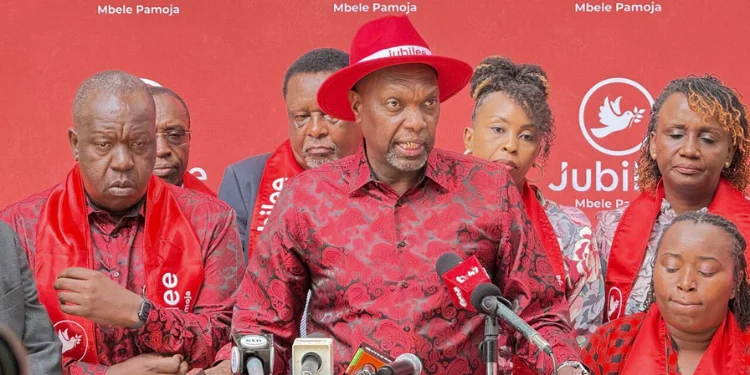
Jeremiah Kioni has reportedly resigned from the Jubilee Party, bringing fresh uncertainty to the former ruling party as it prepares for the 2027 General Election.
In a letter dated Wednesday, November 25, and addressed to party leader Fred Matiang’i, Kioni said he was leaving after reflecting on his political journey and future ambitions.
“It is with deep reflection and a heart both full and heavy that I write to tender my resignation from the party, effective immediately,” he stated.
The reported departure follows weeks of public signs of tension within Jubilee, with Kioni questioning his place in the party and expressing doubts about its ability to attract support, particularly in the Mt Kenya region.
If confirmed, the move would mark a significant break for a politician who played a prominent role in Jubilee's efforts to rebuild its structures after the divisions that followed the 2022 elections.
Resignation follows public fallout over Matiang’i's leadership
Kioni's exit comes after he openly questioned his working relationship with Matiang’i, who took over the Jubilee leadership from former President Uhuru Kenyatta in September.
In an interview with a local vernacular television station on November 15, the former Ndaragwa MP said he had initially expected to work alongside Matiang’i, with the latter concentrating on his presidential ambitions while he focused on strengthening the party.
He said the arrangement changed when Matiang’i sought both the party leadership and the presidential ticket.
Kioni claimed he had subsequently been left out of important political activities and had not been assigned specific responsibilities despite holding the position of Deputy Party Leader.
“As a Deputy Party Leader, I have not been allocated any responsibility,” he said.
He also alleged that he was not involved in planning Matiang’i's political engagements, despite having played a role in introducing the former Interior Cabinet Secretary to opposition politics.
Kioni, however, previously insisted that there was no open war between them.
“There are so many platforms that can be formed. As what I wanted to do can’t be achieved in that platform [Jubilee], I must look for a platform to achieve it,” he said.
His resignation now appears to bring that possibility closer, although he has not publicly identified the political platform he intends to pursue next.
Jubilee's leadership changes preceded Kioni's exit
The departure also follows a contested leadership transition in Jubilee.
In September, Uhuru announced that he would relinquish the party leadership and hand over to Matiang’i, while remaining involved as a senior adviser.
Matiang’i had already been endorsed as Jubilee's presidential candidate for the 2027 elections.
Kioni had expressed interest in succeeding Uhuru, arguing that the next party leader should be chosen through the party's established democratic processes, including a National Delegates Convention.
He publicly offered himself for the position in September, saying party leaders should be elected by delegates rather than simply installed.
The leadership transition nevertheless went ahead with Matiang’i taking over, leaving questions about how the party would accommodate competing ambitions among its senior officials.
Earlier in January, Jubilee had also reorganised its leadership structure, moving Kioni from Secretary General to Deputy Party Leader in charge of Operations. Moitalel Ole Kenta was appointed Secretary General.
The changes were presented as part of efforts to strengthen the party ahead of the next election.
Kioni had questioned Jubilee's support in Mt Kenya
Beyond his personal position within the party, Kioni had raised concerns about Jubilee's declining popularity in the Mt Kenya region.
He warned that candidates seeking elective positions under the party's ticket would have to work harder to persuade voters to support them.
“The Jubilee Party, on this side of the Mountain, is not as popular as we would wish,” he said.
The remarks highlighted a challenge for Jubilee as it seeks to rebuild its support base and position Matiang’i as a credible opposition presidential candidate.
The party's fortunes in the region could be particularly important as political leaders reposition themselves ahead of the 2027 contest.
Kioni's departure, if formally confirmed, would raise further questions about the party's ability to retain senior organisers and maintain unity during its preparations.
What happens after a party resignation?
Under Section 14 of Kenya's Political Parties Act, a member who intends to leave a political party must give written notice to the party.
The resignation takes effect once the party or the relevant parliamentary clerk receives the notice. The party, member or clerk must then notify the Registrar of Political Parties within seven days so that the membership records can be updated.
The Office of the Registrar of Political Parties also provides for resignation through its manual and electronic processes.
Kioni is a former MP, so the parliamentary-clerk requirement applicable to a sitting legislator does not arise.
The next step will be confirmation that Jubilee has received the resignation and that the relevant membership records have been updated.
For Jubilee, the immediate challenge is to manage the departure while continuing to organise for 2027. For Kioni, the question is where he will seek to exercise his political influence next.
You may also like
Category: Politics · Related Topic: 2027 Elections
Related Video: Murkomen Says Kenya Is Safe: “Stop Creating a Crisis” | Political Goons & Security Under Scrutiny
About the Author
Maureen Onyango is a journalist passionate about storytelling, life coaching and spiritual lessons. She studied at the Kenya Institute of Management and enjoys telling stories that inform, inspire and empower communities.
 Facebook
 Twitter / X
 WhatsApp
 LinkedIn
 Telegram
 Reddit