
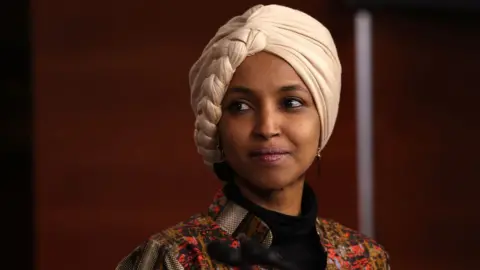
A refugee camp in Mombasa where US Congresswoman Ilhan Omar spent part of her childhood has emerged in reports about a federal investigation into her family's immigration history.
American investigators are reportedly interested in historical refugee registration records from Kenya's former Utange camp, which could help establish the identities and personal details Omar's family gave authorities after fleeing Somalia.
The records, if they exist and can be accessed, may provide another source of information as US prosecutors examine whether details in the family's refugee and immigration documents were accurate.
The New York Post reported on Wednesday, November 25, that investigators could seek records held by the United Nations High Commissioner for Refugees (UNHCR), which handled refugee registration in Kenya during the period.
However, there is no public confirmation that US authorities have formally requested or obtained Omar's family's records from UNHCR. Nor have the documents been made public to establish whether they contain any discrepancies.
The inquiry remains ongoing, and Omar has not been charged with a crime.
Why the Utange camp records matter
Omar was born in Somalia and arrived in the United States with her family in 1995, after spending several years in Kenya as refugees fleeing the country's civil war.
She has previously said her family spent four years in refugee camps before resettling in America.
Kenya's Department of Refugee Services confirms that Utange was among the temporary camps established during the large influx of refugees from Somalia in the early 1990s.
By 1992, Kenya was hosting more than 420,000 refugees, most of them Somalis fleeing the conflict following the collapse of Siad Barre's government.
The camps were later consolidated. In 1998, refugees from several temporary sites were moved to larger settlements, including Dadaab and Kakuma.
The New York Post reported that investigators are interested in registration documents that may have been completed by Omar's father when the family arrived in Kenya.
Such records could potentially contain names, ages, family relationships and other details declared during registration. Investigators could compare those details with information later submitted to US immigration authorities.
The newspaper also quoted Somali-born historian Mohamed Haji Ingiriis, who said refugee records could help clarify aspects of the family's early history.
Ingiriis suggested that Omar's father would likely have registered the family at the camp.
But the existence, completeness and accessibility of any specific family file have not been independently established.
The New York Post also reported that UNHCR had explained that it undertook refugee registration and documentation in Kenya during the period, while acknowledging that some people may not have been captured in every registration exercise.
Investigation reaches back decades
The Kenya records have attracted attention as investigators examine allegations concerning Omar's immigration history, including questions about her date of birth and the information submitted when her family entered the United States.
Omar's congressional biography lists her date of birth as October 4, 1982.
The latest scrutiny follows the release of heavily redacted court documents relating to a search of her Washington, DC, home on October 12.
The Minnesota Star Tribune reported on November 24 that the documents refer to suspected offences dating back as far as 1980.
However, the reference to 1980 does not establish that investigators have found evidence that Omar was born earlier than she says. The released documents do not identify the specific offences or explain the evidence behind the investigation.
More than 160 pages of court material were released after media organisations challenged the continued secrecy surrounding the search.
Much of the material remains redacted. A key 67-page affidavit setting out the evidence investigators presented to obtain the search warrant has also been withheld.
The documents provide only a limited picture of what authorities are examining.
Reuters reported in October that the investigation concerns whether Omar or members of her family provided false information when entering the US as refugees or during the process of obtaining American citizenship.
The possible offences identified in reporting include conspiracy, false statements on immigration paperwork and immigration fraud. These are investigative leads, not charges or findings of guilt.
Grand jury considers evidence
The investigation has also moved beyond the search of Omar's home.
The New York Post reported on November 24 that a federal grand jury had been convened in Washington, DC, to consider evidence gathered by prosecutors.
The Minnesota Star Tribune has separately reported that a Washington grand jury is hearing evidence as part of the inquiry.
The Minnesota newspaper also provided important background on the investigation. It reported that prosecutors in Minnesota had examined Omar's immigration history during President Donald Trump's first term but closed that earlier inquiry without charges after determining that the time limit for prosecution had expired.
The current investigation is being led by prosecutors in Washington, DC, without the involvement of Minnesota's federal prosecutors, according to the Star Tribune.
The distinction matters because the latest inquiry is not simply a continuation of a case that resulted in a conviction or formal finding against Omar.
A grand jury examines evidence and may consider whether criminal charges are warranted. Its involvement does not mean that an individual has been indicted or found guilty.
As of November 26, Omar has not been charged in the current investigation.
Omar calls investigation politically motivated
Omar has rejected allegations of wrongdoing and accused the Trump administration of using federal law enforcement against political opponents.
In comments to the Minnesota Star Tribune, a spokesperson for the congresswoman described the investigation as politically driven.
“This is not legitimate law enforcement,” the spokesperson said. “It is an abusive fishing expedition driven by the president’s political vendettas.”
Omar has also described the search of her home as political intimidation.
The Associated Press reported that the search warrant documents raised constitutional questions because Omar is a sitting member of Congress.
A magistrate judge required a procedure allowing her to claim constitutional protection over material connected to her legislative work before investigators could examine it.
The judge's concerns centred on the US Constitution's Speech or Debate Clause, which protects members of Congress from certain forms of interference relating to their legislative duties.
The court documents did not provide new evidence of immigration fraud.
Old marriage allegations remain unproven
The investigation has also drawn renewed attention to Omar's 2009 marriage to Ahmed Nur Said Elmi, a British national.
Some critics have alleged that Elmi was her brother and that the marriage was intended to help him obtain immigration benefits.
Omar has denied wrongdoing. The allegation has not been established.
Africa Check previously examined the claim and found no conclusive evidence that Omar married her brother. The Minnesota Star Tribune also reported that its investigation could neither confirm nor disprove the allegation.
The former couple's legal divorce was finalised in 2017.
The marriage allegation should therefore not be treated as an established fact or proof of immigration fraud.
Omar's connection to Kenya
Omar has previously spoken about her experience in Kenya and the assistance her family received before resettling in the United States.
In a message marking World Refugee Day in June 2024, she recalled the difficult conditions in the camp, including shortages of food and water and outbreaks of disease.
She credited Kenyans, humanitarian workers and resettlement organisations for helping her family reach America.
“I saw the best and worst of humanity,” she wrote.
“I am grateful that I made it out alive. But I would not be here without the generosity of the Kenyan people, the resolute efforts of UN workers, the help of resettlement organizations such as Lutheran Immigration and Refugee Service, and the welcoming spirit of the American people.”
Omar was elected to the US House of Representatives in November 2018, becoming the first Somali-American woman to serve in Congress.
For Kenya, the latest reports have brought renewed attention to the country's role in hosting Somali refugees during one of the region's most difficult periods.
But whether records from Utange will become part of the American investigation remains unclear. Until investigators disclose the evidence or bring charges, claims about discrepancies in Omar's childhood records remain allegations rather than proven facts.
You may also like
Category: International
Related Video: Dolly Parton’s Family Announces Her Passing in Emotional Tribute
About the Author
Maureen Onyango is a journalist passionate about storytelling, life coaching and spiritual lessons. She studied at the Kenya Institute of Management and enjoys telling stories that inform, inspire and empower communities.
 Facebook
 Twitter / X
 WhatsApp
 LinkedIn
 Telegram
 Reddit