
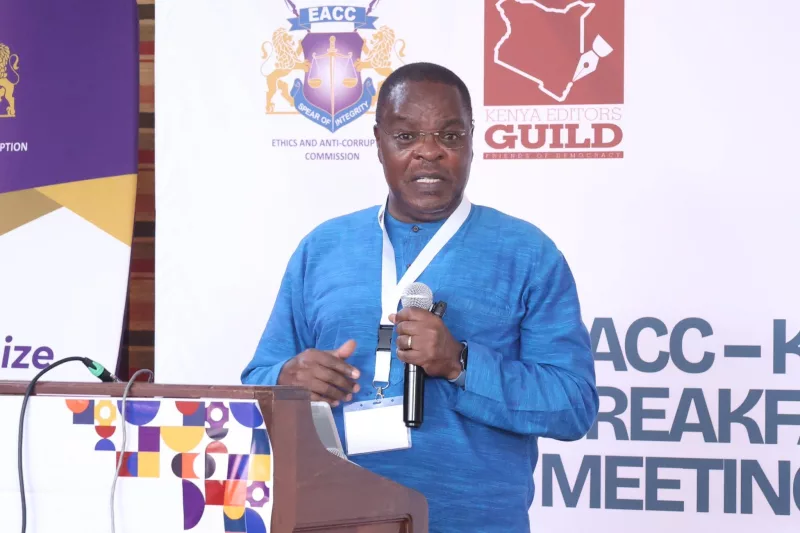
The Ethics and Anti-Corruption Commission (EACC) wants Kenyan journalists to spend less time following politicians’ public feuds and more time investigating their integrity, wealth and record in public office ahead of the 2027 General Election.
EACC Chairperson Bishop David Oginde says the media risks allowing politicians who thrive on controversy to dominate the news cycle while important questions about corruption, public spending and leadership standards receive less attention.
Speaking at an engagement with editors during the Kenya Editors Guild’s 9th Annual Editors’ Convention in Mombasa on Thursday, November 26, 2026, Oginde challenged newsrooms to examine the people seeking power, rather than simply report their political alliances, campaign promises and public disagreements.
He used a familiar media expression to illustrate how political spectacle can distract from more serious issues.
“Because we want stories around ‘men biting dogs always’ on the headlines. While the dogs are actually biting men, they are actually causing greater harm,” he said.
Oginde argued that some politicians had learnt to provoke controversy to attract publicity, leaving journalists with the challenge of deciding which stories deserve sustained attention.
“There are people within the political fraternity who have learnt that trick. The trick of always biting a dog so that they can be in the news. And so they are constantly creating this drama, and we can easily fall for it,” he said.
EACC promises information-sharing mechanism for journalists
One of the key announcements from the meeting was Oginde’s pledge that the commission would establish a mechanism to help journalists access relevant information about people seeking elective and appointed positions.
The proposed arrangement is intended to support public scrutiny of candidates’ integrity and suitability before voters make their choices.
Oginde urged journalists to investigate candidates’ professional histories, academic qualifications, sources of wealth and previous handling of public resources.
He said voters needed information that would help them assess whether those seeking leadership positions had the character and competence required to serve.
However, he cautioned against describing individuals as having been cleared or barred by the EACC.
“Sometimes people report and say EACC has cleared or has barred... We don't have that mandate. We don't have the mandate to clear anybody, we don't have the mandate to bar anybody,” he said.
The distinction is important because the commission’s role is to investigate integrity concerns and provide findings or recommendations to the relevant institutions. Its guidance on Chapter Six of the Constitution says it can inquire into the conduct of people seeking public office and make recommendations to the institutions responsible for considering them.
The EACC does not, however, make the final appointment or electoral decision. Nor does it prosecute criminal corruption cases. That responsibility rests with the Office of the Director of Public Prosecutions, while courts determine guilt or innocence.
Oginde links vote-buying to poor public services
The EACC chairperson also urged newsrooms to explain the long-term consequences of voter bribery, rather than treating cash handouts as isolated campaign incidents.
He questioned whether voters fully appreciate the connection between accepting small payments and the quality of services they receive after an election.
“Let's make the connection between what you get now as two hundred shillings, five hundred shillings, a thousand shillings, for you to vote in a particular direction, and the consequence of that on the roads that you are going to get in your area, the medical supplies, the education,” he said.
His argument was that political money offered during campaigns can have consequences beyond election day, particularly when leaders are not held accountable for how they use public funds.
Kenya’s Election Offences Act makes it an offence to offer or accept a bribe intended to influence how someone votes during an election period. The law also addresses other forms of unlawful influence and the use of public resources in elections.
Oginde urged journalists to investigate not only the people distributing money but also the networks behind political violence and destruction of property.
He expressed concern over reports of young people being paid small amounts to attack businesses, burn vehicles and damage property during periods of political unrest.
He cited payments of Sh200 or Sh500 as examples of the small sums allegedly offered to some young people, compared with the value of property destroyed.
The remarks place a responsibility on journalists to investigate who organises and finances such activities, while carefully verifying claims about individuals involved.
Media warned against treating allegations as convictions
As he called for tougher scrutiny of leaders, Oginde also warned journalists against declaring people guilty simply because they are under investigation.
He said the growth of artificial intelligence, manipulated images and deepfake content had made it increasingly important for newsrooms to verify information before publishing it.
Journalists, he said, should make clear distinctions between allegations, investigations and proven wrongdoing.
The caution is particularly relevant during an election period, when unverified claims about candidates can spread quickly and influence public opinion.
Oginde also urged mainstream media outlets to help audiences assess information circulating on social media.
He said he still looked to established news organisations to confirm stories he encountered online, adding that the absence of a report from mainstream outlets could prompt him to question the authenticity of a claim.
EACC asks journalists to follow corruption cases beyond investigations
Oginde further challenged media organisations to help the public understand how Kenya’s different accountability institutions work.
He said reporting on corruption should not end when the EACC announces an investigation. Journalists should follow the process through the relevant agencies and explain what happens after investigators complete their work.
The EACC investigates corruption and integrity-related offences, but criminal prosecutions are handled by the ODPP. Courts then determine whether accused persons are guilty.
The commission’s own public guidance confirms this division of responsibilities and says it makes recommendations to the ODPP after investigations.
Oginde urged journalists to use information from the commission’s reports to deepen public understanding of corruption and the progress of cases.
The appeal comes as the Kenya Editors Guild holds its five-day convention in Mombasa from November 25 to 29 under the theme Navigating the Storm: Media Resilience on the Road to 2027.
The gathering is bringing together media practitioners and other stakeholders to discuss the pressures facing journalism, including misinformation, artificial intelligence, media freedom and the sustainability of newsrooms.
For Oginde, the challenge ahead of the next election is to ensure that voters are not only informed about who is leading political coalitions or trading accusations, but also about the integrity, qualifications and public records of those asking for their votes.
The proposed EACC information-sharing mechanism could help journalists pursue that work. Its impact, however, will depend on what information is made available, how quickly it is shared and whether newsrooms have the resources and editorial independence to investigate it thoroughly.
You may also like
Category: News · Related Topic: 2027 Elections
Related Video: What Dangote’s proposed Lamu oil refinery could mean for East Africa
About the Author
Maureen Onyango is a journalist passionate about storytelling, life coaching and spiritual lessons. She studied at the Kenya Institute of Management and enjoys telling stories that inform, inspire and empower communities.
 Facebook
 Twitter / X
 WhatsApp
 LinkedIn
 Telegram
 Reddit