
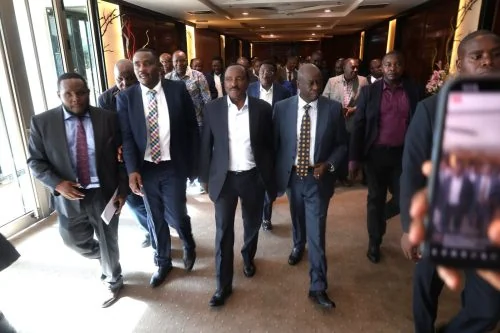
A meeting meant to build confidence in Kenya’s 2027 General Election ended in a public confrontation on Thursday after opposition leaders walked out of talks with the Independent Electoral and Boundaries Commission (IEBC), accusing it of failing to address their key electoral concerns.
Led by Wiper Patriotic Front leader Kalonzo Musyoka and former Deputy President Rigathi Gachagua, the delegation rejected the agenda presented by the commission, arguing that it left out fundamental reforms they want discussed before the August 2027 polls.
The disagreement goes beyond a failed meeting. Opposition leaders have now outlined four major changes they want made to the electoral system, including a clean and verifiable voter register, changes to presidential vote tallying, electronic voting for Kenyans abroad and live broadcasts of voting and results.
The proposals place the IEBC under renewed pressure to demonstrate not only that it is preparing for the election, but also that political parties and voters can trust the process.
“We came to the IEBC today in good faith, and we expected the same in return. Good faith is shown in deeds: an independent, impartial and prepared Commission. Today, we did not find it. So we have walked out,” Kalonzo said in a statement after the meeting.
He warned that the opposition would not lend its presence to what he described as a compromised electoral process.
The Wiper leader also called for every vote to be counted at polling stations, openly verified and declared as cast. He raised concerns about the possibility of ineligible names appearing on the voter register, although he did not provide specific examples of alleged irregularities.
“Not manufactured. Not padded with the names of people who are not on the voter roll,” he said.
Four demands behind the walkout
The walkout followed a meeting of opposition figures under the People’s Coalition on Electoral Reforms, which brought together leaders from several political parties and political movements.
Former Chief Justice David Maraga, who convened the meeting alongside Democratic Party leader Justin Muturi and Linda Mwananchi Movement leader Caroli Omondi, outlined four proposals the group wants addressed.
The first is a clean and verifiable voter register. The coalition wants the IEBC to remove duplicate entries, names of deceased people and other ineligible records, while ensuring that all qualified Kenyans have an opportunity to register.
The demand comes as the commission prepares to expand the voter roll ahead of the next election. In August, the Kenya News Agency reported that the IEBC was targeting at least 28.5 million registered voters for 2027.
The commission's own election plan also provides for continuous voter registration, verification of biometric details, removal of deceased voters and an audit of the register.
The opposition wants greater assurance that these processes will be transparent and open to scrutiny.
Its second proposal is to change the role of the national presidential tallying centre at Bomas of Kenya.
The coalition wants presidential results declared at constituency tallying centres to be final, with the national centre restricted to receiving, aggregating and announcing results already declared at constituency level.
This is a significant proposal because the current Elections Act provides for presidential results to be transmitted to both constituency and national tallying centres, with the IEBC chairperson responsible for declaring the presidential winner.
The proposed change would therefore require legal and institutional consideration. It is not a procedure the IEBC can simply introduce through an administrative decision.
The third demand concerns Kenyans living abroad. The opposition wants the IEBC to pilot electronic voting for diaspora voters, arguing that citizens should not have to travel to Kenyan diplomatic missions to cast their ballots.
The IEBC's current election plan recognises the need to expand diaspora participation. It provides for reviewing the policy on registration and voting outside Kenya, increasing the number of participating countries and establishing additional registration centres.
However, the plan does not amount to approval of electronic voting. Such a move would require careful consideration of security, voter identification, accessibility and the integrity of results.
The fourth proposal is to make live broadcasts of voting, counting and the announcement of results mandatory at polling stations and tallying centres.
The coalition says this would allow voters, political parties and observers to follow the process more closely.
Kenya's Elections Act already provides for the IEBC to establish a mechanism for live-streaming results announced at polling stations. The opposition's proposal goes further by seeking live coverage of voting and counting as well.
Gachagua says opposition concerns were left out
Before the walkout, Gachagua accused the commission of failing to respond adequately to earlier attempts by opposition leaders to secure formal discussions on electoral reforms.
He referred to correspondence dated May 10, 2026, and another letter dated June 24, which he said had raised concerns about the proposed engagement with the commission.
“Since our meeting then in January, you have never called us for a meeting. This is the first time,” Gachagua told IEBC chairperson Erastus Ethekon.
He argued that discussions would be meaningless if the issues raised by Kenyans and opposition parties were excluded from the agenda.
“We feel that any discussion that does not include those issues given to us by the people of Kenya would not be meaningful and will not be useful to the country,” he said.
Gachagua proposed that a team led by Maraga engage the commission to agree on a more comprehensive agenda before another high-level meeting is held.
He also maintained that the opposition was willing to continue engaging the IEBC, provided the discussions addressed its concerns.
The delegation included Kalonzo, Gachagua, People’s Liberation Party leader Martha Karua, Nairobi Senator Edwin Sifuna, Siaya Governor James Orengo, former Interior Cabinet Secretary Fred Matiang’i, Safina Party leader Jimi Wanjigi and Embakasi East MP Babu Owino, among other opposition figures.
IEBC says wider consultations are planned
The commission has not, in the reports reviewed, issued a detailed public response addressing each of the four proposals.
However, IEBC chairperson Erastus Ethekon urged political leaders to work with the commission and said it would begin consultations with other stakeholders the following week.
“Let's work together to have successful elections,” he told the leaders.
He also said the commission would meet different groups as part of efforts to widen engagement ahead of the polls.
The IEBC has already published an Election Operation Plan covering the 2025–2027 period. It outlines work on voter registration, election technology, procurement, training, logistics, results management and stakeholder engagement.
The plan also identifies risks that could affect the election, including funding constraints, delays in procurement, technology failures, cyber security threats and disputes over results.
This means the dispute is not simply about whether the commission has a preparation framework. It is also about whether its plans address the concerns raised by political parties and whether the public will have confidence in how they are implemented.
Why the disagreement matters
Kenya's electoral history has made trust in the IEBC a major issue well before polling day.
The 2022 presidential election ended in a Supreme Court challenge after four commissioners publicly disagreed with the declaration of William Ruto as president-elect. The Supreme Court upheld the result, but the episode highlighted the importance of institutional unity, transparency and confidence in the tallying process.
The next election will require the commission to manage a large voter register, deploy technology across the country, train election officials and ensure that results are accurately transmitted and declared.
The opposition's proposals raise questions that will need answers well before August 2027. How will the voter register be independently verified? What safeguards will protect the results transmission system? Can diaspora electronic voting be made secure and legally sound? And how much of the voting and counting process can realistically be broadcast live?
These are questions that cannot be settled by a walkout or a political statement. They require technical explanations, legal scrutiny and public engagement.
For the opposition, the challenge will be to turn its demands into workable proposals and sustain pressure through formal channels. For the IEBC, the task is to explain its preparations, respond to legitimate concerns and keep consultations open to all political players.
The commission has time to address the issues before the election. But the breakdown of Thursday's meeting is a reminder that electoral credibility is not built on polling day alone.
It also depends on whether Kenyans believe, long before they cast their ballots, that the system will protect their vote.
You may also like
Category: Politics · Related Topic: 2027 Elections
Related Video: Murkomen Says Kenya Is Safe: “Stop Creating a Crisis” | Political Goons & Security Under Scrutiny
Related Explainer: EXPLAINER: How can one mother give birth to five babies? The science behind Kenya’s rare quintuplets
About the Author
Maureen Onyango is a journalist passionate about storytelling, life coaching and spiritual lessons. She studied at the Kenya Institute of Management and enjoys telling stories that inform, inspire and empower communities.
 Facebook
 Twitter / X
 WhatsApp
 LinkedIn
 Telegram
 Reddit