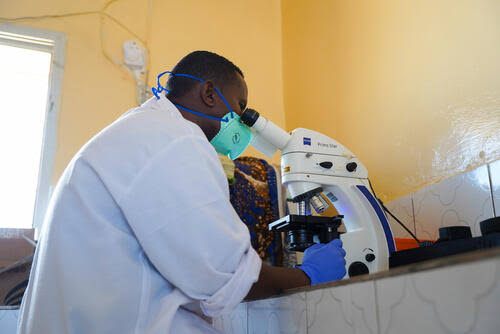
A study in Uganda and the Philippines has found that a shorter tuberculosis treatment can work in routine clinics, but limited diagnostic equipment and staff training remain barriers to wider access.
Children with less severe forms of tuberculosis could spend two fewer months on treatment if health systems make better use of an existing World Health Organisation (WHO) recommendation, Médecins Sans Frontières (MSF) says.
The medical charity is calling on governments to expand access to a four-month treatment course after a study in Uganda and the Philippines found that 95 per cent of participating children successfully completed treatment.
The findings, released on Tuesday, November 17, at the Union World Conference on Lung Health in Rio de Janeiro, Brazil, offer fresh evidence that the shorter regimen can work outside specialised TB centres.
The study involved 214 children receiving care in health facilities in the two countries. Researchers found that 74 per cent qualified for the four-month course. The proportion rose to 89 per cent among children assessed in general healthcare settings.
For families, the difference could be significant. A shorter course means fewer months of medication, fewer trips to health facilities and less disruption to school, work and household routines.
It could also reduce the costs caregivers face when accompanying children to appointments.
The shorter treatment is already approved by WHO
The four-month regimen is not a new medical discovery. WHO recommended it in 2022 for children and adolescents aged three months to 16 years with non-severe, drug-susceptible TB.
It uses the same first-line medicines as the standard six-month course, including child-friendly formulations. The difference is the length of the continuation phase.
The recommendation does not apply to every child with TB. Children with severe disease, suspected drug-resistant TB or certain serious complications may need a different and longer treatment plan.
WHO defines non-severe TB to include certain forms of lymph-node TB and limited lung disease without extensive damage or complications.
The challenge has been ensuring that health workers can identify which children qualify.
MSF says many countries have been slow to put the recommendation into practice because assessing disease severity can require clinical skills and access to chest X-rays.
The organisation's latest study suggests that routine healthcare facilities can identify eligible children and deliver the shorter course successfully, provided they have the right support.
Why implementation remains difficult
The study also highlighted gaps that could limit wider adoption.
In Uganda, chest X-rays were available for only 55.6 per cent of the children assessed, compared with full availability in the Philippine study sites, according to Epicentre, MSF's research arm.
The researchers also identified gaps in healthcare worker training and high staff turnover as challenges.
These findings point to a practical problem: shortening treatment is only useful if children are correctly assessed before starting it.
A child with severe TB or a form of the disease that does not qualify for the shorter regimen must not be placed on an unsuitable course simply to reduce treatment time.
Dr Maria Namulwana, an MSF and Epicentre study coordinator in Uganda, said the experience showed that the shorter regimen could be introduced into ordinary healthcare services.
She called for investment in staff training, diagnostic services, access to child-friendly medicines and support for families.
Valentina Carnimeo, the study's principal investigator, said the shorter course uses the same medicines but reduces the time children and caregivers spend managing treatment.
MSF says governments and donors should now move beyond changing policy documents and make the regimen available to eligible children in practice.
Kenya already has a four-month treatment option
The findings are particularly relevant to Kenya, which is among the countries already reporting use of the WHO-recommended four-month regimen.
Kenya's childhood TB treatment guidance provides for a shorter course for selected children, with eligibility depending on factors such as age, disease severity and clinical condition.
The country's childhood pulmonary TB algorithm, for example, identifies a four-month option for eligible children above one year and up to 10 years old who have non-severe disease and are stable enough for outpatient treatment.
Infants, children with severe illness and those with certain other complications may require longer treatment.
WHO's 2026 Global Tuberculosis Report lists Kenya among 38 countries and territories that reported using the four-month childhood regimen in 2025.
That means the next challenge is not simply adopting the recommendation. It is ensuring that children are diagnosed early, assessed correctly and able to access the appropriate medicines wherever they seek care.
Kenya continues to face a significant TB burden. The WHO Kenya Annual Report 2025 estimated that the country recorded about 117,000 new TB cases and 16,000 deaths in 2024.
The Ministry of Health also reported that 90,900 people were diagnosed and started treatment in 2025, representing 81 per cent of the estimated national burden.
These figures cover TB across the population, not children alone, but they underline the wider need to close gaps in diagnosis and treatment.
A shorter course is not a substitute for early diagnosis
MSF's findings add to the case for making child-friendly TB care easier to access. However, the study involved 214 children in two countries, and its results should not be treated as proof that every health facility can introduce the regimen without additional resources.
The availability of diagnostic equipment, trained staff and suitable medicines will determine whether the approach can be expanded safely.
The wider concern is that many children with TB are still missed before they can receive treatment. WHO's 2026 Global TB Report estimates that half of children under five who developed TB in 2025 were not diagnosed.
MSF is urging governments, donors and health partners to address these gaps while expanding access to shorter treatment.
For families, the prospect is straightforward: eligible children could spend less time taking medication and travelling to clinics. But the real benefit will depend on whether health systems can identify those children and provide the right treatment without delay.
You may also like
Category: Health
Related Video: Gachagua’s explosive Ruto scorecard: Debt, taxes, State capture and a government ‘that has failed’
Related Explainer: Ebola contact tracing: Why the 21-day window matters in Kenya’s response
About the Author
Maureen Onyango is a journalist passionate about storytelling, life coaching and spiritual lessons. She studied at the Kenya Institute of Management and enjoys telling stories that inform, inspire and empower communities.
 Facebook
 Twitter / X
 WhatsApp
 LinkedIn
 Telegram
 Reddit