
Nairobi County says it never approved the building plans, despite the project appearing in National Construction Authority records. Investigators are now facing questions over the approval process, enforcement failures and the people behind the development.
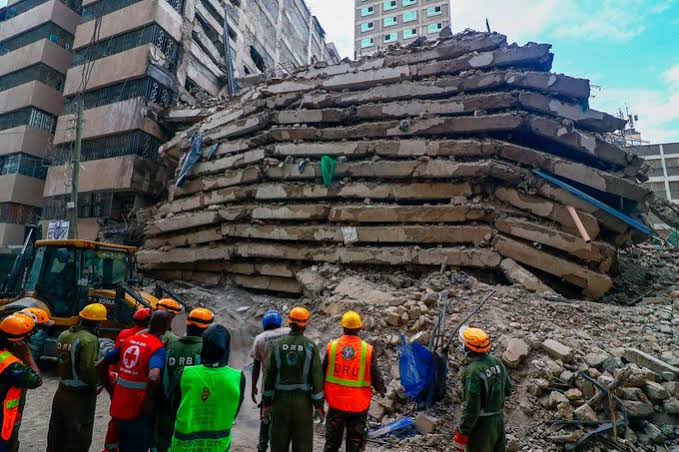
The 18-storey building that collapsed in Nairobi's Eastleigh area, killing eight people, was never approved for construction by City Hall, according to a senior county official who has now told legislators that documents allegedly used to obtain regulatory clearance were forged.
The revelation raises a troubling question: how did a building that had failed to meet basic approval requirements continue rising until it became the scene of a deadly collapse?
Appearing before the Nairobi County Assembly's Urban Planning Committee on Monday, November 16, Assistant Director for Development Control Fredrick Ochanda said the county had received applications for a 15-storey residential development on a plot along Ninth Street.
However, neither application resulted in approval of the proposed building plans.
Ochanda told the committee that the first application was submitted on November 25, 2024, by architect Emmanuel Mwangi Maina on behalf of developer John Mutie Musyoki. It proposed a building with a basement and 15 floors.
The county raised an invoice of about KSh2 million, but the fee was not paid. The application was therefore not processed.
A second application, submitted on November 14, 2025, attracted a fee of approximately KSh1.15 million, which was paid.
But payment did not mean the plans had been approved.
Ochanda said the county raised several outstanding requirements, including removing shops from the basement, providing parking within the property and obtaining clearance from the Kenya Civil Aviation Authority (KCAA).
The developer was also required to address a setback requirement.
“The application was not processed by virtue that it had comments, including omitting shops on the basement, providing on-site parking, and attaching the Kenya Civil Aviation Authority approval. As of now, there is no application that has been approved,” Ochanda told the committee, according to the Daily Nation.
How the alleged forged documents entered the picture
The county official said the documents presented as evidence of county approval in the process of obtaining National Construction Authority (NCA) clearance did not originate from City Hall.
“An application was made to us, but it did not meet the minimum requirements. Regarding the question of NCA approval, the letters in question did not originate from us. They were forgeries,” Ochanda said.
The allegation introduces another layer to the investigation: whether documents purporting to show county approval were used to convince another regulator that the project had met the necessary requirements.
The NCA had previously confirmed that the project was registered on July 30, 2025, under registration number 53128815710410.
Its records identified 9th Street Plaza Limited as the developer and Stromax Holdings EA Limited as the main contractor.
But registration with the NCA is not the same as approval of architectural and structural plans by the county. Nor does it replace other statutory clearances required before construction.
That distinction is important because the presence of a project on a regulatory register does not, by itself, establish that all approvals were secured.
From 15 floors on paper to 18 floors on the ground
Another question facing investigators is how a proposal for 15 floors became an 18-storey structure.
The difference is significant. It raises questions about whether the plans changed during construction, who authorised any changes and whether the relevant authorities inspected the development as it grew.
Earlier reporting by Citizen Digital established that Nairobi County had not approved the building for construction. The National Environment Management Authority (NEMA) had also said the developer failed to provide the clear architectural drawings it had requested.
In a letter dated January 6, 2026, NEMA asked 9th Street Plaza Limited to submit properly detailed plans. The agency said the company did not meet the requirement and had no environmental impact assessment licence for the project.
Nairobi Governor Johnson Sakaja had previously said the building was being constructed without the required approvals.
The latest testimony therefore adds to an already troubling record of missing or incomplete approvals. It does not, on its own, establish who was responsible for allowing the work to continue.
Questions over county enforcement and political interference
The committee's inquiry has also turned attention to the conduct of officials responsible for development control and enforcement.
During an earlier appearance, Acting Director for Compliance Tom Achar told legislators that political interference affected the way building approvals were handled in Nairobi.
“There is political interference, that is true,” Achar said, according to the Daily Nation.
He did not name the individuals he believed were involved.
Achar also told the committee that the collapsed building had been flagged and that two enforcement notices had been issued. Despite those interventions, construction continued.
The claims raise questions about whether enforcement officers had the authority, resources and institutional support to stop work on developments that failed to meet requirements.
They also need to be tested against records showing when the notices were issued, who received them and what action followed.
The committee has sought to hear from several people whose names have emerged during the inquiry.
Its chairperson, Baba Dogo MCA Geoffrey Majiwa, said the developer, architect and contractor had been invited but had not appeared. The committee said it would issue fresh invitations.
Two officials in Governor Sakaja's administration — Chief of Staff David Njoroge and adviser Osman Khalif Abdi — were also mentioned and asked to appear.
Majiwa said the committee wanted those named to have an opportunity to respond rather than be judged in their absence.
The two officials have not been found guilty of any wrongdoing. Their appearance before the committee is intended to clarify the issues raised during the investigation.
The committee has scheduled further appearances for Friday, November 20, 2026.
Eight lives lost, but accountability remains unresolved
The building collapsed on October 23, 2026, along Ninth Street in Eastleigh while construction was under way.
Eight people died, while four others were rescued alive, according to reports on the rescue operation. The tragedy prompted renewed scrutiny of Nairobi's building approval and inspection systems.
The NCA identified the developer as 9th Street Plaza Limited and the contractor as Stromax Holdings EA Limited. The project architect was listed as Emmanuel Mwangi Maina, while Joseph Muturi Mugu was identified as the structural engineer.
The Directorate of Criminal Investigations is also investigating possible negligence, omissions or misconduct by those involved in the project. The Director of Public Prosecutions has directed that the inquiry examine the roles of public officials, developers and construction professionals.
No final finding of criminal responsibility has been announced.
The Eastleigh collapse has exposed a chain of unanswered questions: why the building plans were not approved, how the project was registered, whether forged documents were presented, why construction continued after enforcement action and how the structure grew beyond the height reflected in the county applications.
For the families who lost loved ones, the priority is not another round of accusations. It is a credible investigation that establishes who was responsible and whether anyone should face prosecution.
The committee's hearings may help reconstruct what happened at City Hall. But the wider test will be whether the findings lead to action against those found culpable — and changes that prevent another building from rising without the approvals and inspections meant to protect the people living and working around it.
You may also like
Category: News
Related Video: What Dangote’s proposed Lamu oil refinery could mean for East Africa
Related Explainer: Fact Check: Did elephants save people during Nepal’s floods?
About the Author
Maureen Onyango is a journalist passionate about storytelling, life coaching and spiritual lessons. She studied at the Kenya Institute of Management and enjoys telling stories that inform, inspire and empower communities.
 Facebook
 Twitter / X
 WhatsApp
 LinkedIn
 Telegram
 Reddit