
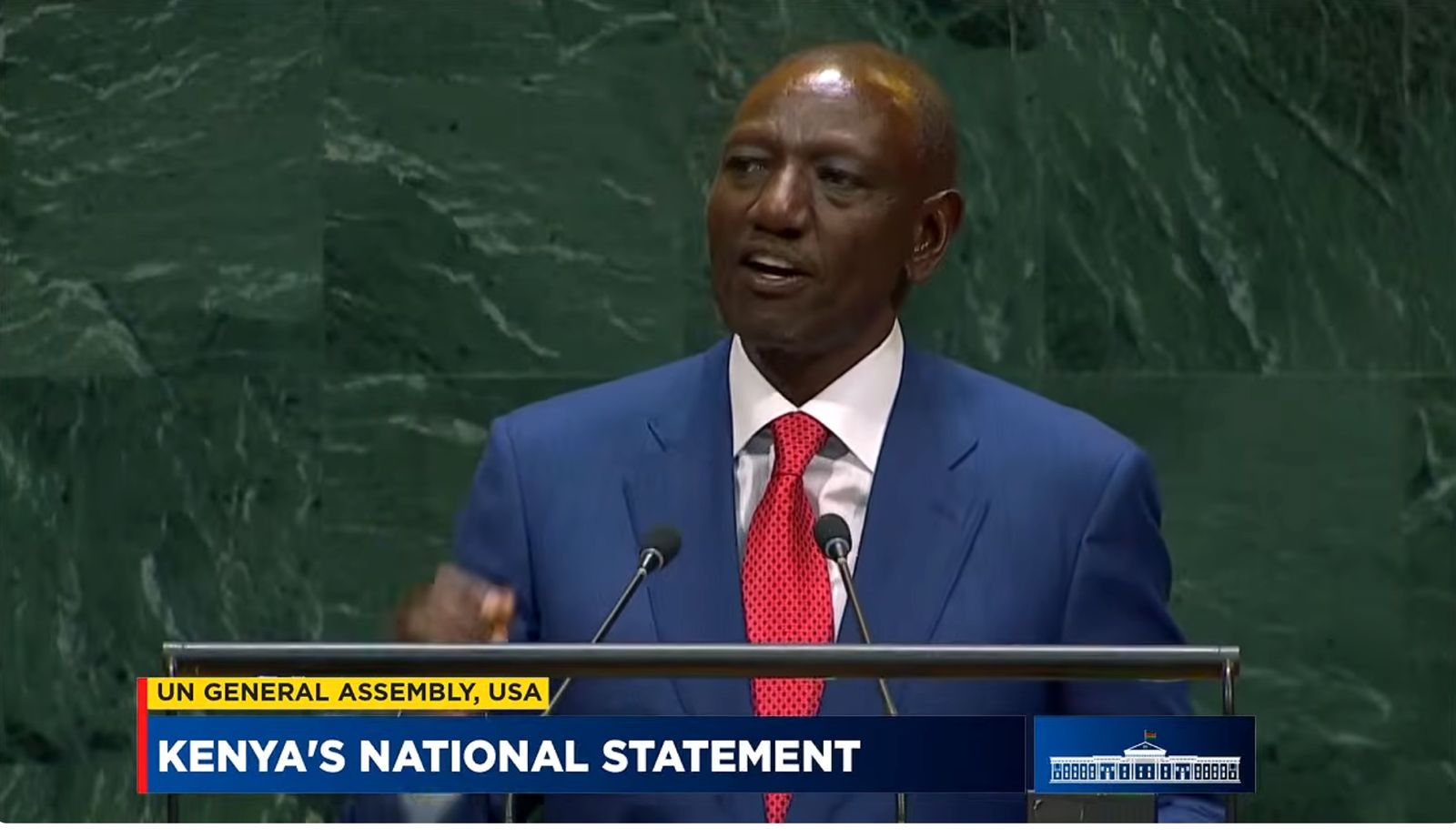
President William Ruto has called for an overhaul of the United Nations Security Council and the global financial system, saying Africa can no longer remain on the margins of institutions that make decisions affecting its security, debt and economic future.
Addressing the 81st United Nations General Assembly in New York, Ruto said the international system still reflects a world shaped in the aftermath of the Second World War, despite profound changes in global population, economic power and geopolitics.
He singled out the UN Security Council, where five countries — China, France, Russia, the United Kingdom and the United States — hold permanent seats and veto powers.
“The equality proclaimed in this assembly ends at the doors of the Security Council,” Ruto said.

Africa, he noted, has 54 UN member states but no permanent representation on the body charged with maintaining international peace and security.
“We are frequently the subject of its decisions. Permanently discussed, yet permanently excluded,” he said.
Ruto argued that the structure may have reflected geopolitical realities in 1945, when much of Africa was still under colonial rule, but no longer represents the world today.
Only four African countries were represented at the 1945 San Francisco conference that laid the foundations of the United Nations, he said.
“The world has since transformed. The Security Council has not,” Ruto said. “We cannot manage transformation with institutions that refuse to transform themselves.”
His remarks reinforce a longstanding African push for permanent representation on the Security Council. The continent's common position seeks at least two permanent seats with the same prerogatives afforded to existing permanent members.
Ruto said reform should deliver “equitable and permanent representation” for Africa and other underrepresented regions, including the privileges associated with permanent membership.
The President also criticised what he described as inconsistent application of international law as conflicts intensify around the world.
“International law cannot be invoked loudly in one crisis, cautiously in another crisis and disregarded when convenient,” he said.
“Every perceived double standard carries a price and that price is trust.”
Ruto said the world recorded 65 state-based armed conflicts last year, with 13 reaching the scale of war and nearly a quarter of a million people killed in organised violence.
From Europe and the Middle East to the Sahel and Horn of Africa, he said civilians were increasingly bearing the consequences through displacement, hunger, destruction and higher prices.
“Too many disputes are no longer being settled. They are being frozen, deferred, or decided by force,” he said.
But Ruto's argument went beyond the Security Council.
He said the same inequality embedded in global political institutions could be seen in the international financial system, where developing countries frequently face substantially higher borrowing costs.
According to figures cited in his speech, global public debt reached a record $12 trillion in 2024, with developing countries paying about $1 trillion in interest.
He said 46 developing countries now spend more servicing interest on debt than they spend on education and health.
“The hospital competes with a creditor. The classroom competes with debt service,” Ruto said.
He argued that borrowing costs are particularly damaging for African countries, which require huge investments in infrastructure, energy, education and industrialisation.
Developing economies, he said, have recently borrowed at average rates two to four times higher than developed countries.
Ruto also cited a UN Development Programme estimate that subjectivity in sovereign credit ratings has cost African countries about $75 billion through excessive interest charges and lost lending opportunities.
“Capital must price risk. It must not price prejudice,” he said.
The President called for multilateral development banks to lend more and for longer periods, while expanding guarantees and risk-sharing mechanisms that could lower borrowing costs.
He also advocated greater access to long-term and local-currency financing so African governments are not forced to finance long-term infrastructure using expensive short-term debt.
But Ruto acknowledged that responsibility did not lie solely with international institutions.
African governments, he said, must manage debt prudently, strengthen institutions, develop credible investment projects, deepen domestic capital markets, honour contracts and tackle corruption.
“Reform abroad cannot substitute for accountability at home,” he said.
Ruto used Kenya's education spending as an example of what he described as investment in future generations.
He said Kenya had spent an additional $5.3 billion on education over the past four years, recruited 100,000 teachers and built more than 23,000 classrooms, while another 1,600 laboratories were being developed.
“Education is not consumption. It is the infrastructure of opportunity, productivity and national transformation,” he said.
The President then shifted his argument from Africa's financing problems to its economic potential.
He pointed to the continent's mineral wealth, agricultural potential, renewable-energy resources, young population and a market of more than 1.5 billion people increasingly connected through the African Continental Free Trade Area.
But he said Africa must move away from simply exporting raw materials.
“Africa's resources must become the beginning of African industry, not the end of Africa's contribution to the value chain,” Ruto said.
“The clean energy transition must not become another extractive transition.”
Ruto used the planned East Africa oil refinery in Lamu to illustrate that industrialisation strategy.
He told the General Assembly that Kenya expects to break ground on the project within a week, describing it as an investment of approximately $16 billion with planned capacity to process 700,000 barrels of oil per day.
The project, he said, represents the kind of Africa Kenya wants to help build — one that processes resources at home, creates jobs and develops industries capable of supplying continental and international markets.
“It represents the Africa we seek to build. Adding value at home, creating jobs for our people, and building industries capable of serving continents and global markets,” Ruto said.
Other reporting around the project has put its estimated value at about $17 billion, with a groundbreaking ceremony expected in Lamu on September 30. The planned refinery has been discussed with Nigerian industrialist Aliko Dangote and the Africa Finance Corporation.
Ruto also challenged African countries to mobilise more of their own financial resources.
He estimated that Africa has more than $4 trillion held across pension funds, insurance assets, sovereign wealth funds, banks and other institutions, arguing that more of that capital should be channelled into productive investment.
The President framed both financial reform and Security Council reform as parts of the same problem: institutions created for an earlier global order retaining disproportionate influence over today's world.
He noted that negotiations on Security Council reform have continued for 17 years without resolving questions including membership, veto power and regional representation.
Ruto recalled that the UN had expanded the Security Council before, from 11 to 15 members following amendments adopted by the General Assembly in 1963.
“What was possible then, ladies and gentlemen, is possible today,” he said.
He also paid tribute to outgoing UN Secretary-General António Guterres for advocating reform of the international financial architecture and greater representation for Africa and the Global South.
Guterres, in his final General Assembly address this week, similarly argued that existing global governance arrangements no longer adequately reflect today's world and renewed calls for reforms, including stronger African representation.
Closing his address, Ruto urged world leaders not to wait for another global catastrophe before reforming institutions whose weaknesses, he said, were already apparent.
He called for consistent application of international law, sustainable debt, more equitable access to development capital and institutions in which developing countries have greater influence.
“Let ours be the generation that completes the unfinished work of San Francisco,” he said.
“Not a United Nations of some nations, not a system in which power determines whose voice matters, but a United Nations worthy of its name, where every nation has a voice, every people have a stake, and every child has a future.”
You may also like
Category: News · Related Topic: William Ruto
Related Video: Dolly Parton’s Family Announces Her Passing in Emotional Tribute
 Facebook
 Twitter / X
 WhatsApp
 LinkedIn
 Telegram
 Reddit