
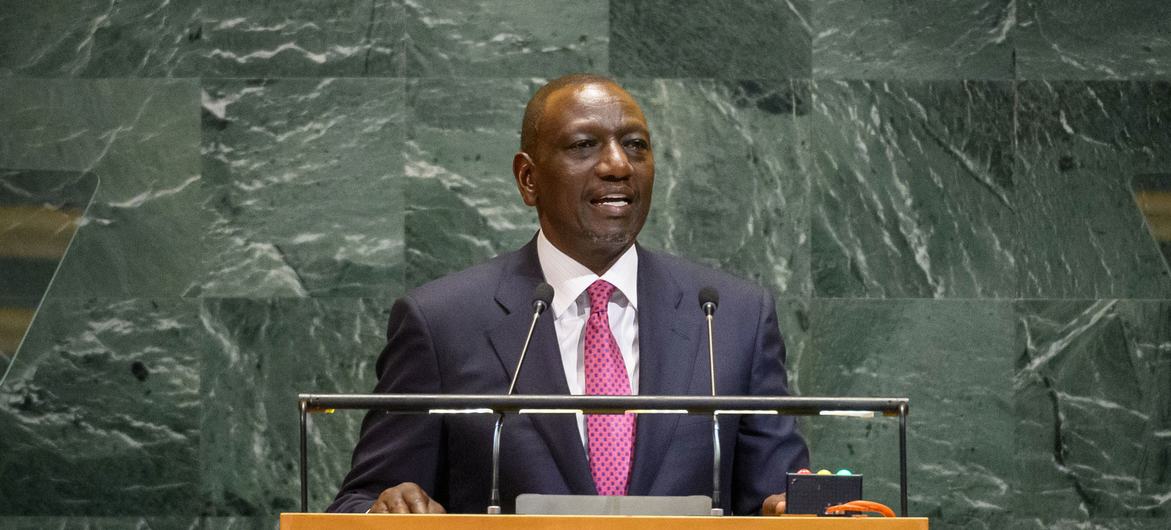
Africa could be short of up to Sh52 trillion every year to meet its climate adaptation needs, President William Ruto has warned, as countries prepare for another round of global climate negotiations.
Ruto put Africa’s annual adaptation finance gap at between $200 billion and $400 billion, equivalent to roughly Sh25.8 trillion to Sh51.6 trillion.
His warning came in New York on Wednesday as he chaired a meeting of the Committee of African Heads of State and Government on Climate Change (CAHOSCC).
The meeting is helping African countries agree on common priorities ahead of COP31 in Antalya, Türkiye, later this year and lay the groundwork for COP32 in Addis Ababa in 2027.

Ruto’s central message was blunt: Africa has heard enough promises. It needs the money behind them.
“The world is also bracing for a predicted super El Niño of unprecedented strength,” Ruto said, warning that vulnerable countries could bear some of the greatest impacts.
He identified finance as the main obstacle to preparing for climate shocks, building resilience and cutting emissions.
Aid is falling as climate needs rise
Ruto said official development assistance fell by 23 per cent in 2025, adding pressure on countries that already rely on external financing for development and climate programmes.
He also pointed to the latest replenishment of the Global Environment Facility, which secured initial pledges of about $3.9 billion.
That is lower than the $5.33 billion pledged during the previous GEF-8 replenishment.
Ruto said the figures showed the wider challenge facing developing countries.
“Climate finance is not charity,” he said, arguing that developed countries have obligations under the UN climate convention and the Paris Agreement.
The African Union has similarly called for climate finance that is more accessible, affordable and predictable, while warning that new funding should not deepen the continent’s debt vulnerabilities.
Africa wants the Belém promise delivered
The funding argument comes less than a year after the COP30 climate summit in Belém, Brazil.
Countries agreed at COP30 to at least triple adaptation finance by 2035. The agreement was intended to strengthen support for developing countries dealing with floods, droughts, rising temperatures and other climate impacts.
But Ruto said the commitment now needs a practical route to delivery.
He pointed to the Adaptation Fund as one example of the gap between ambition and money on the table.
The fund received about $138 million in pledges against a $300 million target, according to the figures cited by the President.
For Africa, the concern is not only how much money is promised but whether it can be accessed quickly enough for projects on the ground.
Recent analysis by the Overseas Development Institute found that negotiations on adaptation finance remained difficult ahead of COP31, particularly over predictability, accessibility and how the commitment to increase adaptation finance should be implemented.
COP31 faces a delivery test
Ruto said African countries should use COP31 to turn the Belém commitment into a credible delivery plan.
He wants adaptation to become a central outcome of COP32, which Ethiopia will host in 2027.
The African Union has backed that approach, calling for stronger adaptation finance alongside support for loss and damage, technology transfer and capacity building.
The push is also being reflected in Africa’s own preparations.
At the Conference on Climate Change and Development in Africa held in Addis Ababa earlier this month, African policymakers and climate experts called for a shift from climate pledges to implementation ahead of COP31 and COP32.
Ruto links climate action to jobs and investment
Ruto also argued that climate action should not be treated solely as an expense.
He said Africa should use climate investment to expand renewable energy, clean cooking, resilient infrastructure and other areas that can create jobs and support economic growth.
The African Union has highlighted similar priorities, including renewable energy, clean cooking, climate-resilient agriculture and regional power integration.
AU Commission Chairperson Mahmoud Ali Youssouf said Africa must secure finance that is predictable and affordable while avoiding additional pressure on already vulnerable economies.
Africa contributes a relatively small share of global greenhouse gas emissions but faces significant exposure to climate impacts, a disparity repeatedly highlighted by African institutions in the climate negotiations.
The question is what happens after the pledges
The next stage will be closely watched at COP31.
For African governments, the challenge is to secure more funding for adaptation while also ensuring that finance reaches communities facing the effects of climate change.
For donor countries and climate funds, the pressure is to show how existing commitments will translate into projects, rather than adding another round of targets.
That is the gap Ruto wants Africa to take to Antalya: not another promise, but a clearer route from a global climate agreement to money, projects and resilience on the ground.
You may also like
Category: News · Related Topic: William Ruto
Related Video: Beyond Aid: How Japan Is Shaping Kenya’s SME Future | JICA Training Experience
About the Author
Maureen Onyango is a journalist passionate about storytelling, life coaching and spiritual lessons. She studied at the Kenya Institute of Management and enjoys telling stories that inform, inspire and empower communities.
 Facebook
 Twitter / X
 WhatsApp
 LinkedIn
 Telegram
 Reddit