
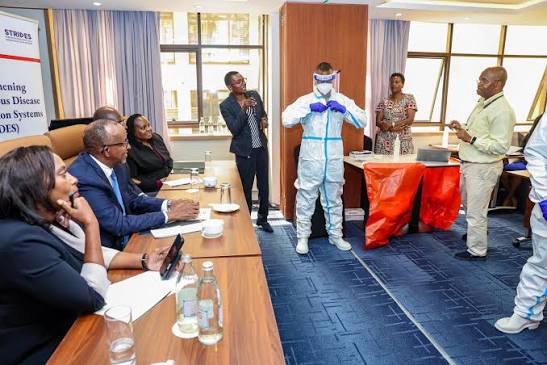
Kenya is tightening disease surveillance at its borders and other high-traffic points as it prepares for a possible Ebola importation while the country battles a widening Mpox outbreak.
The latest government measures come at a time when Mpox has been confirmed in 40 of Kenya’s 47 counties, with 1,298 cases and 19 deaths recorded by September 6.
There is, however, an important distinction.
Kenya has not confirmed a single Ebola case. All suspected cases investigated so far have tested negative.

The Ebola preparations are driven by the continuing regional threat, particularly from the Democratic Republic of Congo (DRC), rather than an outbreak inside Kenya.
The World Health Organisation said on September 10 that the Bundibugyo Ebola outbreak in the DRC had continued to expand, with affected areas reaching six provinces. Uganda, meanwhile, declared its own outbreak over on August 26 after completing 42 days without a new confirmed case.
For Kenya, the concern is movement.
Thousands of people and large volumes of cargo cross the western border every day. Busia, in particular, sits along the Northern Corridor linking Kenya with Uganda and onward to Rwanda, Burundi, South Sudan and the DRC.
WHO estimates that more than 3,000 people cross through Busia daily. The agency says border workers, traders, truck drivers and communities around crossing points are therefore an important part of Kenya’s early-warning system.
Ebola preparedness stepped up
The government has strengthened surveillance at formal and informal crossing points, truck-driver stopovers and other locations where large numbers of people interact.
Multi-agency teams involving the Kenya Defence Forces, National Police Service and national government administrators have also been trained to support surveillance in areas outside formal border posts.
Four laboratories have been designated to test suspected Ebola samples. They are the National Public Health Laboratory, KEMRI Nairobi, KEMRI Kisumu and a mobile laboratory covering Busia and Bungoma.
Healthcare workers are being trained, simulation exercises conducted and isolation facilities prepared.
The government is also building up supplies needed for infection prevention and response, including protective equipment.
These measures are not entirely new.
Kenya activated its National Ebola Incident Management System in May 2026 as the regional outbreak intensified. The system provides a central structure for coordinating surveillance, investigations and emergency response. By June, the Ministry of Health said more than 140,000 travellers from Ebola-affected areas had been screened and more than 100 alerts investigated, with no confirmed Ebola infection recorded.
The latest measures therefore represent an escalation and continuation of preparedness rather than a response to a newly detected case.
Mpox is the more immediate challenge
While Ebola remains a threat Kenya is trying to prevent, Mpox is already spreading within the country.
As of September 6, the Ministry of Health had recorded 1,298 confirmed Mpox infections and 19 deaths across 40 counties.
Mombasa has recorded the highest number of cases at 452, followed by Nairobi with 320 and Busia with 115.
The government has singled out seven counties for heightened attention because of their location along major transport routes or proximity to border points.
They are Mombasa, Nairobi, Busia, Makueni, Kiambu, Kilifi and Nakuru.
The pattern is significant.
The outbreak is no longer confined to a handful of border counties or major cities. With infections now reported in 40 counties, public health authorities are having to balance containment efforts with the reality of extensive movement between counties.
Public Health and Professional Standards Principal Secretary Mary Muthoni has urged Kenyans to maintain hygiene, follow health guidance and remain alert to symptoms.
The Ministry has also continued surveillance, screening and public awareness activities in areas considered more exposed to imported infections.
Border communities are being brought into the response
Kenya’s preparedness is increasingly extending beyond airports and official border posts.
In Busia and Bungoma, health authorities and partners have been training frontline workers and engaging traders, truck drivers and other people who operate around busy crossing points.
WHO reported last week that 35 health workers and 45 border stakeholders from Busia, Malaba and Lwakhakha had been trained on identifying suspected Ebola cases, reporting alerts and communicating accurate information to communities.
That approach matters because an infectious disease can move faster than formal systems if people at the border do not know what to look for or where to report a suspected case.
For Kenya, the challenge is therefore not simply screening travellers.
It is making sure that a trader, truck driver, health worker or resident in a border community can recognise a possible threat and trigger a response quickly.
Kenya faces several health threats at once
The government is also monitoring other infectious diseases.
According to the latest government update, dengue fever cases are being managed mainly in Garissa and Wajir, while measles cases have been reported in Baringo, Marsabit, Wajir, Mandera and Garissa.
That puts additional pressure on a health system already responding to Mpox and preparing for the possibility of Ebola entering the country.
For now, authorities are asking Kenyans not to confuse preparedness with confirmation.
There is no confirmed Ebola case in Kenya.
But with active Ebola transmission continuing in parts of the DRC and large numbers of people moving across East Africa, officials are trying to make sure the first suspected case, if it ever arrives, is detected quickly.
The more immediate reality is Mpox, which has already reached most parts of the country.
The government is therefore fighting two different battles: trying to keep Ebola out while containing a Mpox outbreak that is already inside Kenya.
You may also like
Category: News
Related Video: Gachagua’s explosive Ruto scorecard: Debt, taxes, State capture and a government ‘that has failed’
About the Author
Maureen Onyango is a journalist passionate about storytelling, life coaching and spiritual lessons. She studied at the Kenya Institute of Management and enjoys telling stories that inform, inspire and empower communities.
 Facebook
 Twitter / X
 WhatsApp
 LinkedIn
 Telegram
 Reddit