
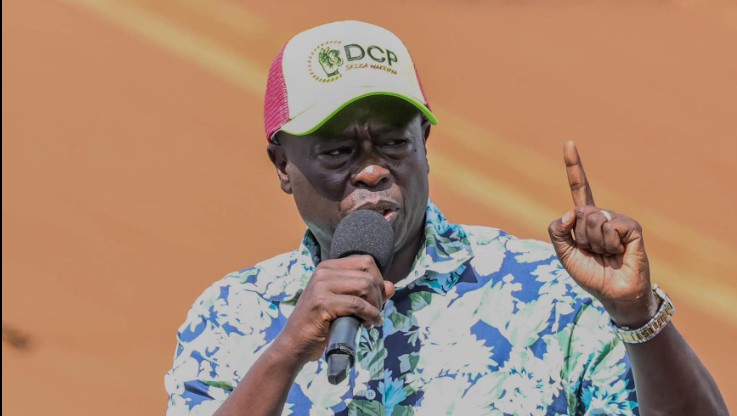
Former Deputy President Rigathi Gachagua says he has no personal grievance against Nairobi Senator Edwin Sifuna over the 2024 Senate vote that removed him from office, arguing that the two were political opponents at the time and can now work together against President William Ruto.
Gachagua’s remarks offer a glimpse into the delicate negotiations taking place within the opposition as its leaders try to agree on a single presidential candidate for the August 2027 General Election.
Speaking in a television interview on Wednesday, 28 October, Gachagua said he had directly questioned Sifuna about his role in the impeachment when the senator and his delegation visited his Wamunyoro home in Nyeri County on 20 October.
According to Gachagua, Sifuna explained that the Orange Democratic Movement (ODM), which he represented during the impeachment period, had acted in line with its political interests. Gachagua said he accepted that explanation.
“He told me, ‘Riggy G, if you were in our shoes, you would have done the same,’” Gachagua recounted.
The former deputy president said the exchange helped him distinguish between political opponents and people he believed had betrayed an agreement with him.
Why Gachagua says Sifuna did not betray him
Gachagua argued that Sifuna’s participation in the process was not a betrayal because they were not political allies when the Senate considered his removal.
“In my community, a betrayal by an outsider is not betrayal. Sifuna and I were not in the same camp; he did not vote for me, so how does he betray me?” he said.
He reserved his strongest criticism for former allies in the Kenya Kwanza coalition, saying their relationship with him had been built on shared political commitments.
“The betrayal is with the Kenya Kwanza team. These are people we were together with; we had an agreement on how to work, and we campaigned for them,” Gachagua said.
His comments recast the impeachment as a political turning point rather than a personal dispute with every leader who supported it.
Gachagua also argued that the fallout weakened Ruto’s relationship with Mount Kenya, where he had secured substantial support in the 2022 election. He believes the President will face questions from voters in the region about why his former deputy was removed from office.
That remains Gachagua’s political assessment, rather than proof that the entire region has shifted away from Ruto. The President’s support in 2027 will depend on voter priorities, campaign alliances and developments between now and polling day.
Impeachment remains a defining political event
On 17 October 2024, the Senate voted to remove Gachagua from the deputy presidency after finding him guilty on five of the 11 charges brought against him. Fifty-four senators upheld the first charge, while the Senate found him guilty on four other grounds and cleared him on six. The removal was the first of a sitting Kenyan deputy president through impeachment. <Cite refs={["turn245303search0","turn245303news47"]}/>
Gachagua had been Ruto’s running mate in 2022 and played a key role in campaigning for the Kenya Kwanza ticket in Mount Kenya. His relationship with the President deteriorated before his removal, and he has since built his own political platform through the Democracy for the Citizens Party (DCP).
He now presents the impeachment as a mistake by Ruto’s allies that ultimately created room for a new opposition alignment.
“It’s a blessing in disguise. I’m happier than I was,” Gachagua said, describing his willingness to work with leaders who once supported his removal.
The claim that the impeachment has permanently cost Ruto support in Mount Kenya remains contested political territory. It will ultimately be tested at the ballot box.
Sifuna’s changing political position
Sifuna was ODM secretary-general during the impeachment period and is now associated with the Linda Mwananchi faction, which has been engaging with Gachagua’s camp.
His relationship with ODM’s leadership has since deteriorated. The party’s National Executive Committee removed him as secretary-general on 11 February 2026, citing concerns about discipline within its senior leadership. Sifuna’s political future has since become part of the wider debate over who should lead the opposition in 2027. <Cite refs={["turn245303search1","turn245303search10"]}/>
The meeting at Wamunyoro brought together leaders who have not always agreed on strategy or political direction. Sifuna later described the visit as the beginning of further engagement aimed at building cooperation ahead of the election.
Gachagua has praised the energy of Sifuna’s political movement, but he has also made clear that no official DCP endorsement of the senator’s presidential bid has been agreed. He has cautioned against treating personal preferences expressed by individual politicians as formal party decisions. <Cite refs={["turn245303search4","turn416128search4"]}/>
That distinction matters. Sifuna is among the figures being discussed for the opposition ticket, but he is not the agreed candidate.
Opposition unity faces a bigger test
Gachagua has also held talks with Wiper leader Kalonzo Musyoka as opposition figures weigh how to settle on a joint candidate. Recent reports indicate that the negotiations remain unresolved, with competing presidential ambitions and questions about the running mate still in play. <Cite refs={["turn416128search2","turn416128search3"]}/>
The challenge is not simply to bring leaders into the same room. They must agree on a credible way to select a flag-bearer, persuade their supporters to accept the outcome and build a campaign that reaches voters beyond their traditional political bases.
Gachagua says his DCP is open to former Kenya Kwanza allies who want to change sides, provided they formally join the party and pay the required membership fee. He argues that the opposition needs to bring people together rather than exclude them over past disagreements.
“That is why I must embrace everybody, including those who removed me from office, because I need everybody. We need each other, and we have a job to do,” he said.
His willingness to reconcile with Sifuna may help lower the temperature between the two camps. But it does not settle the harder questions of leadership, policy or political bargaining.
For the opposition, the real test will be whether personal reconciliation can translate into a common strategy before the 2027 election. Gachagua’s message is that past political battles should not prevent cooperation now. Whether that approach can hold together leaders with their own presidential ambitions remains to be seen.
You may also like
Category: Politics · Related Topic: William Ruto
Related Video: Dolly Parton’s Family Announces Her Passing in Emotional Tribute
About the Author
Maureen Onyango is a journalist passionate about storytelling, life coaching and spiritual lessons. She studied at the Kenya Institute of Management and enjoys telling stories that inform, inspire and empower communities.
 Facebook
 Twitter / X
 WhatsApp
 LinkedIn
 Telegram
 Reddit