
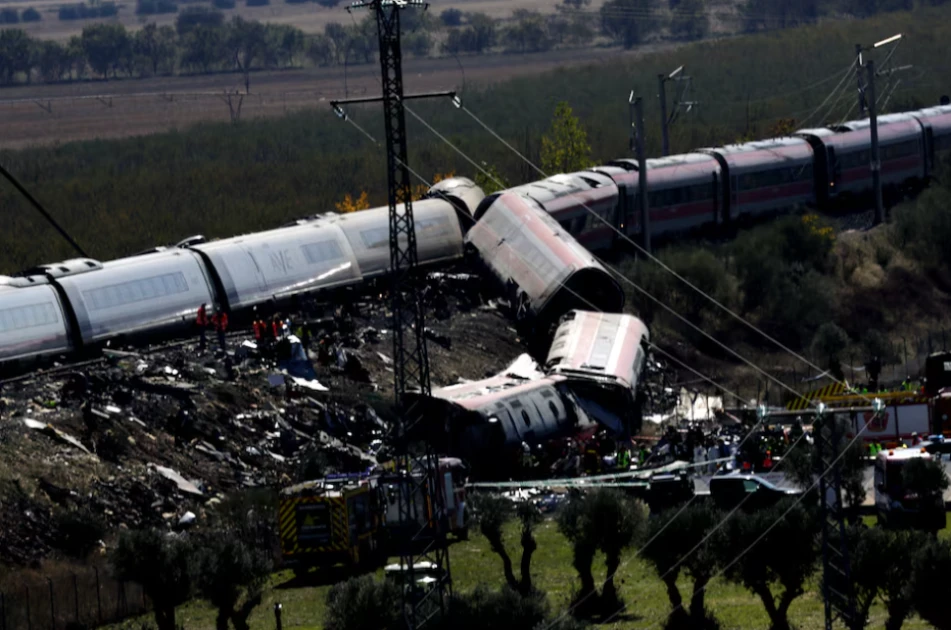
At least 64 people have been killed and 58 injured after two high-speed trains collided in central Spain, turning a busy rail route into the scene of one of the country’s deadliest railway disasters in decades.
The collision happened on Wednesday morning near Urda, in Toledo province, when a Renfe high-speed train struck an Iryo service that had stopped on the Madrid–Andalusia line. Several carriages derailed, with some tumbling down an embankment.
The latest death toll was reported by sources in the regional government of Castilla-La Mancha, according to Spanish news agency Europa Press and other media reports. Rescue operations and efforts to reach passengers trapped in the wreckage have continued, and the figures may change as authorities account for those involved.
The two trains were carrying a combined 544 people, including a baby, according to regional authorities. The Iryo train had 147 passengers, while 397 were travelling on the Renfe service.
Passengers describe a violent impact
Survivors described a sudden collision that left passengers injured and struggling to understand what had happened.
A passenger identified as Miguel told Spanish radio station COPE that he heard a huge roar followed by a prolonged impact. Looking through a window, he said, he could see the wreckage of another train.
Another passenger, Eduarda, told Cadena SER that the impact threw her forwards. She initially thought the train had made an emergency stop. The extent of the damage became clear only when she saw injured passengers and was instructed to evacuate.
She said she climbed down an embankment to reach safety and saw a carriage hanging down the slope, with fire in one section of the train.
Emergency services, including firefighters, police officers and medical teams, were deployed to the scene. Authorities also arranged facilities to accommodate passengers and established support services for affected families.
What caused the collision?
The precise cause remains under investigation.
Initial reports indicate that the Renfe train struck the Iryo service from behind while the latter was stationary. Early accounts have raised questions about signalling and decisions made by railway control staff, but investigators have yet to establish a definitive sequence of events or assign responsibility.
Spain’s rail infrastructure manager, Adif, announced that high-speed services on the Madrid–Andalusia route had been suspended following the collision. Renfe activated its emergency assistance plan for passengers and relatives of those affected. Iryo also said it had activated its emergency procedures.
The distinction matters. While early accounts can help establish what happened, the final findings will need to explain why a moving train reached a stationary service and whether safety systems and operating procedures worked as intended.
A second major rail disaster in the same year
The crash comes around nine months after a January collision near Adamuz, in Córdoba province, killed 46 people and injured many others.
That disaster prompted questions about the condition of Spain’s railway infrastructure, investment in maintenance and the safeguards designed to prevent trains from colliding. Wednesday’s tragedy is likely to intensify those questions, particularly as investigators examine the signalling systems and operational decisions involved.
However, the earlier accident does not establish the cause of the latest crash. Each incident requires its own technical investigation before conclusions can be drawn about possible failures or wider safety problems.
Spain has built one of the world’s largest high-speed rail networks and carries millions of passengers each year. The latest collision is therefore a major test of public confidence in a system that is central to domestic travel.
Government responds as services remain suspended
Prime Minister Pedro Sánchez expressed shock over the accident and said he was in contact with the transport minister and the regional government.
The opposition People’s Party also cancelled its planned campaign events, according to the original reports, as the country responded to the disaster.
Renfe said its priority was to assess the casualties and support victims and their families. The company established a dedicated helpline for relatives seeking information.
Passengers planning to travel between Madrid and Andalusia should check directly with their rail operator for the latest service information, as the suspension affects a key route.
The regional emergency information line for people seeking information about relatives involved in the crash is 900 122 112. Renfe has also published a family assistance number, 900 10 10 20.
As recovery operations continue, the immediate priority remains reaching victims, identifying those who have died and supporting survivors. The investigation will then have to establish how two high-speed trains came to collide and what measures are needed to prevent a similar disaster.
Category: International
Related Video: Human Ladder Reaches Dangerous Heights as Climbers Keep Going
Related Explainer: Ebola contact tracing: Why the 21-day window matters in Kenya’s response
About the Author
Maureen Onyango is a journalist passionate about storytelling, life coaching and spiritual lessons. She studied at the Kenya Institute of Management and enjoys telling stories that inform, inspire and empower communities.
 Facebook
 Twitter / X
 WhatsApp
 LinkedIn
 Telegram
 Reddit