
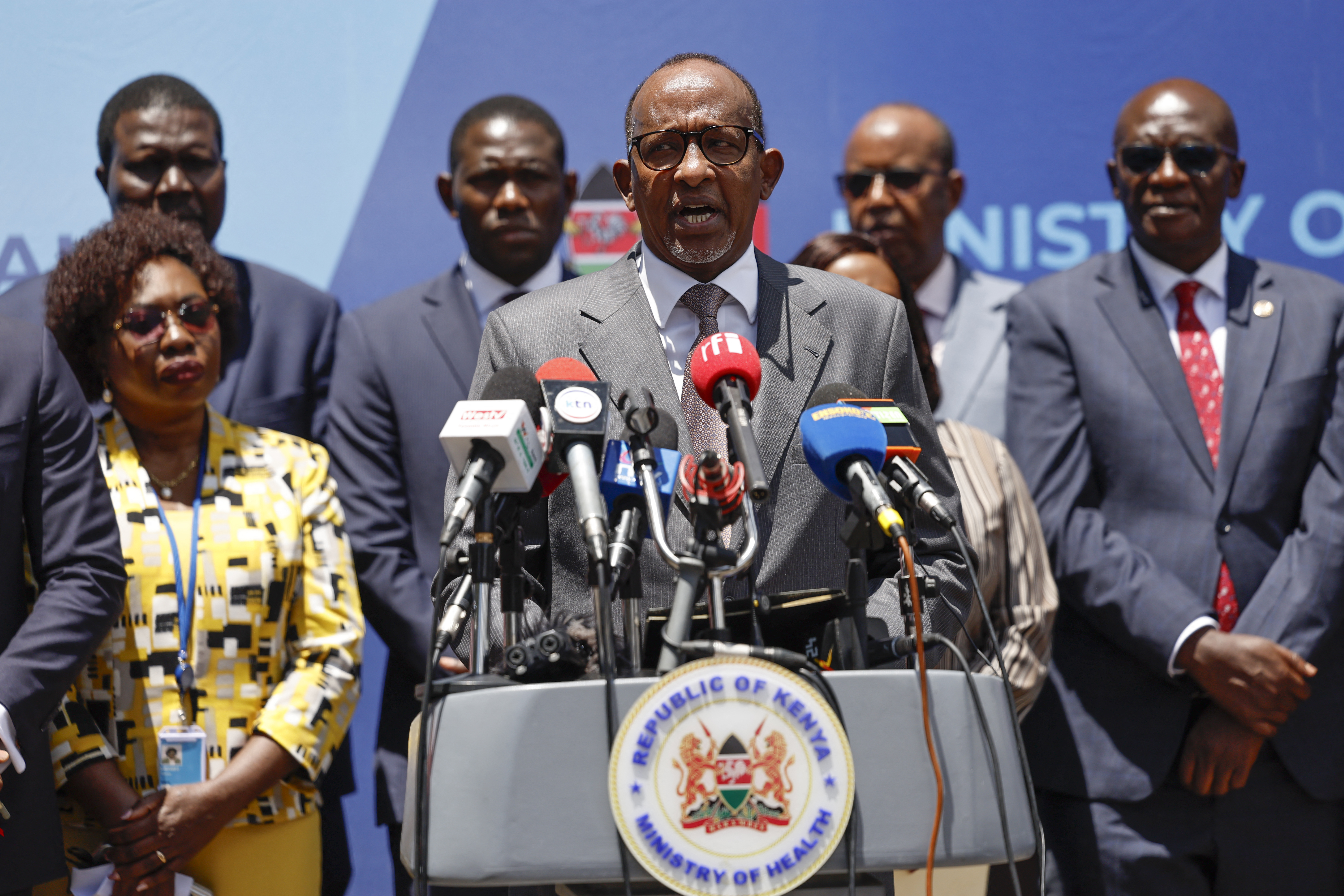
Kenya has launched an urgent contact-tracing operation after confirming its first imported Ebola case, with health authorities seeking 27 people who travelled on the same flight as the patient.
Health Cabinet Secretary Aden Duale said 28 contacts had already been identified. They include relatives of the deceased and healthcare workers who attended to him.
A further 23 passengers and four crew members who were on the same Jambojet flight are being traced.
The patient, a Kenyan citizen who had lived in the Democratic Republic of Congo (DRC) for about seven years, died at Nairobi Hospital late on Monday, October 5.
The case was confirmed on Tuesday, October 6, after laboratory tests detected the Bundibugyo strain of Ebola.
Duale said the government was moving quickly to locate and monitor people who may have been exposed.
“So far, we have listed 28 contacts of the deceased, including family members and health workers who attended to the deceased,” Duale said.
He added: “We are also pursuing a further 23 passengers and four crew members who were on the same flight with the deceased.”
The two groups should not automatically be treated as 55 separate people. The Ministry has not indicated whether any of the passengers or crew are already among the 28 identified contacts.
The patient's final journey
The patient had been living and working in the DRC for seven years.
He fell ill about a month ago and received treatment at several health facilities in the DRC before beginning his journey back to Kenya.
He travelled by road to Kampala, Uganda, before boarding a Jambojet flight to Nairobi.
The flight landed at Jomo Kenyatta International Airport at about 1.10pm on Saturday, October 3.
The patient underwent routine public health screening at the airport before clearing immigration.
A relative and a friend then picked him up and took him directly to Nairobi Hospital.
At the hospital, he was isolated after presenting with fever, chills, severe fatigue, weakness, muscle pain, painful swallowing, a sore throat and bleeding beneath the skin.
Doctors considered his travel history and symptoms before collecting samples for laboratory testing.
Tests carried out by the National Virology Reference Laboratory and the Kenya Medical Research Institute confirmed Ebola.
He was placed on supportive treatment but died at about 11.30pm on Monday.
Contact tracing now takes centre stage
The death has shifted the focus of Kenya's response to people who may have been exposed.
The first 28 contacts include people who had direct links to the patient before and during his treatment.
The 27 people from the flight present a separate tracing challenge because authorities must establish where each passenger and crew member travelled after arriving in Nairobi and whether any further close contacts resulted.
The government has not announced any additional confirmed Ebola case arising from these contacts.
Being identified as a contact does not mean a person has Ebola.
The purpose of contact tracing is to find people who may have been exposed, monitor them for symptoms and act quickly if illness develops.
WHO guidance places the maximum Ebola incubation period at 21 days. Contacts are therefore followed for 21 days after their last known exposure, with those who develop symptoms requiring immediate assessment and appropriate isolation.
Kenyan authorities have also prepared quarantine arrangements for people considered to be at risk.
Patient's direct route to hospital
One factor giving health officials some room to trace the patient's movements is that he was taken directly from JKIA to Nairobi Hospital rather than making other reported stops after landing.
At Nairobi Hospital, he was first isolated in the Accident and Emergency area before being moved to the East Wing isolation facility.
Duale said the facility had previously been prepared during the Covid-19 pandemic and had infrastructure suitable for managing serious infectious disease cases.
The government is also arranging a safe and dignified burial under Ebola infection-control protocols.
Kenya had prepared before the case arrived
The first confirmed case comes after months of government preparations linked to the Ebola outbreak in the DRC and Uganda.
The Ministry of Health says it had maintained heightened surveillance since the outbreak began in May.
By October 6, more than 652,000 travellers had been screened, while 267 samples had been tested across five laboratories. The Ministry said only one had returned positive for Ebola — the current case.
Kenya had also strengthened surveillance at key border points and trained health workers to identify and respond to suspected Ebola infections.
That preparation is now being tested by an actual imported case.
Wider outbreak remains active
Kenya's case is linked to the wider Bundibugyo Ebola outbreak in the DRC.
WHO's latest epidemiological update, covering data to October 2, recorded 8,442 confirmed cases and 4,080 confirmed deaths in the DRC. Uganda had reported 20 confirmed cases and two deaths before ending its outbreak response in July.
The Kenyan case therefore represents an imported infection from an outbreak that remains active in the region.
But confirmation of one imported case does not mean Ebola is circulating widely in Kenya.
The immediate test for the country's health system is whether contact tracing can identify everyone who may have been exposed and ensure that anyone who develops symptoms is assessed quickly.
Duale has urged Kenyans to remain calm while following public health advice.
For people who may have had direct contact with the patient or are contacted by health officials, the priority is to cooperate with monitoring teams and promptly report any symptoms.
The Ministry has also urged members of the public to seek care at recognised health facilities if they become unwell rather than delay treatment.
You may also like
Category: Health
Related Video: Human Ladder Reaches Dangerous Heights as Climbers Keep Going
Related Explainer: Explainer: Why Kenya is moving hospitals to HMIS and what it means for SHA patients
About the Author
Maureen Onyango is a journalist passionate about storytelling, life coaching and spiritual lessons. She studied at the Kenya Institute of Management and enjoys telling stories that inform, inspire and empower communities.
 Facebook
 Twitter / X
 WhatsApp
 LinkedIn
 Telegram
 Reddit