
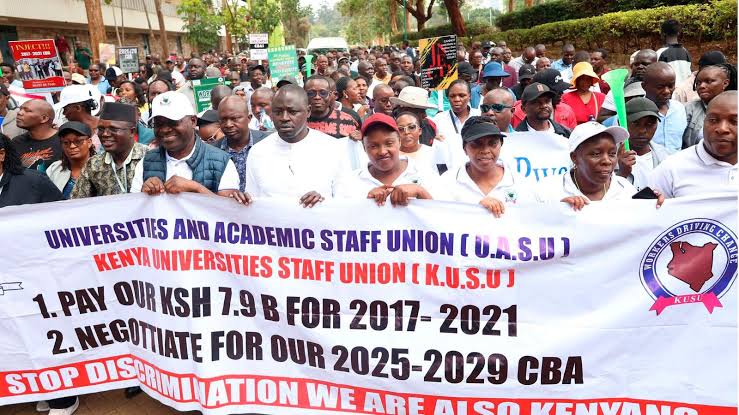
Public university lecturers are preparing to march to Parliament and key government offices after fresh talks collapsed, leaving students uncertain about when normal learning will resume.
University lecturers are set to take their pay dispute to the streets of Nairobi on Thursday, October 15, after another round of negotiations failed to end a nationwide strike now in its second week.
The Universities Academic Staff Union (UASU) has announced a peaceful procession from the University of Nairobi’s Graduation Square to Parliament, the National Treasury and the Ministry of Education. The protest is intended to increase pressure on the government after lecturers’ unions rejected a reported Sh12 billion counter-offer on Monday.
At the centre of the dispute is the 2025–2029 collective bargaining agreement (CBA), which the unions want negotiated, signed, registered and fully implemented, backed by a clear commitment on how the government will fund the deal.
The breakdown in talks means students in public universities face further uncertainty, while some final-year students are already struggling to complete clearance requirements ahead of scheduled graduation ceremonies. Why the Sh12 billion offer failed
The latest negotiations between the government, university employers and staff unions collapsed on October 12, with UASU and the Kenya Universities Staff Union (KUSU) rejecting the proposed package.
UASU Secretary-General Constantine Wasonga said the offer did not meet the unions’ expectations.
“The counter-offer from the government is awfully inadequate, and we have rejected it in toto,” Wasonga said.
The unions have argued that the negotiations must address their specific demands rather than focus on a single financial figure. They also say the government has not provided the firm funding commitment they consider necessary to conclude the agreement.
The Standard reported that the unions viewed the latest proposal as largely unchanged from an earlier offer presented on October 1. The absence of National Treasury officials from the October 12 meeting also became a concern, given that funding is central to the dispute.
The disagreement is therefore about more than the amount on the table. The unions want certainty over the terms of the agreement and the source of funding for university staff salaries.
Wasonga has opposed a proposal that he says could leave staff salaries dependent on student fees. He argues that university employees should be paid through public funds appropriated by Parliament or the Consolidated Fund.
The protest route and what UASU wants
In a notice dated October 12, Wasonga informed the Inspector General of Police of plans for a procession beginning at 10am at the University of Nairobi’s Graduation Square.
The planned route will take demonstrators along University Way and Koinange Street before crossing Kenyatta Avenue to Cardinal Otunga Plaza. They will then proceed along Kaunda Street, Parliament Road and Harambee Avenue.
The union plans to hold sit-ins at Parliament Buildings, the National Treasury and the Ministry of Education offices before returning to the university grounds, where its leaders are expected to address members.
UASU has requested police security for the procession. The notice was also copied to relevant police commanders in Nairobi.
The demonstration is part of the union’s effort to press the government to resolve the outstanding issues. It comes after the October 12 meeting failed to produce a settlement, despite previous engagement between the parties.
Government says previous salary arrears have been cleared
The government has maintained that it has addressed important grievances raised by university staff.
Education Cabinet Secretary Julius Ogamba said on October 5 that outstanding arrears under the 2017–2021 and 2021–2025 CBAs had been cleared. He urged lecturers to resume teaching while negotiations on the new agreement continued.
“As we speak today, all arrears under the 2017–2021 and 2021–2025 CBAs have been fully cleared,” Ogamba said during the World Teachers’ Day celebrations at Kasarani Stadium.
That position has not ended the strike. The unions continue to insist that the current CBA and other outstanding employment concerns require a satisfactory settlement.
The difference between the two positions is central to the impasse: the government says it has settled historical arrears and remains willing to negotiate, while the unions say the proposed terms and funding arrangements do not provide the guarantees they need.
The government has also urged lecturers to obey court orders and return to work. The unions, however, have maintained that industrial action will continue until their demands are addressed.
A dispute that has returned after last year’s strike
The current standoff follows a prolonged university staff dispute in 2025, when unions pressed for outstanding payments under the 2017–2021 agreement, implementation of the subsequent CBA and the start of negotiations for the 2025–2029 deal.
A return-to-work formula was signed on November 5, 2025, but the new round of negotiations has again stalled.
The latest strike began on October 2, 2026, after a seven-day strike notice expired without an agreement. UASU, KUSU and the Kenya Union of Domestic, Hotels, Educational Institutions, Hospitals and Allied Workers (KUDHEIHA) have been involved in the wider industrial action.
The renewed disruption has raised concerns about the academic calendar, particularly for students nearing graduation. The Standard reported on October 15 that some final-year students were struggling to clear outstanding requirements and resolve missing marks because lecturers were unavailable.
Students caught between the two sides
For students, the immediate concern is when teaching will resume and whether the strike will affect examinations, clearance and graduation dates.
The dispute also raises a broader question about the stability of public universities. Repeated industrial action can interrupt learning and leave students uncertain about when they will complete their studies, even when the disagreement is primarily between employers, the government and staff unions.
The planned march is another attempt to force a breakthrough. But a protest alone will not settle the disagreement over the CBA, funding arrangements and the government’s financial offer.
For now, the next step rests with the negotiating parties. Unless they find terms acceptable to both sides, lecturers remain on strike and students face further disruption.
You may also like
Category: Education
Related Video: What Dangote’s proposed Lamu oil refinery could mean for East Africa
Related Explainer: Inside Kenya’s crude supply puzzle as Dangote prepares to break ground in Lamu
About the Author
Maureen Onyango is a journalist passionate about storytelling, life coaching and spiritual lessons. She studied at the Kenya Institute of Management and enjoys telling stories that inform, inspire and empower communities.
 Facebook
 Twitter / X
 WhatsApp
 LinkedIn
 Telegram
 Reddit