
Standfirst: Migwena Grounds filled with mourners, music and tributes as the Odinga family urged political leaders to set aside rivalry and focus on the late former Prime Minister’s legacy.
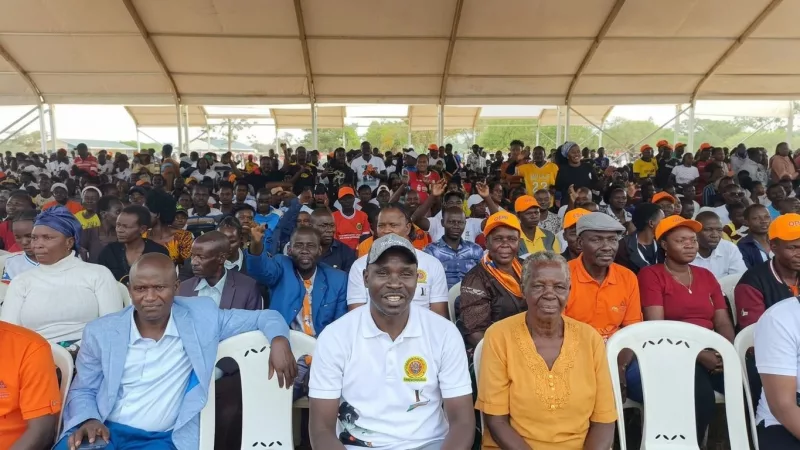
Thousands of Kenyans gathered at Migwena Cultural and Sports Grounds in Bondo, Siaya County, on Thursday to honour former Prime Minister Raila Odinga, one year after his death.
Mourners began arriving as early as 6am, with police officers on standby to guide people into designated areas as the gathering grew. Music, dance and cultural performances formed part of the programme celebrating the life of the veteran opposition leader.
Many supporters wore orange, the colour associated with the Orange Democratic Movement (ODM), as they joined members of the Odinga family, political leaders and other guests for the anniversary.
But beyond the tributes, the gathering carried another message: Raila’s family wants the day to bring Kenyans together, not become a contest between rival political camps.
His widow, Ida Odinga, and Siaya Governor James Orengo had appealed for restraint ahead of the event, asking leaders to avoid turning the commemoration into a platform for political rivalry.
“The main reason we are here is to commemorate Baba. He belonged to many people, belonged to denominations, belonged to many parties, and let’s give him a good sign-off,” Ida said during an inspection of the preparations on Tuesday.
Orengo also urged Kenyans to maintain peace and allow people from different political backgrounds to pay their respects.
The appeals come as political alliances and disagreements take shape ahead of the 2027 General Election, making a gathering in honour of one of Kenya’s most influential political figures significant beyond its ceremonial purpose.
Why Migwena holds special meaning for the Odinga family
The choice of venue gives the anniversary a deeply personal connection to Raila’s family and the community that shaped his life.
Migwena has long hosted sporting competitions and cultural gatherings in the greater Siaya region. Raila himself attended events there, including the Migwena Sports and Cultural Festival in 2024, where he watched traditional wrestling and flagged off a boat race.
The grounds also hold a place in the Odinga family’s history. Accounts of the family’s past link the venue to the meeting between Raila’s father, Jaramogi Oginga Odinga, and Mary Adhiambo, who later became his wife and the mother of Raila and his brother, Oburu Oginga.
For residents, the grounds are a community meeting place. For the family, they represent a connection between Raila’s public life and his roots.
That history helps explain why the family selected Migwena rather than a major urban venue for the first anniversary.
Prof Adams Oloo, chairperson of the National Steering Committee coordinating the celebrations, said the programme was designed to reflect the relationship between Raila and the people he served.
“It will be a celebration worthy of the man. Musicians from across the country and beyond will take to the stage to honour him in song, because Raila Odinga loved the people, and the people loved him back,” Oloo said.
Family warns against turning the memorial into a political contest
The family’s call for unity comes at a time when ODM’s political direction is under close scrutiny.
Raila died on October 15, 2025, aged 80, while receiving medical treatment in India. His death ended a political career spanning decades, during which he played a major role in Kenya’s multiparty politics, constitutional reform and negotiations between rival political camps.
His legacy remains a rallying point for supporters, but it also carries political weight as parties and leaders position themselves ahead of the next election.
Organisers have therefore stressed that the anniversary should not be used to demonstrate political strength or mobilise rival factions.
Rarieda MP Otiende Amollo, who serves as vice-chairman of the anniversary steering committee, said the gathering should remain focused on remembering Raila rather than providing a platform for political competition.
The organisers have also called for peaceful conduct and warned against attempts to disrupt the event.
The message is clear: people from different political backgrounds are welcome, but the family wants the day to honour Raila’s life rather than deepen existing divisions.
Music, prayer and reflection mark the anniversary
The programme brings together religious services, cultural performances, speeches and video presentations reflecting on Raila’s life and public service.
The main service was scheduled to begin at 11am, following performances and screenings tracing his political journey. Interdenominational prayers and tributes from family members, dignitaries and other guests were also planned.
The anniversary followed a candle-lighting ceremony at the Odinga family home, Kang’o ka Jaramogi, on Wednesday evening. The organisers invited supporters in Kenya and abroad to take part in the tribute.
The commemorations have also included an intergenerational dialogue in Kisumu, where participants reflected on Raila’s ideas about democracy, inclusion and social cohesion.
These activities have extended the anniversary beyond Bondo, giving people who cannot attend the main gathering an opportunity to remember him.
A year later, questions remain about Raila’s political legacy
Raila’s influence extended beyond the ODM party. He was a central figure in the push for multiparty democracy, the negotiations following the disputed 2007 General Election and the 2010 Constitution.
His 2018 political agreement with former President Uhuru Kenyatta also marked a major shift in Kenya’s political landscape.
One year after his death, the question is how the ideals associated with his political career will be carried forward by the party, his allies and the wider political class.
The anniversary offers an opportunity to reflect on that record, including both his achievements and the challenges that defined his long political journey.
For the thousands gathering in Bondo, however, the day is first about remembrance.
The crowds at Migwena are a sign that Raila’s place in Kenya’s public life remains significant a year after his death. Whether that enduring attachment can encourage greater political unity, as his family hopes, will depend on what leaders do long after the music and speeches have ended.
You may also like
Category: News · Related Topic: Kenya Politics
Related Video: What Dangote’s proposed Lamu oil refinery could mean for East Africa
Related Explainer: Why the BCG Vaccine Leaves That Small Scar on Your Arm
About the Author
Maureen Onyango is a journalist passionate about storytelling, life coaching and spiritual lessons. She studied at the Kenya Institute of Management and enjoys telling stories that inform, inspire and empower communities.
 Facebook
 Twitter / X
 WhatsApp
 LinkedIn
 Telegram
 Reddit