
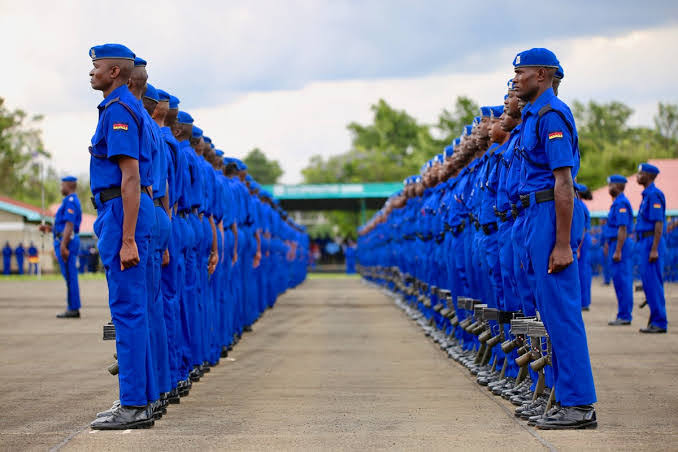
The National Police Service is preparing to make ethics, integrity and anti-corruption training a more central part of police education, with new modules being developed for both officers and their commanders.
The initiative comes as corruption remains a persistent concern in public service, with recent national survey findings placing the police among the institutions most frequently associated with bribery encounters.
The new curriculum is being developed through the National Criminal Investigations Academy (NCIA) with the aim of making ethical conduct part of police training from the start, rather than relying mainly on disciplinary action when misconduct occurs.
Two competency-based modules are being developed.
One will focus on ethics and integrity for police officers generally.
The second will target leaders and supervisors, with a stronger focus on how commanders can identify weaknesses within their institutions and put safeguards in place.
Assistant Inspector General Aljir Hassan, the NPS Director of Training and Research, said the modules should eventually be taught across the service's training institutions.
“Training must equip officers not only with professional skills, but also with the values that guide responsible and accountable policing,” Hassan said.
The message marks a shift towards treating corruption prevention as part of professional police training rather than an issue dealt with only through investigations and disciplinary procedures.
Commanders put under the spotlight
A major part of the new programme will focus on police commanders.
The leadership module is expected to help senior officers identify areas where corruption can occur within their institutions and establish controls to reduce those risks.
It will also examine how complaints and reports of misconduct are handled.
That includes ensuring that reporting mechanisms work and that allegations are followed up rather than simply recorded and left unresolved.
The approach recognises that corruption can involve more than the actions of an individual officer.
Supervisory systems, reporting structures and institutional controls can also determine whether misconduct is detected and addressed.
The workshop bringing together the NPS, Directorate of Criminal Investigations, NCIA, Ethics and Anti-Corruption Commission and United Nations Office on Drugs and Crime is developing the modules around those concerns.
Why the training matters
The move comes against a backdrop of continuing public concerns about bribery involving law enforcement agencies.
The Kenya National Gender and Corruption Survey 2025, produced through a partnership involving the Ethics and Anti-Corruption Commission and other institutions, found that 35.5 per cent of respondents who reported giving a bribe to a public official identified police officers.
Police ranked ahead of other public institutions in the frequency of reported bribery encounters.
The survey also put the average bribe associated with police officers at KSh4,656. That figure refers to the average amount reported in the survey and should not be interpreted as an average income or proven amount received by police officers.
The broader national picture is also significant.
The survey found that the average bribe across the country rose from KSh4,878 in 2024 to KSh6,724 in 2025. It also found that most bribes were paid before a service was provided, suggesting that corruption can affect access to public services at the point where citizens seek help.
Recent police bribery allegations
The training initiative also follows recent investigations into alleged bribery involving police officers.
In August, the EACC arrested two officers attached to Kenya Power's Coast Regional Office over allegations that they demanded KSh100,000 from a Mombasa resident.
The officers, identified as Inspector Benjamin Ochieng and Corporal Said Bakari, were accused of seeking the money after alleging that the resident had illegally connected electricity to his home.
The EACC said investigators arrested the officers after they allegedly received KSh50,000 as part of the larger amount.
The two were released on KSh30,000 cash bail each as investigations continued. The allegations have not been determined by a court.
The case is not evidence that all police officers engage in corruption. It does, however, illustrate why the new training programme is being developed alongside enforcement measures.
From workshop to police academies
The curriculum is not yet ready for full rollout.
The modules are undergoing development and review, with stakeholder validation expected before further technical and editorial work.
Once finalised, they are expected to be introduced on a pilot basis before being incorporated into the wider NPS training curriculum.
The programme is receiving support from the European Union through the Programme for Legal Empowerment and Aid Delivery in Kenya Phase II, commonly known as PLEAD II.
EACC and UNODC are also involved in the process.
The NCIA already works with national and international partners on specialised law-enforcement training, including EACC, UNODC and the EU.
Training alone will not settle the corruption question
The new modules could give officers and commanders clearer guidance on ethical decision-making and corruption risks.
But training is only one part of the wider response.
The EACC itself says effective corruption prevention also requires institutional systems that identify risks, strengthen controls and promote integrity in day-to-day operations. Its National Integrity Academy provides specialised ethics and anti-corruption training to public institutions as part of that broader approach.
For the NPS, the real test will therefore come after the classroom.
Officers need functioning channels for reporting misconduct. Complaints need to be investigated. Supervisors need to act on identified weaknesses. And officers accused of wrongdoing must continue to receive due process.
The planned modules are expected to move the NPS in that direction by making ethics and accountability part of the professional training officers receive before and during their careers.
The government now faces the harder task of ensuring that those lessons are reflected in everyday policing.
You may also like
Category: News
Related Video: What Dangote’s proposed Lamu oil refinery could mean for East Africa
About the Author
Maureen Onyango is a journalist passionate about storytelling, life coaching and spiritual lessons. She studied at the Kenya Institute of Management and enjoys telling stories that inform, inspire and empower communities.
 Facebook
 Twitter / X
 WhatsApp
 LinkedIn
 Telegram
 Reddit