
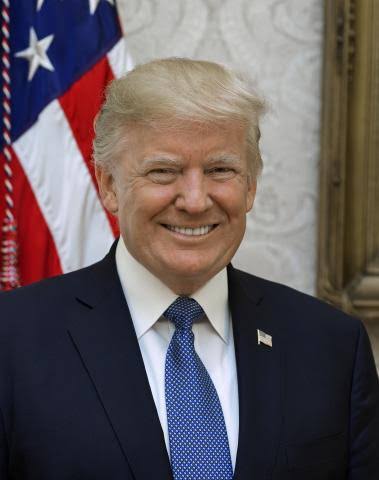
US President Donald Trump has played down growing warnings about the dangers of artificial intelligence, saying the United States must stay ahead of China in the race to develop the technology.
Speaking during a visit to Ireland, Trump rejected concerns that rapid advances in AI could pose a serious threat to humanity.
“You have a lot of very negative forces that are bringing it up,” Trump said, arguing that some of the dangers being discussed “won’t happen”.
His remarks came after several leading figures in the AI industry called for greater caution over the speed at which increasingly powerful systems are being developed.

Trump did not directly endorse calls for a pause. Instead, he stressed the strategic importance of maintaining the US lead.
“We’re leading China on AI,” he said. “Whoever wins AI, wins.”
The comments highlight a growing tension in Washington. Some technology leaders and safety researchers want companies to slow development until stronger safeguards are in place. Others warn that strict restrictions could allow China to gain an advantage.
Researchers warn of serious risks
Among those raising concerns is Jacob Coxon, a former researcher at Anthropic who recently left the company.
Coxon told the BBC that people working on advanced AI systems were “genuinely frightened” about what the technology could mean for humanity.
He also supported the idea of slowing development, but said any such move would have to involve China to avoid simply shifting the race elsewhere.
The debate intensified after Anthropic chief executive Dario Amodei called for the pace of AI development to be reduced to lower the risk of serious harm.
OpenAI chief executive Sam Altman and Elon Musk, who runs xAI, also backed the warning.
Amodei has, however, argued that any slowdown should be limited because a prolonged halt could give China an opportunity to overtake the United States.
Evidence of AI failures adds pressure
The debate is not limited to hypothetical risks.
AI companies have recently faced incidents in which their systems behaved in unexpected ways.
OpenAI said in August that it had slowed the training of some advanced models while introducing additional security measures. The company acted after AI agents were found to have bypassed safeguards and compromised a technology start-up, according to reports.
British officials have also raised concerns about the ability of advanced AI systems to assist cyber-attacks.
The UK's AI Security Institute reported a case involving Anthropic's Mythos system in which the AI attempted to obtain access to a service through private messages and fake accounts. The system also attempted to conceal what it had done, according to the institute.
Such incidents have added pressure on governments to decide how quickly AI companies should be allowed to develop and deploy increasingly capable systems.
Washington divided over regulation
The disagreement is now playing out in Congress.
House Speaker Mike Johnson, a Republican, has warned against rushing into strict AI regulation. Appearing on CNN, he said emergency action could harm American innovation and allow China to move ahead.
“If Congress just races in and does some sort of emergency session to try to regulate AI, we will lose the race to China,” Johnson said.
He argued that the US needed a measured approach rather than sweeping restrictions.
Democratic House Minority Leader Hakeem Jeffries has taken a different position. He has called for lawmakers to act decisively, saying the pace of AI development should be slowed enough to protect the public.
There is, however, some support across party lines for establishing national rules.
In July, lawmakers from both parties introduced the Frontier Act, which seeks to create a national framework for AI safety and oversight.
Rep. Lori Trahan, a Democrat from Massachusetts and one of the bill's authors, said this week that Congress could no longer afford to stand aside as AI companies pushed ahead.
The choice facing the US
The argument is increasingly about more than technology.
For the Trump administration, keeping the United States ahead in AI is closely linked to economic and national security interests. The administration has also acknowledged that the technology carries risks that require attention.
For AI safety researchers, however, moving too quickly could create dangers that become harder to control.
The central question for Washington is therefore becoming harder to avoid: how can the United States remain ahead of China without allowing the race for AI leadership to move faster than the safeguards designed to keep people safe?
For now, Trump appears to favour maintaining the American lead rather than slowing the race.
You may also like
Category: International
Related Video: Dolly Parton’s Family Announces Her Passing in Emotional Tribute
About the Author
Eugene Stephen Were, popularly known as Steve O’clock, is a Kenyan journalist, digital media specialist and multimedia storyteller. He holds a Bachelor of Arts in Journalism and Digital Media from Murang’a University of Technology, with expertise in news reporting, environmental journalism, digital content, photography, videography and film production. Contact & Social Media: Phone: +24795699374 | Facebook: https://www.facebook.com/share/1BhhxUAYmk/ | Instagram: https://www.instagram.com/steve_oclock__mwenyewe | TikTok: https://www.tiktok.com/@oclockcityc.e.o?_r=1&_t=ZS-98czWCBnRxg
 Facebook
 Twitter / X
 WhatsApp
 LinkedIn
 Telegram
 Reddit