
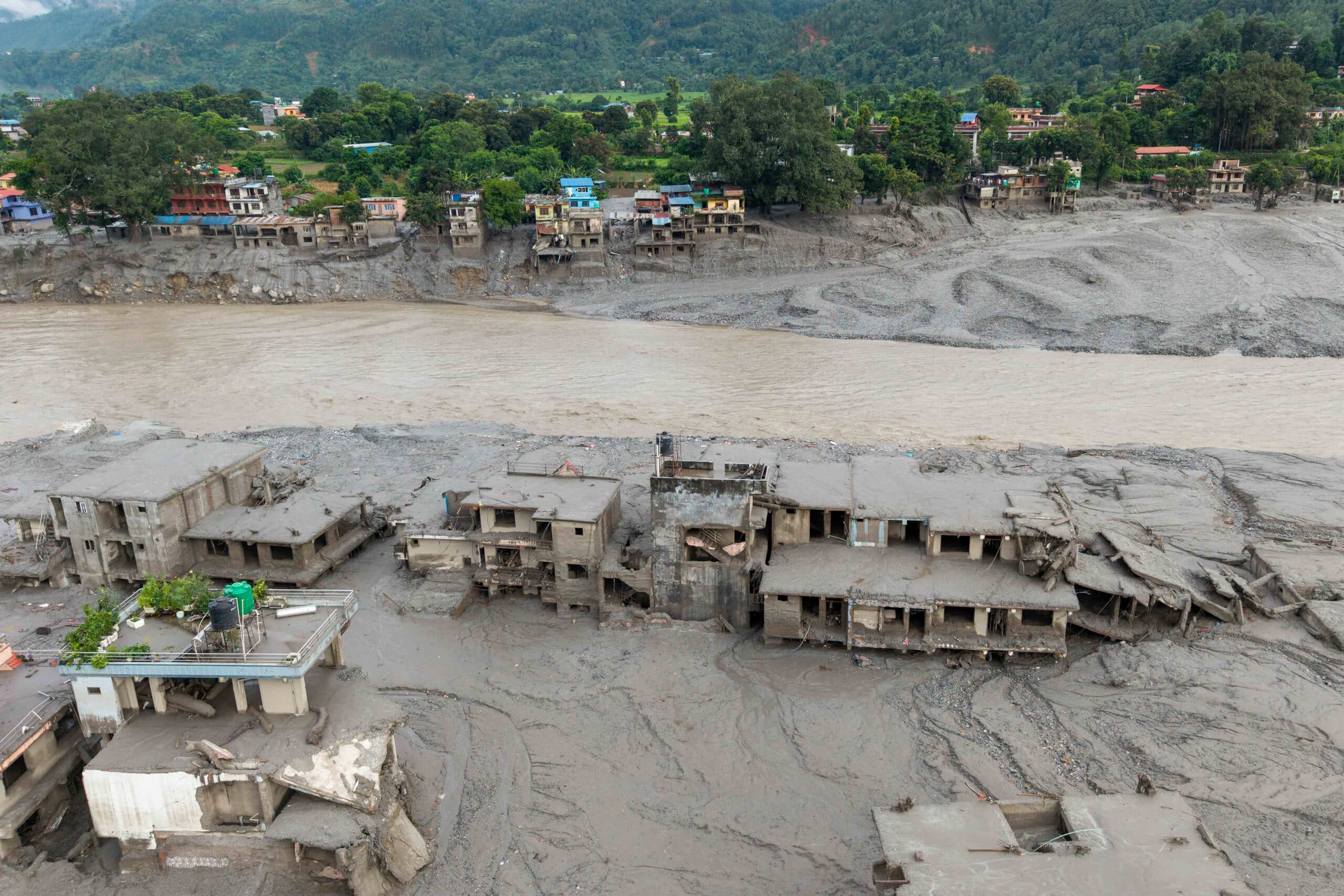
A catastrophic flash flood that tore through Nepal’s Himalayan border with China has killed at least 350 people in Nepal, while hundreds more remain missing as rescue teams race against time to reach communities cut off by destroyed roads and bridges.
The disaster struck on Wednesday, August 26, after a huge mass of ice, rock and debris collapsed into a mountain river near the Nepal-China border. The resulting surge swept through settlements in Rasuwa and downstream districts, carrying mud, boulders and wreckage into the valleys below.
Nepal Police said the death toll had climbed to 359 by Thursday, although casualty figures have continued to change as bodies are recovered from rivers and debris. More than 800 people are still unaccounted for in Nepal, according to the latest reports.
Across the border in Tibet’s Gyirong County, Chinese authorities have reported three deaths and 558 people missing, taking the combined number of missing people in Nepal and China to more than 1,300.
The figures remain fluid as authorities work to reconcile missing-person reports and identify bodies.
What triggered the devastating flood?
Initial reports suggested that a 4.4-magnitude earthquake may have triggered the disaster.
That explanation has since been revised.
The US Geological Survey said further analysis of seismic data and satellite imagery indicated that the event was instead caused by a glacial collapse and debris flow, rather than an earthquake.
Scientists believe a large mass of ice and rock collapsed at high altitude and plunged into a river channel. As it moved downhill, it picked up enormous quantities of sediment and debris, creating a fast-moving wall of water and mud.
The force was devastating.
Entire sections of villages were buried or swept away. Roads, bridges, power infrastructure and other buildings were destroyed. The strategic Gyirong border crossing, an important trade and travel route between China and Nepal, was also badly damaged.
Survivor clung to a mango tree
Among those who survived is 24-year-old Nepali labourer Bibek Kumal, whose story captures the terrifying speed of the disaster.
Kumal was digging a toilet pit outside a newly constructed house in Bidur when his colleagues heard a strange sound and warned him to run.
He escaped the pit moments before the flood arrived.
The torrent swept him through mud and debris until he became trapped in a mango tree.
“Luckily I was stuck up in a mango tree,” Kumal told Reuters from his hospital bed in Kathmandu. “Had there been no mango tree, I would have been washed away to death.”
Kumal watched as the house where he had been working disappeared beneath the flood.
He suffered injuries to his right leg after being struck by the water and a large rock before police rescued him.
His survival stands in stark contrast to the thousands of families still waiting for news of relatives.
Foreign tourists and pilgrims among the missing
The disaster has also triggered an international search for missing travellers.
Nepal is a major gateway for tourists and pilgrims travelling towards Tibet, including people heading to Mount Kailash, one of the region’s most important religious destinations.
Nepali authorities say hundreds of foreign nationals are among those unaccounted for. Reports have listed missing citizens from countries including India, the United States, Malaysia, Australia, Britain and Canada, among others.
India has reported the largest number of missing nationals, with 288 Indians among those still unaccounted for in Nepal, according to the latest figures cited by Reuters.
Families across several countries are now waiting for information as rescue teams try to establish who survived, who remains trapped and who may have been swept downstream.
Rescue effort faces huge obstacles
Nepal’s Army, police and other emergency teams have been deployed in the affected areas.
Helicopters are being used to evacuate survivors and deliver emergency supplies because floodwaters and landslides have destroyed or blocked roads.
The Nepalese Army says it has already rescued more than 100 people by helicopter, while teams have also evacuated workers trapped at hydropower facilities along the affected river system.
But the terrain is making the operation extremely difficult.
Dozens of bridges have reportedly been destroyed, while nearly 40 kilometres of roads have been damaged in affected areas. Entire communities have been cut off from the outside world.
The International Red Cross has warned that the full scale of the destruction remains unclear because some communities are still inaccessible.
Fresh flood threat raises alarm
Even as rescuers search for survivors, authorities are warning of another possible danger.
A blockage has formed along the Bhotekoshi River, creating a lake upstream from some affected areas. Nepal’s disaster authorities have warned that the water could continue rising and potentially burst through the blockage.
Residents and rescue workers near the river have been urged to move to safer ground.
The warning could further complicate an already difficult rescue operation.
Rainfall in the region is also making conditions more dangerous, with the risk of additional landslides and mudslides.
Why scientists are watching the Himalayas
The disaster has renewed attention on the growing risks facing communities living below the Himalayas' glaciers.
Nepal has experienced rapid glacier loss in recent decades as temperatures rise. Scientists have warned that destabilised ice, rock and glacial lakes can create sudden and extremely destructive floods.
That does not mean climate change alone caused Wednesday’s disaster. The precise chain of events is still being investigated.
But the growing instability of high-mountain environments is an increasing concern for countries across the Himalayas.
The 2026 disaster also follows other deadly glacial and landslide events in Nepal in recent years, including the destruction of the village of Thame in 2024 after a glacial lake outburst flood.
Nepal government appeals for help
Nepal’s Ministry of Home Affairs said the government immediately began search, rescue and emergency relief operations after the Bhote Koshi River flood.
The ministry said the disaster affected riverbank communities in Rasuwa, Nuwakot, Dhading and Gorkha, with damage assessment continuing.
The government has appealed for financial support for disaster relief as authorities begin the enormous task of helping survivors and rebuilding damaged communities.
International organisations are also mobilising.
The United Nations and Red Cross movement have pledged support, while several governments have offered assistance and begun efforts to account for their citizens caught in the disaster.
A disaster still unfolding
The Nepal floods are no longer simply a story about a sudden wall of water.
They have become a race against time.
Rescuers are searching for people buried beneath mud, families are waiting for news of missing relatives, and authorities are monitoring another potentially dangerous blockage upstream.
At the same time, the scale of infrastructure damage means that reaching survivors could become harder before it gets easier.
For people like Kumal, a mango tree offered an unlikely lifeline.
For hundreds of others still missing, Nepal’s rescue teams are now searching for any lifeline they can find.
You may also like
Category: International
Related Video: Beyond Aid: How Japan Is Shaping Kenya’s SME Future | JICA Training Experience
Related Explainer: Fact Check: Did elephants save people during Nepal’s floods?
About the Author
Maureen Onyango is a journalist passionate about storytelling, life coaching and spiritual lessons. She studied at the Kenya Institute of Management and enjoys telling stories that inform, inspire and empower communities.
 Facebook
 Twitter / X
 WhatsApp
 LinkedIn
 Telegram
 Reddit