
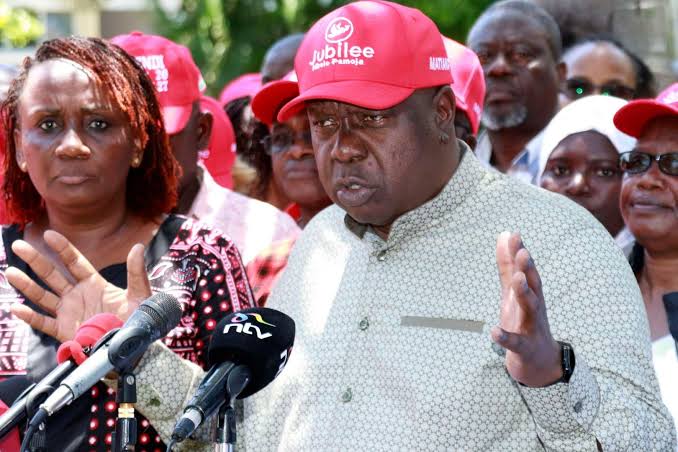
Jubilee Party leader Fred Matiang’i has challenged President William Ruto to give Kenyans clear answers on major government decisions, arguing that asking questions about public resources should not be treated as an offence.
Matiang’i said citizens, journalists and Parliament have a legitimate role in demanding information about agreements that could shape Kenya’s economy and the future of its natural resources.
He spoke in Mombasa on Monday, October 5, after meeting leaders of Kadu Asili during his ongoing Coast tour.
His remarks came days after Ruto faced questions from journalists in Mombasa about claims by former Deputy President Rigathi Gachagua concerning the proposed exploitation of minerals at Mrima Hill in Kwale.
Ruto dismissed the question and criticised Gachagua before moving on to discuss his administration’s plans for the mining sector.
Matiang’i said the response should instead have been an explanation.
“I don’t know why you should be abused for asking that question, especially when you are asking your leader,” he said.
He added that the opposition would continue questioning the government while respecting the presidency and other constitutional offices.
“We will continue asking questions about the Dangote oil refinery in Lamu,” Matiang’i said.
Dangote deal under scrutiny
The comments come as the proposed Dangote East Africa Petroleum Refinery in Lamu enters a new phase.
Construction was officially launched on September 30, with the project expected to cost about $16 billion and have a processing capacity of 700,000 barrels of crude oil a day.
The project is being developed by Nigerian businessman Aliko Dangote and is expected to serve Kenya and other East African markets.
Matiang’i said supporting foreign investment should not mean lowering the standards of public accountability.
He argued that if there was evidence that an investor had been improperly pressured or solicited for money, the government should investigate and take action.
“If, for example, there was a case where Dangote came here and he was shaken down, I don’t know why leaders of government would like to tell us stories. My message to them is simple. Act,” he said.
“If they have told you who shook them down, arrest them. Who is supposed to arrest them? It is not us, wananchi. You are the ones who are in office. You are the ones who have powers to act.”
Matiang’i did not provide evidence that Dangote had been shaken down. His remarks were framed as a call for the authorities to investigate if such wrongdoing had occurred.
The refinery itself has also attracted scrutiny over land and environmental concerns. A court has ordered the parties in a land dispute involving residents to maintain the status quo as the case proceeds.
Parliament should see sensitive deals
Matiang’i said there could be circumstances in which some details of a government agreement could not immediately be made public.
However, he argued that confidentiality should not become a blanket excuse for keeping Parliament in the dark.
“If you have a problem with the public or going to press conferences to do that disclosure, we have departmental committees in the House, which are led by elected leaders,” he said.
“You go before them and disclose to them and then work with them on confidentiality. In turn, those leaders will explain to their people. That is how a democratic environment works.”
His argument comes against the backdrop of Article 35 of the Constitution, which gives citizens a right of access to information held by the State. Parliament is also required to conduct its business openly and facilitate public participation under Article 118.
Matiang’i said the same principle should apply to major agreements involving Kenya’s mineral wealth.
He called on relevant parliamentary committees, including those dealing with energy, finance and trade, to have access to agreements between the government and investors.
“That is not too much to ask,” he said.
Mrima Hill questions
Mrima Hill has become one of the most closely watched mineral projects at the Coast.
Government documents show that Kenya has identified niobium and rare earth elements at the Kwale site as strategic minerals. In March, the State Department for Mining designated Mrima Hills as an area for mineral rights to be awarded through a tender process.
The government subsequently invited expressions of interest from potential operators to develop the deposits.
The process is therefore not the same as saying that a final mining concession has already been awarded.
The issue has nonetheless raised questions in Parliament.
In April, Kwale Woman Representative Fatuma Masito asked the National Assembly for information on the proposed project, including its status, public participation, environmental and social safeguards, benefit-sharing arrangements and possible compensation for affected residents.
Matiang’i said his approach would be to make the process more open.
“If I were president today, there would be no debates about how Kenya is concessioning in Mrima. Everybody would know everything that is going on,” he said.
He argued that county leaders and affected communities should be brought into discussions involving resources found in their areas.
Opposition agenda
Matiang’i also rejected claims that the opposition lacks a policy agenda ahead of the 2027 General Election.
He said the opposition’s discussions were focused on issues including jobs, regional development and management of natural resources.
“We are talking about the Coast Region Integrated Development,” he said.
“We have an agenda. We are sitting here looking at how we are going to provide jobs to the people of the Coast. How we are going to manage resources differently from how it is being done by this administration.”
His remarks come as opposition parties continue talks over a possible joint political arrangement ahead of the 2027 election.
Matiang’i has acknowledged that bringing several parties and presidential hopefuls under one coalition will be difficult, but said the discussions were continuing.
During Monday’s meeting, Kadu Asili leader Mudzo Nzili backed Matiang’i as the party’s preferred presidential candidate.
For Matiang’i, however, the immediate political argument is also about accountability.
His message was that major investments and mineral projects can be pursued without sacrificing public scrutiny.
“Please act,” he told the government, arguing that those holding public office have both the authority and responsibility to investigate wrongdoing and explain major decisions to Kenyans.
You may also like
Category: Politics · Related Topic: William Ruto
Related Video: What Dangote’s proposed Lamu oil refinery could mean for East Africa
Related Explainer: Inside Kenya’s crude supply puzzle as Dangote prepares to break ground in Lamu
About the Author
Maureen Onyango is a journalist passionate about storytelling, life coaching and spiritual lessons. She studied at the Kenya Institute of Management and enjoys telling stories that inform, inspire and empower communities.
 Facebook
 Twitter / X
 WhatsApp
 LinkedIn
 Telegram
 Reddit