
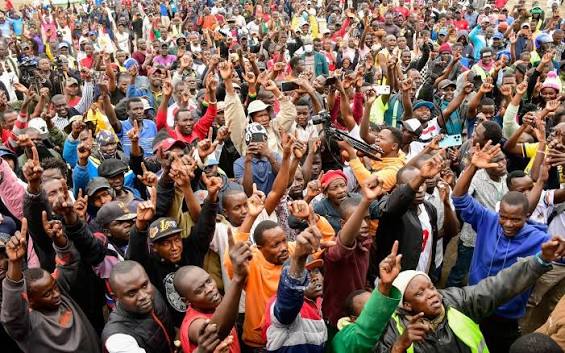
Nairobi offered Linda Mwananchi something it badly needed: a large opposition rally that did not descend into the kind of chaos that has followed some of its recent political tours.
Thousands of supporters followed the movement’s leaders through the capital on Sunday before converging at Jacaranda Grounds in Embakasi East.
There were traffic disruptions and a lengthy procession. Police had also warned organisers against taking the rally into the Central Business District.
But the day ended without the tear gas, running battles and serious violence that have overshadowed some of Linda Mwananchi’s earlier rallies.

That may be the most politically important part of the Nairobi story.
For a movement seeking to become a serious vehicle for the 2027 elections, the question is no longer simply whether it can attract crowds.
It is whether it can mobilise large numbers of people without turning every rally into a confrontation with the police or rival groups.
A different kind of opposition rally
The Nairobi procession began at All Saints Cathedral before moving through parts of the city towards Jacaranda Grounds.
Nairobi Senator Edwin Sifuna, Embakasi East MP Babu Owino, Siaya Governor James Orengo and Vihiga Senator Godfrey Osotsi were among the prominent figures leading the mobilisation.
The convoy passed through busy areas including Marikiti, Gikomba and Burma before heading towards Jogoo Road and the Eastlands neighbourhoods. Large crowds gathered along the route and Jacaranda Grounds eventually filled with supporters.
Police had imposed restrictions on access to the CBD ahead of the event but also promised to provide security and facilitate lawful political activity.
That cooperation became one of the day’s notable features.
Sifuna publicly thanked the police for securing the procession.
“I want to thank the police service in Nairobi because today they have provided us with security.”
The senator also alleged that people had planned to disrupt the rally and thanked supporters for preventing the alleged disruption.
Those claims should, however, be treated as political assertions rather than established facts. There was no independent evidence presented publicly on Sunday to establish who may have planned any disruption.
What was clear was that the procession proceeded and reached Jacaranda without the major confrontation that many had feared.
Why the contrast with Homa Bay matters
The calm in Nairobi was particularly striking because it came less than a month after Linda Mwananchi's Homa Bay tour descended into deadly violence.
On August 16, the Homa Bay rally was disrupted by stone-throwing, roadblocks and tear gas as the convoy moved through parts of the county.
Two people, including a police officer, were reported killed, while dozens were injured. Police later arrested suspects in connection with the violence.
The violence also exposed how quickly political mobilisation can become dangerous when rival groups collide.
Journalists covering the Homa Bay events reported being assaulted, while vehicles were damaged and some businesses were forced to close during the unrest.
The death of the police officer also left unanswered questions for his family, which later called for an independent investigation into the circumstances surrounding his death.
Against that background, Nairobi was more than another political rally.
It was a test of whether Linda Mwananchi could organise a mass opposition event while keeping the political temperature under control.
For now, it passed that test.
But peaceful does not mean problem-free
The rally was not without criticism.
The procession took several hours, with leaders spending a considerable amount of time moving through the city before reaching the main venue.
That created frustration among some supporters and observers who felt the movement's organisers could have been more disciplined with time and the programme.
The criticism points to a broader challenge.
Large political movements need more than enthusiasm. They need organisation.
As Linda Mwananchi expands beyond its established strongholds, its ability to plan routes, coordinate speakers, communicate with police and manage large crowds will become increasingly important.
A movement that wants to compete nationally cannot afford to measure success only by the size of the crowd at the end of the day.
It must also be judged by what happens along the way.
The police relationship could become crucial
The Nairobi experience also offered an interesting contrast in the relationship between the movement and the police.
Before the rally, Nairobi Regional Police Commander Issa Mohamud warned that the CBD would not become a battleground and said officers would facilitate lawful activities.
The movement nevertheless passed through parts of the CBD despite the earlier restrictions.
Yet there was no major confrontation.
That matters because opposition movements and police have often approached each other with deep suspicion during political demonstrations.
If Linda Mwananchi can maintain a working relationship with security agencies while continuing to exercise its constitutional right to assemble peacefully, it could change the tone of its political engagements.
But that will require restraint on both sides.
Police must protect lawful political activity without discrimination.
Organisers, in turn, must ensure their supporters remain peaceful and comply with lawful security arrangements.
The bigger political test is still ahead
Linda Mwananchi is not merely trying to build a protest movement.
Its leaders are increasingly positioning it as part of the search for a political vehicle capable of challenging President William Ruto in 2027.
That makes discipline increasingly important.
The movement is also dealing with an internal question over who could ultimately carry its presidential ticket.
Sifuna has attracted significant public backing, but Orengo has now openly declared his presidential ambitions, creating a contest that the movement will eventually have to manage. Recent reports indicate that the two leaders are expected to discuss how their ambitions can be reconciled as Linda Mwananchi pushes for a single opposition candidate.
That means the movement faces two tests at once.
It must maintain unity among its leaders.
And it must demonstrate that its rallies can remain peaceful even when political competition becomes more intense.
One rally is not yet a new pattern
It would be premature to declare that Linda Mwananchi has permanently broken with the confrontational history of Kenyan opposition politics.
Nairobi was one rally.
Homa Bay was another.
Other Linda Mwananchi events have also experienced security problems, including a tear gas incident during a rally in Meru on August 30.
The real measure will therefore be consistency.
Can the movement hold large rallies in Nairobi, Nyanza, Western, Central, Coast and other regions without violence?
Can it prevent rival political groups from turning its events into confrontations?
Can police provide security without being accused of selectively restricting opposition activity?
And can the movement itself enforce discipline among its supporters?
Those questions will matter more than the size of Sunday's crowd.
For now, Nairobi has provided Linda Mwananchi with a useful political template: large crowds, visible mobilisation, strong political messaging and no major confrontation.
Whether that becomes the movement's new normal will be decided on the road ahead.
For an opposition movement preparing for 2027, that may prove to be one of its most important tests.
You may also like
Category: Politics · Related Topic: 2027 Elections
Related Video: Dolly Parton’s Family Announces Her Passing in Emotional Tribute
About the Author
Maureen Onyango is a journalist passionate about storytelling, life coaching and spiritual lessons. She studied at the Kenya Institute of Management and enjoys telling stories that inform, inspire and empower communities.
 Facebook
 Twitter / X
 WhatsApp
 LinkedIn
 Telegram
 Reddit