
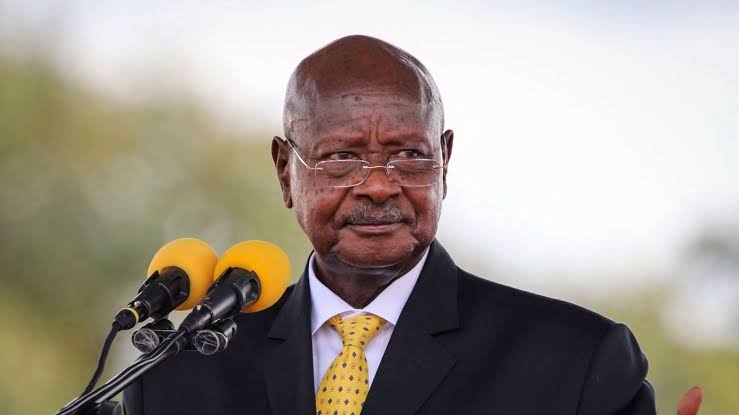
Ugandan President Yoweri Museveni says an unnamed Kenyan senator helped expose what he considered an expensive gap in Uganda’s fuel supply chain, setting in motion a shift away from Kenyan oil marketing companies and towards direct imports.
Museveni made the revelation on Thursday, September 17, while breaking ground for a 320-million-litre Kampala Storage Terminal in Mpigi District.
He said he had not known that Uganda was purchasing petroleum products through intermediaries in Kenya until the Kenyan senator raised the issue with him.
“The person who woke me up first was a senator from Kenya. He told me, ‘Do you know that your country is buying petroleum through middlemen?’ I didn’t know,” Museveni said.

The President did not identify the senator.
Museveni questioned Uganda’s fuel procurement
Museveni said the warning prompted him to question why Uganda was not buying petroleum products directly from refiners or bulk suppliers.
He said he raised the issue with then-Energy Minister Irene Muloni, asking why the country was relying on intermediaries in Kenya.
Uganda subsequently moved to give the Uganda National Oil Company (UNOC) a central role in importing petroleum products.
The change became particularly significant after Kampala decided to move away from the traditional model in which Kenyan-based oil marketing companies handled much of Uganda’s fuel imports.
Uganda began direct imports under a five-year supply arrangement involving UNOC and Vitol Bahrain, with the first UNOC cargoes arriving through Mombasa in 2024.
Museveni cites lower import premiums
During Thursday’s ceremony, figures presented by the Ugandan government showed lower premiums under the newer procurement model.
According to figures cited by Museveni:
- The diesel premium fell from US$118 to US$83 per metric tonne.
- Petrol dropped from US$97.50 to US$61.50 per metric tonne.
- Aviation fuel fell from US$114.25 to US$79.25 per metric tonne.
These figures represent the difference in import premiums cited by the Ugandan government. They should not be read as independently audited savings or as a direct measure of the final pump price paid by motorists.
The shift was aimed at allowing Uganda to deal more directly with international suppliers while giving UNOC greater control over the country's petroleum imports.
Uganda did not abandon Mombasa
Despite the dispute over middlemen, Uganda's new system has not ended its dependence on Kenya's petroleum infrastructure.
UNOC's direct imports continue to use the Port of Mombasa and Kenya Pipeline Company infrastructure for much of the fuel destined for Uganda.
In May 2024, UNOC and KPC signed an agreement covering the transportation and storage of Uganda-bound petroleum products through Kenya. UNOC says the majority of its imports continue to be routed through Kenya, alongside additional supplies through Tanzania.
This means the change was primarily about who buys and controls the cargo, rather than Uganda completely cutting Kenya out of its fuel supply chain.
Uganda has continued paying for access to the Kenyan system. Business Daily reported in January 2026 that UNOC paid KPC KSh1.2 billion in the first year of the direct-import arrangement.
The new system has also faced challenges
The move to direct imports was not without complications.
Uganda and Kenya had a dispute over UNOC's access to the Kenyan market and infrastructure. The disagreement was eventually resolved in March 2024, allowing UNOC to import through Mombasa and use the Kenya Pipeline system.
The first UNOC cargoes also encountered logistical and regulatory difficulties after arriving at Mombasa in July 2024.
Kenyan authorities raised concerns over discrepancies in the declared volume of one diesel shipment, leading to additional bond requirements before the cargo could proceed through the system.
There have also been questions about whether direct procurement automatically translates into cheaper fuel for consumers.
A 2024 analysis by The EastAfrican found that while UNOC negotiated a lower freight and insurance premium for petrol with Vitol than the rate under Kenya's government-to-government arrangement, Uganda faced higher logistics charges through its new system.
Bigger plan goes beyond fuel imports
The Mpigi terminal is part of a much larger strategy by Uganda to strengthen control over its petroleum supply chain.
UNOC says financing secured through Vitol will support storage facilities in Namwabula, Mpigi, expansion of the Jinja petroleum terminal, pipeline infrastructure and other investments across the petroleum sector.
The new Kampala Storage Terminal is expected to provide substantially more storage capacity as Uganda builds towards a more integrated petroleum industry.
The country is also pursuing plans for an oil refinery in Hoima and other infrastructure designed to link domestic petroleum production, storage and distribution.
Museveni's latest account therefore comes at a significant moment. The unnamed Kenyan senator may have provided the initial warning, but Uganda's response has grown into a broader attempt to give the state greater control over how the country imports, stores and distributes fuel.
For Kenya, the change has altered the commercial relationship without eliminating the country's role as Uganda's main petroleum gateway.
And for Uganda, the real test will be whether greater control over imports and new storage capacity can consistently translate into lower costs and more secure fuel supplies for consumers.
You may also like
Category: International · Related Topic: Social Health Authority (SHA)
Related Video: Dolly Parton’s Family Announces Her Passing in Emotional Tribute
Related Explainer: Explainer: What happened to milk in Kenya?
About the Author
Maureen Onyango is a journalist passionate about storytelling, life coaching and spiritual lessons. She studied at the Kenya Institute of Management and enjoys telling stories that inform, inspire and empower communities.
 Facebook
 Twitter / X
 WhatsApp
 LinkedIn
 Telegram
 Reddit