
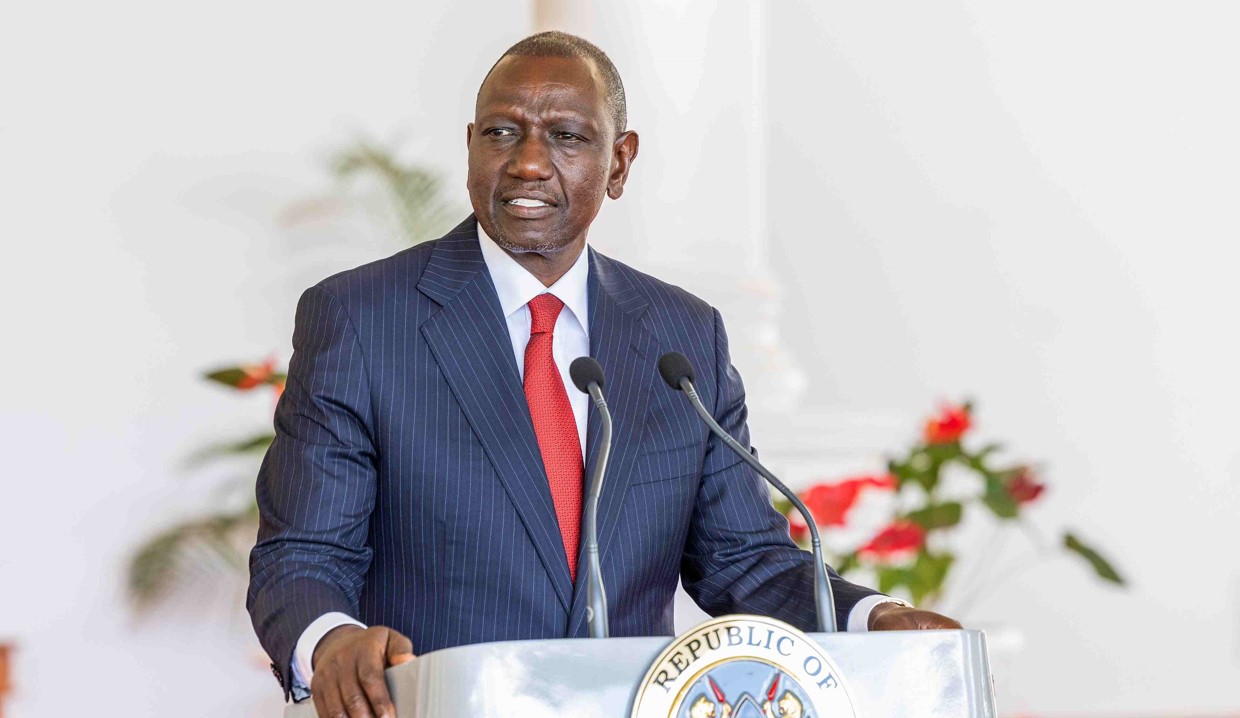
President William Ruto has called for cheaper and more accessible credit for Kenyans and businesses, saying the country's improving economic stability must now translate into investment, jobs and higher production.
Speaking during celebrations marking the 60th anniversary of the Central Bank of Kenya (CBK) in Nairobi on Wednesday, Ruto said that while lending rates have declined, borrowing remains expensive for many households and businesses.
The President said the Central Bank Rate currently stands at 8.75 per cent, while average lending rates were 14.39 per cent in July.
“The gains of stability must now reach the real economy through more affordable and accessible credit,” Ruto said.

He argued that strong banks should ultimately serve the wider economy by financing farms, factories, businesses, infrastructure, technology, exports and enterprise.
“Our financial institutions must become better at converting Kenyan savings into Kenyan production,” he said.
Ruto said Kenya's immediate economic challenge had shifted from defending macroeconomic stability to using that stability to generate economic growth.
“Stability is not prosperity. It is the foundation on which prosperity must be built,” he said.
The President said Kenyans should now be able to see the benefits of lower inflation, a more stable currency and a stronger financial system through increased investment, business expansion, employment opportunities and access to capital.
According to the President, Kenya faced significant economic pressures when his administration took office in 2022, including high inflation, rising food and energy prices, pressure on the shilling, higher international interest rates and a major external debt maturity.
He said the government responded through fiscal and structural measures while CBK tightened monetary policy to contain inflation, stabilise the currency and protect the financial system.
Ruto acknowledged that the measures came at a cost, particularly through higher borrowing costs and difficult fiscal adjustments, but maintained that failing to act would have posed greater risks to the economy.
He said inflation has since moderated, exchange-rate pressures have eased, foreign-exchange reserves have strengthened and immediate external refinancing risks have been addressed.
The President also defended the independence of the Central Bank, describing it as an important component of Kenya's economic strength and saying monetary and fiscal institutions must be allowed to perform their respective mandates.
Financial inclusion
Ruto also called for Kenya to move beyond simply expanding access to financial services towards ensuring that access creates tangible economic opportunities.
He said formal financial access had increased from 26.7 per cent of adults in 2006 to 84.8 per cent in 2024, largely driven by mobile money and digital finance.
“The first financial revolution connected millions of Kenyans to finance. The next must connect finance to opportunity,” he said.
The President said emerging technologies, including artificial intelligence, digital assets and new payment technologies, presented new opportunities but required safeguards to protect consumers and maintain confidence in the financial system.
Ruto calls for African capital to finance Africa
Ruto also used the CBK anniversary to call for greater mobilisation of African capital to finance the continent's development.
He said Africa holds more than $4 trillion in financial assets across banks, pension funds, insurance funds and capital markets, arguing that more of this money should finance infrastructure, agriculture, industry, technology and enterprise on the continent.
The President also backed deeper integration of African payment systems to reduce the cost and complexity of cross-border trade under the African Continental Free Trade Area.
He cited the Pan-African Payment and Settlement System (PAPSS), developed by Afreximbank in partnership with the African Union and AfCFTA Secretariat, as an example of how African institutions can facilitate cross-border payments using local currencies.
Ruto said Africa should continue attracting international investment while simultaneously strengthening its capacity to mobilise domestic resources.
“Our ambition is an Africa that trades more with itself, finances more of its own development and converts more of its wealth into productive capacity,” he said.
The Central Bank of Kenya was established in 1966, replacing the East African Currency Board as Kenya developed independent monetary institutions following independence.
Ruto said CBK's next chapter should focus on converting monetary and financial stability into investment, production, employment and prosperity for Kenyans.
You may also like
Category: Business · Related Topic: William Ruto
Related Video: Dolly Parton’s Family Announces Her Passing in Emotional Tribute
Related Explainer: Kenya’s inflation holds near 30-month high as transport and food costs squeeze households
 Facebook
 Twitter / X
 WhatsApp
 LinkedIn
 Telegram
 Reddit