
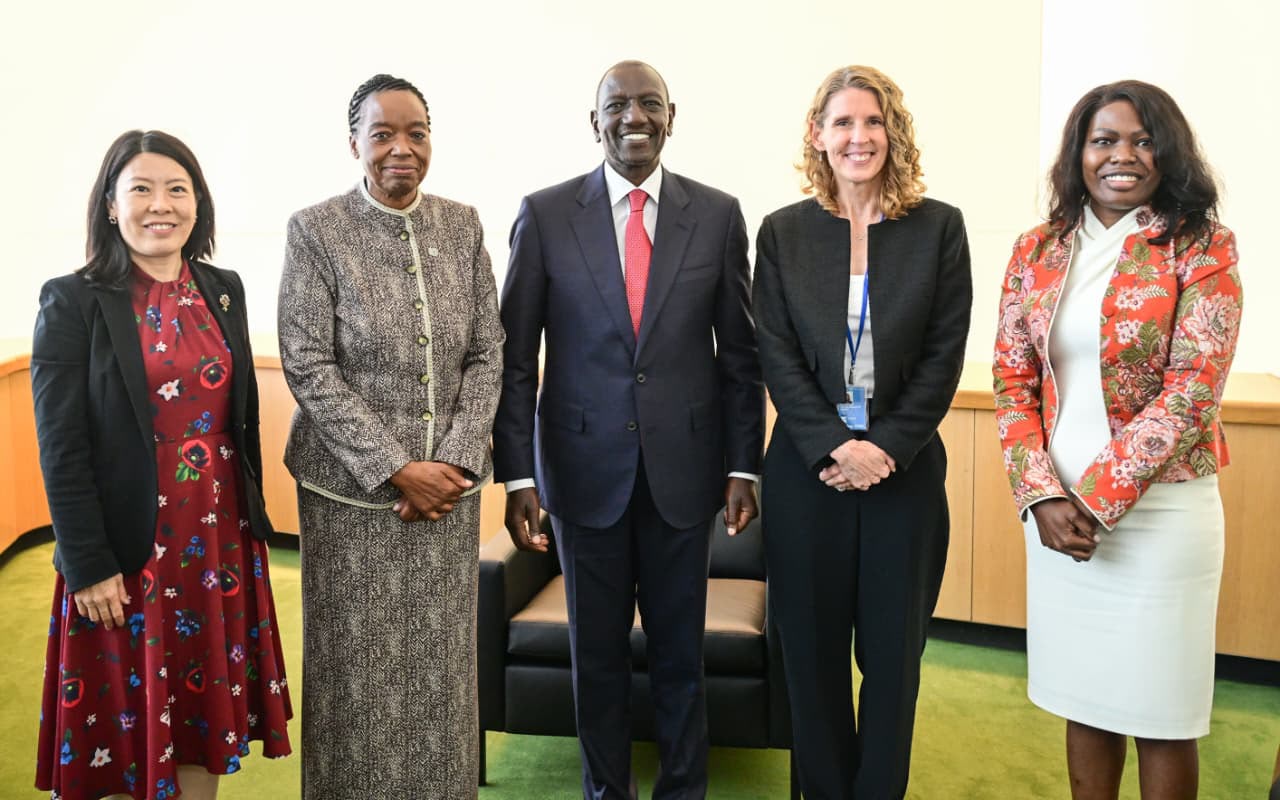
President William Ruto has warned that Africa risks repeating its history of economic dependency in the artificial intelligence era unless countries build greater control over the technology, infrastructure, data and skills increasingly shaping their economies.
Speaking in New York on Monday, September 21, on the margins of the 81st United Nations General Assembly, Ruto said political independence alone would not be enough in a world where computing power, advanced chips, AI models and digital standards are concentrated in relatively few countries and companies.
“Political sovereignty without technological agency risks becoming sovereignty in law, but dependency in practice,” Ruto said.
The President made the remarks during a high-level meeting on the AI Middle Powers initiative, which he is co-leading with Finnish President Alexander Stubb.

The initiative seeks to bring together countries that may not independently control the entire AI supply chain but have resources they can combine, including computing infrastructure, data, renewable energy, research capacity and skilled workers.
Ruto argued that attempting to achieve complete technological self-sufficiency would be unrealistic for most countries.
“No nation can efficiently secure every critical mineral, fabricate every advanced chip, build every data centre, train every frontier model, and determine every global standard,” he said.
Instead, he proposed what he called “shared sovereignty”, under which countries cooperate in areas requiring large investments and scale while retaining national control over critical decisions.
“Shared sovereignty is not sovereignty surrendered. It is agency enlarged through organised cooperation,” he said.
The proposal comes as artificial intelligence moves rapidly up the global diplomatic agenda.
AI governance is one of the priorities of the 81st UN General Assembly. The UN has warned that many countries remain outside important decisions about how AI is developed and governed.
Earlier this month, UN General Assembly President Khalilur Rahman said 118 countries had yet to participate in major AI governance discussions and fewer than one-third of developing countries had national AI strategies.
The UN is pushing for broader participation in setting international AI rules, building on the Global Digital Compact adopted in 2024 and subsequent international discussions on AI governance.
Ruto said Africa faced a particularly important choice.
He warned that the continent should not supply the raw materials, electricity, data and human talent required by the AI industry while remaining dependent on technology and intelligence produced elsewhere.
“We must not reproduce the old extractive economy in digital form,” Ruto said.
“Africa cannot provide the minerals, energy, data, content, and talent of the AI revolution, only to import the resulting intelligence at a premium.”
He said Africa needed to move “from consumption to creation; from mine to model; from adoption to ownership”.
The argument reflects a wider debate over so-called sovereign AI: the ability of countries to develop or control enough of the infrastructure, data, skills and institutions behind artificial intelligence to reduce excessive dependence on foreign technology providers.
For Kenya, the push builds on its National Artificial Intelligence Strategy 2025–2030, launched in March 2025.
The strategy is organised around three main pillars: AI digital infrastructure; data and AI governance; and AI research, innovation and commercialisation.
The government has identified agriculture, healthcare, education, public services and financial inclusion among areas where AI could have significant economic and social impact.
But Ruto said using AI applications developed elsewhere was not enough.
“We need access to the foundations of AI; compute, data, energy, and talent,” he said.
He placed particular emphasis on electricity and computing infrastructure.
“There is no Artificial Intelligence without electricity,” Ruto said, arguing that countries with abundant renewable energy should be able to attract data centres and AI computing infrastructure rather than remain consumers of technology produced elsewhere.
Kenya has increasingly sought investment in data centres and cloud infrastructure, presenting its renewable energy resources, connectivity and position as an East African technology hub as competitive advantages.
In May, the Ministry of Information, Communications and the Digital Economy said Kenya was emerging as a preferred destination for data centres and AI infrastructure, citing expanding connectivity, renewable energy potential and growing regional demand for cloud services.
The government has also been promoting what it describes as “green and sovereign AI infrastructure” capable of using Africa's energy resources to support computing capacity on the continent.
The AI Middle Powers initiative is intended to extend that strategy internationally.
According to State House's programme for Ruto's UNGA visit, participating countries would explore pooling computing resources, data and talent rather than attempting to build every part of the AI ecosystem individually.
Finland confirmed ahead of UNGA that President Stubb would co-chair an international AI discussion with Ruto during the high-level week.
The partnership follows discussions between the two presidents during the Kultaranta Talks in Finland in June.
Ruto said the initial priorities of the new initiative would be mobilising finance, expanding trusted infrastructure and developing the human and institutional capacity needed to build, adapt, test and regulate artificial intelligence.
Countries could cooperate on computing infrastructure, trusted data systems, research, AI skills, multilingual models and public-sector capacity, he said.
Language is another area where Ruto argued Africa remains disadvantaged.
African languages and local contexts remain underrepresented in many AI systems despite Africans increasingly using AI-enabled platforms and contributing data, writing, research and other material to the global digital ecosystem.
“A model that cannot understand millions of people in their own language cannot claim to be truly global,” he said.
But Ruto also cautioned against pursuing rapid AI development without safeguards.
He cited misinformation, deepfakes, cyber threats and harmful AI-generated or AI-mediated content as risks capable of damaging public trust, democratic institutions and children's safety.
The warning comes as governments are increasingly debating how to manage the risks associated with increasingly capable AI systems.
On Monday, Stubb and Norwegian Prime Minister Jonas Gahr Støre separately launched an international appeal calling for advanced AI systems to remain under meaningful human control. Finland said leaders from 20 countries had backed the appeal at its launch, including Kenya, South Africa, Canada, Australia, Germany, Spain, Singapore and the United Arab Emirates.
At the same time, the United States and China are discussing mechanisms for managing serious AI incidents. US Treasury Secretary Scott Bessent said on Monday that Washington and Beijing had agreed to continue AI safety discussions, including work around an incident communication mechanism.
Those developments illustrate how AI is increasingly being treated not simply as a technology or business issue, but as a question of national security, economic power and international diplomacy.
Ruto argued that developing countries must have a meaningful role in creating the rules.
“The rules of the intelligence era cannot be written by a handful of governments, companies, or laboratories,” he said.
He said the United Nations should remain central to international AI governance to ensure countries affected by the technology have a voice in deciding how it is governed.
Kenya's AI diplomacy in New York goes beyond the Middle Powers initiative.
State House says the country will also advance an African Development Bank-backed AI investment initiative targeting up to $10 billion by 2035, intended to expand Africa's participation across the AI value chain.
Ruto is also expected to participate in efforts around child safety in the age of AI and promote the use of AI, satellite observation and predictive technologies to strengthen Africa's preparedness for climate shocks.
For Ruto, however, the larger question is who ultimately owns and controls the infrastructure on which the emerging AI economy depends.
“The architecture of the intelligence era is being built now,” he said.
“We must not become tenants in a future built from our data, powered by our resources, shaped by technologies we cannot influence and governed by rules we did not write.”
He said cooperation among middle powers could give countries greater bargaining power without requiring them to isolate themselves technologically.
“Africa seeks partnership, not charity. Middle powers seek agency, not isolation,” Ruto said.
You may also like
Category: News · Related Topic: William Ruto
Related Video: Dolly Parton’s Family Announces Her Passing in Emotional Tribute
 Facebook
 Twitter / X
 WhatsApp
 LinkedIn
 Telegram
 Reddit