
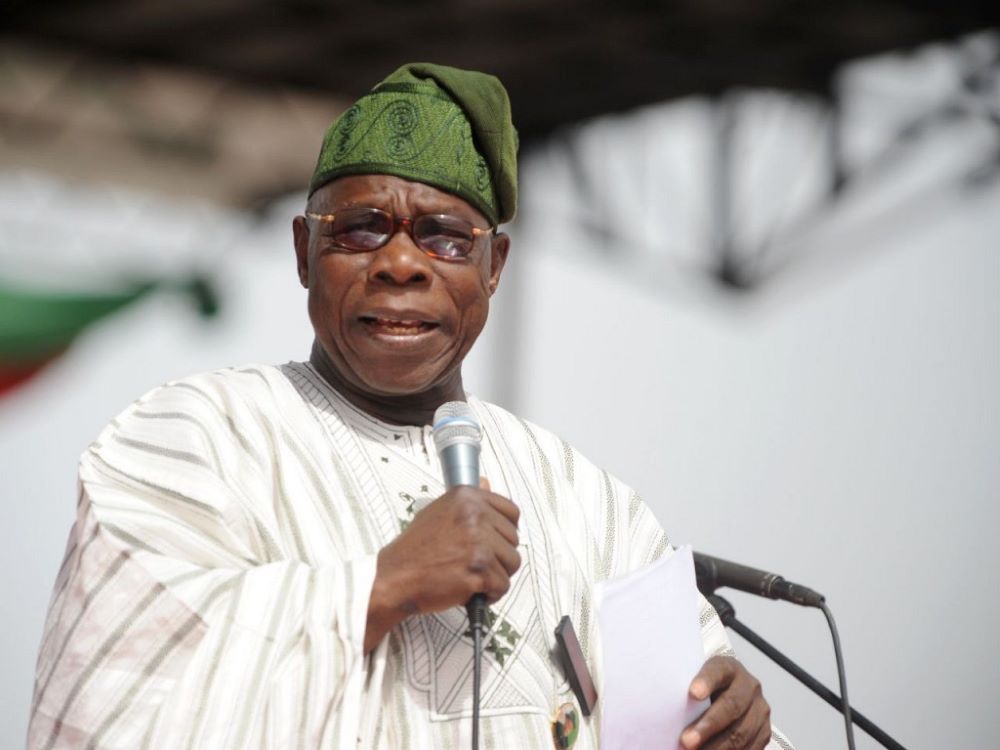
Former Nigerian President Olusegun Obasanjo has used the groundbreaking of the $16 billion Dangote refinery in Lamu to argue that African governments must deliberately create conditions that encourage local industrial production rather than continued dependence on imports.
Speaking at the ceremony in Lamu, Obasanjo said the project represented more than an investment in Kenya, describing it as an example of growing economic integration between East and West Africa.
“East Africa and West Africa are being brought together with the commitment of our leaders and with the courage, commitment and enterprise of one man, Aliko Dangote,” Obasanjo said.
He then recounted how his relationship with Dangote's industrial expansion began in Nigeria in 2003.
At the time, Obasanjo said, Nigeria had produced cement for almost 50 years but continued importing large quantities of the commodity. Dangote was then one of the country's major cement importers.
Obasanjo recalled calling the businessman at 5am and asking why he continued importing cement instead of manufacturing it locally.
According to Obasanjo, Dangote gave a straightforward commercial explanation: importing cement was more profitable.
“Then I said, Aliko, tell me, what can I do for you and for myself to make you produce cement?” Obasanjo recalled.
Dangote proposed linking permission to import cement to commitments to establish local production.
The Nigerian government subsequently adopted a policy requiring cement importers to demonstrate plans for domestic manufacturing.
Dangote proposed building capacity of five million metric tonnes — more than double what Obasanjo said Nigeria had managed to produce annually after decades of domestic cement manufacturing.
Government officials were initially sceptical.
“The officials in the ministry came to me and said, ‘Aliko is lying. Don't believe him. He just wants to get an import licence. He will not produce anything,’” Obasanjo said.
The former president said he nevertheless backed the investment and even deployed officials to quietly monitor progress at the construction site.
Shortly before Obasanjo left office in 2007, the first five-million-tonne plant was commissioned.
Dangote subsequently expanded cement production in Nigeria and across several African markets.
Obasanjo says private investment can still be a national project
Obasanjo said one of the lessons from the experience was that governments should treat strategically important private-sector investments as part of national development.
He recalled Dangote once questioning why the president appeared to know so much about progress at what was technically a private project.
“This cement project is not a government project. It is a private project,” Obasanjo recalled Dangote telling him.
His response was: “This project is a Nigerian project, and any Nigerian project is a government project as far as I'm concerned.”
The remarks echoed President William Ruto's position at Wednesday's ceremony that the Lamu refinery should be government-enabled but private-sector driven.
Obasanjo recalls obstacles to Dangote's African expansion
Obasanjo also alleged that French cement producer Lafarge sought to obstruct Dangote's expansion in African cement markets.
He specifically cited a dispute surrounding Dangote's cement investment in Senegal, where he said legal challenges delayed operations for about two years after construction had been completed.
Obasanjo claimed the disputes ultimately cost Dangote about $12 million before the plant could operate.
The allegations were made by Obasanjo during his speech, and no response from Lafarge was presented at the ceremony.
He said Dangote eventually overcame those obstacles and expanded cement manufacturing across Africa, presenting that experience as evidence of what African-owned industrial businesses can achieve when governments create an enabling environment.
Obasanjo's central message in Lamu was that the same approach that helped transform Nigeria from a major cement importer into a producer should now be applied to other industries across the continent.
The Lamu refinery, planned to process up to 700,000 barrels of crude oil per day, represents that philosophy on a much larger regional scale.
You may also like
Category: Business
Related Video: What Dangote’s proposed Lamu oil refinery could mean for East Africa
Related Explainer: Inside Kenya’s crude supply puzzle as Dangote prepares to break ground in Lamu
 Facebook
 Twitter / X
 WhatsApp
 LinkedIn
 Telegram
 Reddit